


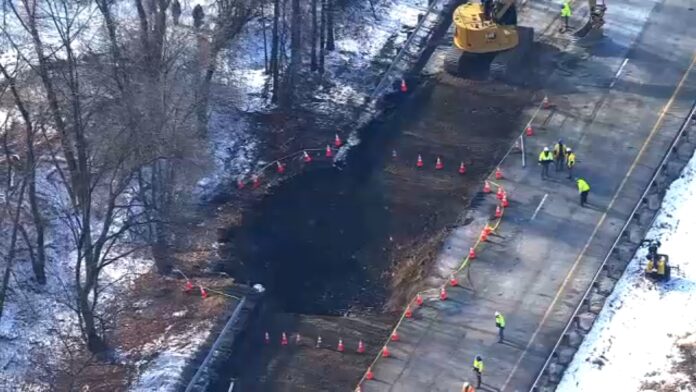

New Jersey’s transportation network is under extraordinary strain as two major infrastructure events unfold simultaneously in Morris County: the continuing stabilization of a massive subsurface void beneath Interstate 80 eastbound in Wharton and the scheduled three-month closure of Gaston Road in Morris Township for a full bridge replacement beginning Monday, March 2, 2026.
Together, these developments underscore a larger reality facing the Garden State — aging infrastructure, legacy industrial impacts, and the accelerating urgency of long-deferred capital investment.
I-80 Eastbound in Wharton: Abandoned Mine Collapse Creates Major Subsurface Void
Interstate 80 eastbound in Wharton remains one of the most closely monitored highway corridors in New Jersey following the discovery of a significant underground void caused by the collapse of an abandoned mine shaft beneath the roadway.
The issue first emerged when a sinkhole opened under the eastbound lanes, prompting immediate emergency response and lane closures. Subsequent geotechnical investigations revealed that the initial collapse was not isolated. Engineers identified a broader underground cavity system — a substantial void beneath portions of the roadway — requiring extensive stabilization before full traffic restoration could safely occur.
This section of Morris County sits atop a historic mining region dating back more than a century. While many abandoned shafts were mapped, not all were reinforced to modern engineering standards. The collapse beneath I-80 reflects the long-term risks posed by dormant subsurface infrastructure intersecting with modern transportation demands.
Repair operations have included deep drilling, pressure grouting to fill underground cavities, soil compaction, structural reinforcement, and continuous structural monitoring. Because stabilization must ensure long-term roadway integrity rather than temporary patchwork, the timeline has extended beyond initial projections.
Lane closures and traffic shifts remain in effect while crews continue remediation. Motorists traveling eastbound through the Wharton corridor are urged to anticipate congestion, particularly during peak commuting hours. Regional detours and alternate routes have absorbed overflow traffic, impacting surrounding municipalities and increasing travel times across northern New Jersey.
The scale of the void beneath I-80 represents more than a traffic inconvenience. It highlights the intersection of geological legacy conditions and modern infrastructure load demands — a combination that requires sophisticated engineering response and sustained public investment.
Regional Impact: Commuter Delays and Economic Pressure
Interstate 80 is not merely a local roadway; it is a critical freight and commuter artery linking western New Jersey to the greater New York metropolitan area. Extended lane restrictions have produced ripple effects across Morris County and neighboring communities.
Morning and evening congestion patterns have shifted dramatically. Secondary roads are carrying increased traffic volumes. Commercial delivery schedules have required adjustments. Small businesses near affected interchanges report fluctuating customer flow due to altered travel patterns.
Public safety officials have also modified routing protocols to maintain emergency response times in areas influenced by traffic diversion.
State transportation officials emphasize that safety and structural permanence remain the primary objectives. Restoring full capacity prematurely could risk additional collapse, compounding disruption. The ongoing stabilization effort is therefore proceeding methodically to ensure durable reconstruction.
Gaston Road Bridge Replacement Begins March 2 in Morris Township
While I-80 repairs continue to command statewide attention, Morris Township is preparing for its own significant infrastructure milestone: the complete replacement of the Gaston Road Bridge.
Beginning Monday morning, March 2, 2026, Gaston Road will be closed to through traffic for approximately three months as the County of Morris undertakes a $641,487 bridge reconstruction project.
Gaston Road is a one-mile connector between Sussex Turnpike and Washington Valley Road. The bridge, located just north of Jonathan Smith Road and spanning a tributary of the Whippany River, effectively divides the roadway. Once closed, the project will split Gaston Road access into north and south segments.
Residents south of the bridge will access their neighborhoods via Washington Valley Road. Residents north of the bridge will enter via Sussex Turnpike.
A clearly marked detour will guide motorists from the south end of Gaston Road along Washington Valley Road, Schoolhouse Lane, and Mount Pleasant Road before reconnecting with Sussex Turnpike approximately one mile west of the north terminus of Gaston Road.
Why the Bridge Is Being Replaced
The existing Gaston Road Bridge is a short concrete slab structure supported by stone masonry abutments and wingwalls. Though modest in span — roughly five feet in length — the structure has experienced progressive deterioration. Multiple prior repairs have extended its lifespan, but engineering assessments determined that complete replacement is the most practical and cost-effective solution.
Rather than continue incremental maintenance, Morris County elected to construct a new four-sided precast structure featuring stone-faced walls and a picket-style railing. The design balances modern structural integrity with aesthetic sensitivity appropriate to the surrounding landscape.
CMS Construction, Inc. of Plainfield, New Jersey, will spearhead the project. Construction is scheduled for completion within approximately three months, barring severe weather or unforeseen site conditions.
A Defining Moment for New Jersey Infrastructure
Taken together, the I-80 subsurface collapse in Wharton and the Gaston Road Bridge replacement in Morris Township represent two different expressions of the same challenge: infrastructure built decades ago now confronting contemporary demands.
In one case, historic mining activity has resurfaced — literally — beneath a major interstate. In the other, a small but aging county bridge has reached the end of its service life after years of patchwork repair.
Both projects demonstrate the importance of proactive capital planning, structural evaluation, and engineering oversight. They also reinforce the reality that infrastructure modernization often requires temporary inconvenience to prevent larger, more costly failures.
For residents and commuters across Morris County, the coming months will require patience, route flexibility, and awareness of changing traffic patterns. For policymakers and transportation planners, these projects serve as tangible reminders that the resilience of New Jersey’s economy and daily life depends on sustained infrastructure investment.
The Garden State’s roadways carry millions of vehicles every week. Ensuring their structural integrity is not optional — it is foundational.
As crews continue stabilizing the void beneath I-80 and heavy equipment mobilizes along Gaston Road, Morris County stands at the center of a broader statewide conversation about infrastructure reliability, geological risk, and long-term transportation resilience.
Sunset Daily News will continue to monitor developments as repairs progress and traffic conditions evolve.



