


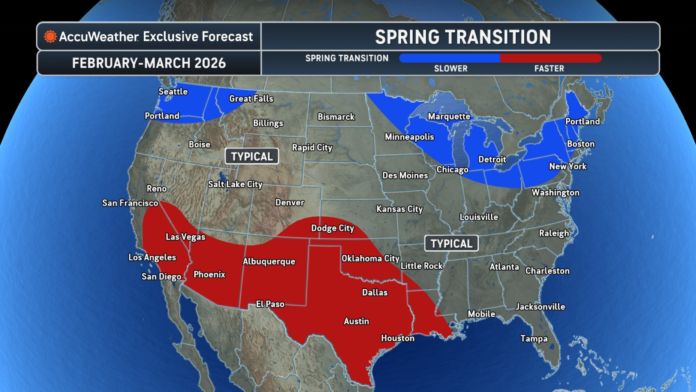

New Jersey is about to experience a dramatic atmospheric pivot — one that shifts us from snowpack, freezing fog, and Arctic intrusions into what could be the first legitimate taste of spring in 2026. A mild weather pattern is now firmly detected across the Garden State, and while a brief cold snap still stands in the way, the broader setup points toward a multi-day warm surge that could send temperatures soaring into the 60s and possibly even 70 degrees between March 5 and March 12.
For residents tracking the seasonal transition — and for industries ranging from real estate and retail to recreation and infrastructure — this evolving pattern is significant.
Friday and Saturday: The Warm-Up Phase
As of mid-afternoon Friday, February 27, temperatures have climbed into the mid-40s statewide, with several inland locations touching 50 degrees. Immediate coastal areas remain cooler, lingering in the mid-to-upper 30s due to marine influence.
Skies are mostly sunny and winds have shifted light out of the southwest — a subtle but important signal. Southwest flow introduces warmer air aloft, and that warm advection over remaining snowpack is creating overnight visibility concerns.
Overnight lows Friday into early Saturday will dip into the 20s and lower 30s statewide. Freezing fog is possible, especially in areas where residual snowpack remains. Reduced visibility and refreezing surfaces may produce slick conditions late night into early morning.
Saturday, February 28, marks the true beginning of the mild push.
High temperatures should reach the low-to-mid 50s statewide, with interior Central and South Jersey potentially flirting with 60 degrees. The southwest flow remains light, skies trend mostly sunny after any early fog burns off, and the remaining snowpack — outside of larger plowed mounds — will largely disappear.
Overnight lows Saturday night fall into the upper 20s to mid-30s. Fog and freezing fog remain possible once again due to the temperature gradient between surface snow remnants and warmer air above.
Sunday Cold Front: One Last Arctic Reminder
Sunday, March 1, brings transitional energy as a cold front sweeps west to east across New Jersey between roughly 7am and 2pm.
Precipitation will accompany the frontal passage, but impacts are expected to remain minor overall.
Regional breakdown:
- South of I-78: Primarily rain.
- Between I-78 and I-80: Wintry mix transitioning to rain.
- North of I-80 and northwest of I-287: Snow and sleet mix possible, with trace-to-light accumulations.
Accumulation concerns remain minimal outside portions of Northwest New Jersey, where light coatings may create temporary slick roads.
High temperatures Sunday will range from the mid-30s in North Jersey to upper 40s in South Jersey before dropping sharply behind the front. Winds shift from light southwest to breezy northwest by evening.
Sunday night temperatures plunge into the 10–20 degree range statewide, with lower teens common inland and near 20 along the immediate coast. Monday, March 2, will likely be the final “cold cold” day of this stretch, with some locations struggling to reach freezing.
Late Monday Into Tuesday: A Brief Wintry Window
Meteorological models indicate a disturbance moving in late Monday night into Tuesday morning.
Initial precipitation could fall as light wintry mix or wet snow before transitioning to rain statewide by Tuesday afternoon. Accumulations, if any, appear minimal due to rapid warming after sunrise Tuesday.
The primary concern window for travel impacts would be before 8am Tuesday. After that, rising temperatures should eliminate accumulation potential quickly.
From a broader perspective, this system appears weak and short-lived from a winter standpoint.
Midweek Calm Before the Warm Surge
Wednesday into early Thursday returns to quieter conditions. Highs will moderate into the 40s — a near-seasonal profile — and skies should remain generally dry.
Then comes the pattern shift.
Thursday Rain and the Onset of Prolonged Warmth
Another disturbance is likely Thursday morning, primarily rain statewide. But the larger significance is what follows.
Upper-level dynamics indicate a zonal flow pattern transitioning into a meridional ridge beneath the jet stream. This configuration allows warmer air masses to expand northward into the Mid-Atlantic.
The result: surface temperatures building into the 60s — and potentially 70 degrees — across New Jersey during the March 5–12 window.
This is not a one-day spike. It appears to be a sustained multi-day warm period.
For perspective, temperatures in the 60s and 70s in early March represent a substantial departure from climatological averages. Golf courses will reopen tee sheets quickly. Outdoor dining reservations will surge. Real estate showings increase significantly during early spring warmth. Even seasonal retail patterns respond almost immediately to these temperature swings.
From a health standpoint, warmer stretches often correlate with increased outdoor activity and seasonal illness circulation. The interplay between late-winter viruses and early spring mobility is a well-documented phenomenon.
A “Teaser Spring” — But Watch the Polar Vortex
While early March warmth is likely, long-range signals suggest a return to more realistic temperature profiles after March 12.
Climatology reminds us that March remains volatile in New Jersey. The polar vortex, though weakened compared to midwinter strength, can still influence the Northeast in late-season episodes. Early spring snow events, while rare, are not unprecedented.
The second half of March will require monitoring for:
• High-latitude blocking patterns
• Sudden stratospheric warming events
• Renewed Arctic intrusions
New Jersey’s weather history includes several late-season snow surprises. Baseball season extends into late March, and atmospheric volatility does not adhere to the calendar.
What This Means for New Jersey Residents
This upcoming mild stretch presents opportunities and cautions.
Opportunities:
• Accelerated snowmelt and reduced ice hazards
• Outdoor recreation revival
• Construction and infrastructure acceleration
• Early spring landscaping preparation
Cautions:
• Freezing fog through Saturday morning
• Brief slick road potential Sunday north of I-80
• Possible early Tuesday morning travel impacts
• Overconfidence in “winter being over”
New Jersey’s transitional seasons are notoriously deceptive. Warm surges can be powerful but temporary.
The Broader Pattern Outlook
From a meteorological standpoint, the key development is the evolution from zonal flow to meridional ridging. That ridge formation beneath the jet stream allows warmer continental air to advect northward without immediate suppression by Arctic high pressure.
If sustained, this pattern supports above-average temperatures statewide for at least one week.
After March 12, model ensembles suggest a return to seasonal averages, possibly dipping below average if polar dynamics reassert themselves.
For now, the dominant signal is clear: winter’s grip is loosening.
The Bottom Line for New Jersey
Friday and Saturday bring welcome mildness.
Sunday delivers one last cold front reminder.
Monday is sharply cold.
Tuesday morning could feature minor wintry travel issues.
Midweek stabilizes.
Then warmth surges in — potentially into the 60s and 70s.
It’s a classic late-winter transition pattern: volatility followed by reward.
New Jersey residents should prepare for fog hazards in the short term, remain cautious Sunday north of I-80, and keep an eye on early Tuesday morning conditions.
Beyond that, the state may be on the verge of its first true spring preview of 2026.
And while winter may not be fully finished, the atmosphere is clearly signaling that its dominance is weakening.
Sunset Daily News New Jersey will continue monitoring polar vortex indicators, frontal boundary developments, and temperature anomalies as we move deeper into March.



