


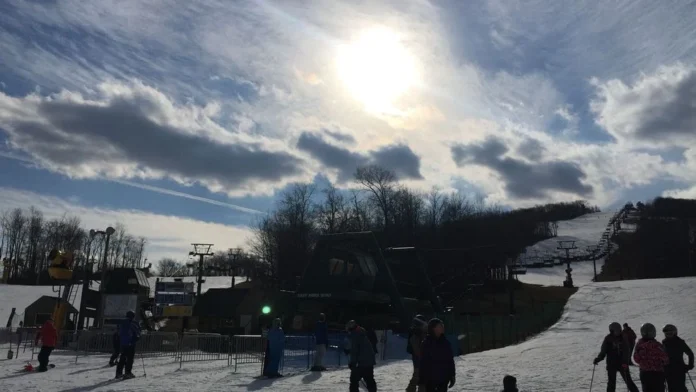

New Jersey can feel it. Even before you look at a thermometer, even before you scan a radar loop, you can sense the seasonal pivot underway. The higher late-February sun angle has officially entered the chat, and it is quietly, methodically changing the way snow behaves across the Garden State.
After a winter defined by legitimate cold, repeated snow opportunities, and persistent snowpack in many communities, we are now entering a transitional stretch. The atmosphere still supports snowfall. The calendar still says winter. But climatology, solar geometry, and boundary layer thermodynamics are beginning to work against meaningful accumulation.
This is not the end of winter. But it is winter’s sunset phase.
The Higher Sun Angle Effect: Why Snow Is Struggling to Stick
The first sign was subtle but telling. On February 15, 3–6 inches of snow fell from the sky across parts of New Jersey, yet only 1–3 inches actually stuck — primarily on grassy surfaces. That discrepancy was not a forecast bust. It was physics.
As we move deeper into late February, the sun climbs higher in the sky, increasing incoming solar radiation even when air temperatures hover near or below freezing. Pavement, rooftops, and other dark surfaces absorb and retain heat more efficiently. Snowfall rates must be more intense — and temperatures meaningfully colder — to overcome this effect.
We saw this again with the recent major snowstorm. Temperatures struggled to crash below freezing despite heavy snowfall overnight. In late December or mid-January, that same synoptic setup likely would have driven readings into the lower 20s. Instead, temperatures hovered just below freezing. Then during the daytime snowfall, readings of 33–34°F inhibited further accumulation.
The result? Compaction. Rapid settlement. Reduced snow-to-liquid ratios. And a snowpack that feels noticeably “milder” even when thermometers remain below freezing.
This is classic late-season snow climatology for New Jersey.
For regular updates and deeper weather analysis across the state, visit the Explore New Jersey Weather Report.
The Baseball Game Analogy: Where We Are in Winter’s Timeline
If winter were a baseball game, we are somewhere in the late innings — perhaps the 7th or 8th. There is still time on the board. Comebacks are possible. But the margin for meaningful impact is shrinking.
For lighter snow events to accumulate meaningfully from here on out, one or more of the following must occur:
• Cold air already entrenched ahead of the system (New Jersey inside a trough or behind a recent cold front)
• Overnight snowfall to avoid daytime solar heating
• A strong, dynamically forced storm capable of overcoming marginal surface temperatures
Absent those ingredients, snowfall becomes more cosmetic than consequential — more “snow on the grass” than widespread measurable accumulation.
Wednesday Morning Clipper: Routine, Quick-Hitting, Visibility Impacts Possible
The next snowfall potential arrives in the form of a classic Alberta clipper — a colder northern-stream system riding along the southern flank of low pressure positioned well into Canada.
Clippers are moisture-starved by nature. They move fast, drop quick bursts of snow, and rarely deliver major totals unless unusually amplified.
Timing: 2:00 a.m. to 9:00 a.m. Wednesday
Highs Today: 29–33°F (north to south)
Overnight Lows: 24–28°F, potentially a few degrees colder via radiational cooling
With existing snowpack and clear skies, localized colder pockets are possible overnight.
Expected Snowfall Totals
• Coating to 1 inch across much of North and Central New Jersey
• 1–3 inches possible in Northern/Northwestern NJ
• Less accumulation expected in South Jersey
• Absolute upside ceiling: 3 inches in isolated northern zones
The primary hazard is not accumulation — it is visibility reduction during periods of heavier snowfall rates. Clippers can briefly “dump” snow hard enough to create hazardous driving conditions before sunrise.
Untreated surfaces may become slick until temperatures climb above freezing by mid-morning. However, with afternoon highs surging into the 40s — possibly mid-to-upper 40s — expect a rapid melt, especially on paved surfaces.
Bottom line: This is a nuisance event, not a high-impact storm. But morning commuters in North and Central NJ should stay alert.
Thursday Afternoon and Evening: Boundary Placement Is Everything
Another system follows quickly on Thursday afternoon into Thursday evening (February 26). This one tracks along the frontal boundary dragged south by Wednesday’s clipper.
The latitude of that boundary will determine where the snow swath sets up.
Currently:
• The GFS tracks the system farther north, favoring South Jersey with a 1–3 inch scenario, possibly 2–4 in an upside case
• The European and Canadian guidance are far less enthusiastic, showing little to no precipitation except perhaps grazing extreme southern zones
This system arrives during the warmest part of the day and transitions into evening — again raising surface temperature concerns.
If accumulation occurs, it likely favors grassy surfaces. Pavement stickage would improve only after sunset as temperatures feather downward.
Maximum upside potential: 2–4 inches
Most likely outcome: Light hit or graze, especially across South Jersey
Model consensus remains weak. Much depends on how Wednesday’s clipper reshapes the frontal boundary.
March 2–4: The Next Legitimate Signal
Looking beyond these minor waves, the period of March 2–4 shows a more potent synoptic signal. Models hint at a stronger system, but thermal profiles remain marginal.
If a significant late-season snow is to occur, this window holds the most intrigue.
However, even here:
• Surface temperatures will likely hover near freezing
• Daytime accumulation would be challenging
• Strong dynamics would be required to overcome solar and climatological resistance
After that, March 5–7 currently trends toward a warmer rainmaker that could usher in a prolonged mild stretch. If that verifies, it would further reduce the probability of meaningful snow through mid-March.
And by that point, the sun angle becomes even more hostile to accumulation.
Historical Perspective: March Can Still Deliver
New Jersey residents know better than to declare winter over prematurely.
March 1993.
March 2014.
March 2017.
Each delivered significant late-season snowfall events that reshaped expectations. But those setups featured strong cold air advection and robust storm dynamics — not marginal boundary layer temperatures fighting daytime solar radiation.
So yes — we remain “in the baseball game.” But it would take a powerful, well-timed system to produce a memorable late-season snow.
What This Means for New Jersey Residents
• Expect lighter snow events to struggle during daylight hours
• Overnight systems have a better chance to accumulate
• Grass-first accumulation is increasingly common
• Rapid compaction and melt cycles will dominate
• The pattern is transitioning, not collapsing
For snow enthusiasts, this is a bittersweet phase. After a winter that delivered legitimate cold and frequent snow opportunities, even dedicated winter lovers are beginning to eye spring.
For others, the thaw cannot come soon enough.
Either way, New Jersey is entering a climatological pivot point.
SEO Focus: New Jersey Weather Forecast, NJ Snowfall, Late-Season Snow
This late-February forecast highlights a critical seasonal inflection point in New Jersey weather patterns. As the sun angle increases and climatology shifts, snowfall behavior changes across North Jersey, Central Jersey, and South Jersey.
While minor clipper systems may bring coatings and conversational snowfall totals, meaningful accumulation now requires stronger atmospheric dynamics and well-timed overnight windows.
We continue monitoring:
• Wednesday morning clipper system
• Thursday afternoon/evening boundary wave
• March 2–4 potential snow system
• March 5–7 warmer synoptic setup
Winter is not over. But it is evolving.
Stay tuned for continued in-depth analysis and real-time updates as New Jersey navigates the closing innings of the 2026 winter season.



