


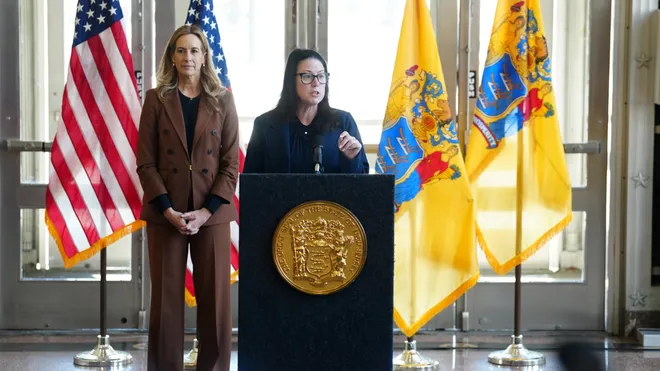

New Jersey’s political and economic trajectory is being rapidly redefined as Governor Mikie Sherrill moves through the opening phase of her administration with a series of high-impact decisions that are already reverberating far beyond state lines. Just weeks into her tenure, Sherrill has positioned herself at the center of national policy debate, while simultaneously driving a domestic agenda focused on affordability, energy, and economic competitiveness.
This is not a quiet transition into office. It is an assertive recalibration of how New Jersey governs, competes, and defines its priorities in 2026.
A Historic Election Transitions Into Immediate Action
After securing a decisive victory in November and being sworn in on January 20, 2026, Sherrill entered office as the first Democratic woman elected governor in New Jersey history. That milestone alone marked a generational shift in leadership. What has followed is an accelerated rollout of policy initiatives that signal an administration intent on acting quickly—and, at times, controversially.
Rather than easing into governance, Sherrill’s early months have been defined by bold executive action, aggressive policy framing, and a clear willingness to engage in issues that carry both statewide and national implications.
Immigration Policy Move Draws National Spotlight
At the center of the current political landscape is a sweeping executive order that restricts federal immigration enforcement activity on certain state-owned properties. Under the directive, immigration agents are prohibited from entering non-public state facilities without a judicial warrant—a move that immediately elevated New Jersey into the national immigration policy conversation.
The administration has paired that order with the rollout of a public-facing digital reporting system, allowing residents to upload video documentation of immigration enforcement activity. The initiative reflects a broader strategy to increase transparency and public participation, but it has also intensified debate across political lines.
Supporters frame the policy as a civil liberties safeguard and a modernization of state oversight. Critics argue it introduces friction between state and federal authorities while raising concerns about enforcement consistency and operational clarity.
What is clear is that this decision has defined the early narrative of Sherrill’s governorship—establishing her as a leader willing to engage in complex, high-stakes policy arenas from the outset.
The NJ-11 Special Election Becomes a Statewide Battleground
The ripple effects of Sherrill’s move to the governor’s office are already reshaping the political map.
Her departure from New Jersey’s 11th Congressional District has triggered a special election scheduled for April 16, 2026—an increasingly competitive race that is drawing significant attention from both major parties. The district, long viewed as a strategic stronghold, is now a focal point in a broader contest for influence at the federal level.
This election is more than a local race. It is a referendum on political momentum, party alignment, and voter sentiment in a state that often serves as a bellwether for national trends.
With control of messaging, turnout dynamics, and policy positioning all in play, the NJ-11 race is shaping up to be one of the most consequential political events in New Jersey this year.
Economic Strategy: Affordability, Energy, and Stability
Beyond headline-grabbing policy decisions, Sherrill’s administration is advancing a core economic agenda centered on affordability and long-term stability.
Key areas of focus include utility cost relief, with discussions around potential rate stabilization measures aimed at addressing rising energy costs for residents. At the same time, the administration is navigating a complex energy landscape—balancing investments in renewable infrastructure with the realities of grid reliability and supply demands.
The governor’s budget framework, which approaches $60 billion, reflects the scale of these priorities. It signals an administration attempting to address immediate financial pressures on households while positioning the state for sustained economic performance.
This dual approach—short-term relief paired with long-term structural planning—will likely define how the administration is evaluated in the months ahead.
Life Sciences Take Center Stage in New Jersey’s Innovation Economy
While policy debates dominate headlines, New Jersey’s economic engine continues to be driven by one of its most powerful sectors: life sciences.
At a recent industry forum hosted at Middlesex College, Governor Sherrill underscored the state’s position as a global leader in medical innovation. With more than 2,400 life sciences companies operating across New Jersey and a workforce exceeding 350,000 jobs tied to the sector, the industry remains a cornerstone of both economic growth and global impact.
From pharmaceutical breakthroughs to advanced immunotherapies, New Jersey’s role as the “medicine chest of the world” is not just branding—it is a measurable driver of investment, research, and job creation.
The forum brought together leaders from academia, industry, and government, reinforcing a central theme: collaboration is essential to maintaining New Jersey’s competitive edge.
Institutions such as Rutgers University and Rowan University, alongside major pharmaceutical and biotech organizations, are actively shaping the next generation of medical innovation. At the same time, policy decisions at both the state and federal levels are being closely monitored for their potential impact on research funding, regulatory environments, and long-term investment.
Policy Tension: Innovation vs. Regulation
As New Jersey continues to lead in life sciences, a parallel conversation is emerging around the role of policy in sustaining—or hindering—that leadership.
Industry stakeholders are emphasizing the importance of maintaining an environment that incentivizes research and development. Concerns around regulatory pressure, pricing mandates, and shifting policy frameworks are being weighed against the need for accessibility and affordability in healthcare.
This tension is not unique to New Jersey, but the stakes are particularly high given the state’s outsized role in global pharmaceutical innovation.
The Sherrill administration’s approach to this balance will be critical. Decisions made in the coming months could influence not only the trajectory of the industry within New Jersey, but also its position relative to competing states and international markets.
Technology, Innovation, and the Expanding Digital Infrastructure
New Jersey’s broader economic strategy is also intersecting with rapid advancements in technology.
Across the evolving landscape highlighted in the technology & tech sector, the integration of artificial intelligence, data infrastructure, and digital platforms is reshaping how industries operate. From healthcare to logistics to media, organizations are increasingly dependent on intelligent systems to drive efficiency and scale.
For New Jersey, this convergence of life sciences and technology represents a strategic advantage. The state’s ability to integrate advanced research with digital innovation positions it as a hub for next-generation industry development.
The challenge—and opportunity—lies in aligning policy with this pace of change.
A Governorship Defined by Momentum and Scrutiny
What distinguishes the current moment in New Jersey is the speed at which multiple forces are converging.
A new governor with a willingness to act decisively. A high-profile policy move drawing national attention. A competitive congressional race unfolding in real time. An economic strategy balancing affordability with innovation. And an industry ecosystem that continues to drive global impact.
Each of these elements carries its own weight. Together, they create a political and economic environment that is both dynamic and unpredictable.
Governor Mikie Sherrill’s early tenure is not being shaped in isolation—it is unfolding within a broader context of national debate, technological transformation, and economic recalibration.
The Road Ahead for New Jersey
As the state moves deeper into 2026, the trajectory set during these first months will continue to influence outcomes across multiple fronts.
Policy decisions made now will affect affordability, energy stability, and business competitiveness. The NJ-11 special election will offer insight into voter sentiment and political alignment. The life sciences sector will continue to test the balance between innovation and regulation. And technology will remain an accelerating force reshaping industries statewide.
For New Jersey, this is a defining period—one where leadership, policy, and economic strategy intersect in ways that will shape the state’s future for years to come.
Governor Sherrill has made it clear that her administration intends to operate at full speed. The question now is how that momentum translates into measurable outcomes for residents, businesses, and the broader regional economy.