



New Jersey is entering the most dangerous phase of a historic winter storm as meteorologists issue their final snowfall projections, dramatically escalating expectations for widespread accumulation, hurricane-force wind gusts along coastal regions, and the potential for severe coastal flooding. What began as a complex winter system has now evolved into a full-scale nor’easter poised to deliver crippling conditions statewide, with every region of New Jersey now projected to receive at least a foot of snow.
With state officials enforcing emergency measures and local governments closing offices, this storm represents one of the most significant winter weather events to impact the Garden State in recent years. Residents are being urged to prepare for rapidly deteriorating conditions, prolonged disruptions, and potentially dangerous overnight impacts.
For continuous statewide storm coverage, local forecasts, and seasonal alerts, readers can follow the latest updates through the Weather Report section, which tracks developing weather events impacting communities across New Jersey.
Final Call Snow Map Expands Heavy Snow Zone Across New Jersey
Forecast models have intensified expectations for snowfall across the entire state, with North Jersey now fully upgraded into the 12-inch-plus accumulation zone. Meteorologists describe the system as capable of producing explosive snowfall rates and localized extreme impacts, particularly in parts of Central and South Jersey where isolated pockets could see extraordinary accumulation.
Current projections indicate:
North Jersey is expected to receive between 12 and 18 inches of snowfall, with sustained heavy bands capable of producing rapid accumulation and near-whiteout visibility.
Central Jersey is projected to fall near the midpoint of the storm’s range, with totals averaging around 18 inches, though localized variations could produce higher amounts depending on storm band placement.
South Jersey is forecast to experience the most significant snowfall totals statewide, with widespread accumulations of 18 to 24 inches possible, alongside isolated areas that could see even higher totals under intense snow bands.
Meteorologists continue to monitor the possibility of localized extreme snowfall scenarios capable of producing highly disruptive impacts in select communities. These narrow but powerful bands could dramatically increase accumulation within short timeframes, potentially overwhelming snow removal operations and transportation infrastructure.
Eastern Pennsylvania projections have been slightly reduced due to updated precipitation trends, but New Jersey remains firmly positioned within the storm’s primary impact corridor.
Storm Transition: Rain Changing to Snow Statewide
Precipitation has already begun across New Jersey, with rain transitioning rapidly to snow from north to south as colder air pushes into the region. The rain-snow line continues to move southward, with the entire state expected to transition to all snow by mid-afternoon.
While initial precipitation may struggle to accumulate immediately due to relatively warmer ground conditions, rapidly falling temperatures will soon allow snowfall to stick and intensify. Forecasters warn that road conditions will deteriorate quickly once accumulation begins.
Conditions are expected to worsen noticeably beginning around mid-afternoon, with significant impacts developing during the early evening commute. From late afternoon onward, visibility will drop, roadways will become hazardous, and travel conditions will rapidly become dangerous.
Peak storm intensity is expected overnight, when heavy snow, strong winds, and coastal flooding risks will combine to produce the most severe impacts.
Nor’easter Development and Atmospheric Dynamics
Meteorologists describe the storm’s structure as a powerful coastal system evolving into a classic nor’easter. A developing coastal low off the Outer Banks has strengthened while an upper-level system closing over the Midwest is steering the storm toward the New Jersey coastline.
This interaction between upper and surface systems will intensify precipitation rates and drive powerful wind fields across the region. The storm’s energy is expected to focus along the Jersey coast before gradually weakening Monday morning as it moves away from the region.
This atmospheric setup supports the potential for explosive snowfall rates, sustained blizzard conditions along coastal communities, and prolonged impacts across inland regions.
Extreme Wind Gusts and Blizzard Conditions
Wind will play a major role in the storm’s severity, significantly increasing the danger posed by heavy snowfall. Meteorologists expect wind speeds to intensify rapidly from early evening through early morning hours, with the strongest gusts occurring around midnight.
Along immediate coastal areas of Eastern and Southeastern New Jersey, wind gusts between 50 and 70 miles per hour are possible. These conditions could create true blizzard environments, producing blowing and drifting snow, near-zero visibility, and dangerous exposure risks.
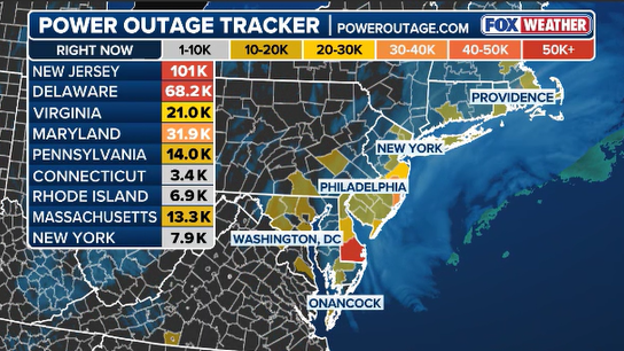
Inland regions across the rest of the state may experience gusts between 40 and 55 miles per hour, strong enough to cause tree damage, power outages, and hazardous travel conditions.
The combination of heavy snow and high winds will create drifting accumulations, rapidly burying roadways and increasing the likelihood of infrastructure damage.
Coastal Flooding Threat Along the Jersey Shore
The storm is also expected to generate a powerful wind-driven storm surge along the New Jersey coastline. Coastal flooding is most likely to occur during the same window as peak wind intensity overnight.
Forecasters anticipate moderate coastal flooding as the most probable outcome, though lower-end major flooding cannot be ruled out in vulnerable areas. Despite the absence of a full or new moon — which often increases tidal impact — the storm’s strong onshore winds may still push significant water levels into coastal communities.
Shore towns are preparing for potential flooding of low-lying roadways, infrastructure disruptions, and hazardous conditions near waterfront areas. Blizzard conditions are expected to begin along the Jersey Shore by approximately 9 p.m., marking the transition into the storm’s most dangerous phase.
Government Closures and Emergency Response Measures
Local and state authorities have implemented significant emergency measures as conditions worsen. Morris County government offices, for example, have closed to the public and non-essential personnel due to hazardous weather and ongoing snowfall.
Heavy snow continues across the county, with forecasts indicating total accumulations between 12 and 24 inches before the storm concludes. Officials report that road conditions remain extremely hazardous as crews work continuously to clear accumulating snow.
Residents and county employees have been urged to avoid travel unless absolutely necessary, allowing emergency responders and road crews to operate effectively.
Emergency management agencies statewide are coordinating snow removal operations, monitoring infrastructure conditions, and preparing for potential power disruptions caused by heavy snow and strong winds.
Timeline: When Conditions Will Peak
The storm’s progression follows a clear and increasingly dangerous timeline:
Snow and rain began spreading across New Jersey earlier in the day, with the transition to all snow occurring statewide by mid-afternoon.
Road conditions begin deteriorating significantly during the afternoon hours, with major impacts developing after 5 p.m.
Blizzard conditions, including peak snowfall rates and strongest winds, are expected overnight.
Storm intensity gradually tapers Monday from west to east between midday and early evening, though lingering impacts may continue beyond the storm’s official end.
This extended period of heavy precipitation and strong winds increases the risk of prolonged disruptions, including transportation delays, power outages, and infrastructure challenges.
Travel Warnings and Public Safety Guidance
Officials across New Jersey continue to emphasize that residents should remain indoors and avoid all non-essential travel. Heavy snowfall, drifting snow, and strong winds create extremely dangerous driving conditions, while falling branches and downed power lines pose additional risks.
Residents are encouraged to prepare for possible extended power outages by securing emergency supplies, maintaining communication access, and monitoring official alerts.
Emergency responders stress that keeping roads clear for snow removal and rescue operations is critical during the storm’s peak.
A Defining Winter Storm for New Jersey
The current winter storm represents a defining moment for New Jersey’s 2026 winter season, combining historic snowfall potential, powerful winds, and coastal flooding threats into a single high-impact event. Its statewide reach, rapid intensification, and complex atmospheric dynamics place it among the most significant winter weather systems to affect the region in recent years.
As conditions continue evolving, state officials and meteorologists will monitor impacts, assess damage, and coordinate recovery efforts while residents navigate one of the most intense winter events in recent memory. Continuous updates, local alerts, and community response efforts will shape the state’s path forward as New Jersey endures the full force of this powerful nor’easter.