


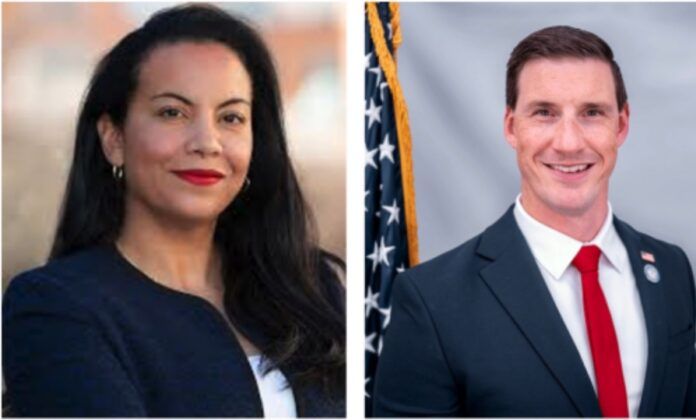

A congressional race that was expected to move quickly and quietly toward an April 16 decision has instead taken on a sharper, more unpredictable edge, as a dispute over debate terms between Democratic candidate Analilia Mejia and Republican challenger Joe Hathaway has reframed the dynamics of New Jersey’s 11th Congressional District special election. What began as a routine effort to organize a single candidate forum has evolved into a broader political flashpoint—one that touches on representation, institutional neutrality, campaign strategy, and the evolving expectations voters now place on public discourse.
At the center of the controversy is Mejia’s decision to decline participation in a debate organized by the League of Women Voters, a longstanding civic institution widely associated with nonpartisan voter engagement. The League, working in coordination with its Morris Area chapter and affiliated groups in Montclair, Livingston, and Mountain Lakes, ultimately announced it could not reach an agreement with Mejia’s campaign while maintaining its established debate policies. That breakdown prompted a public response from Mejia that immediately shifted the narrative of the race.
Her position was direct and calibrated to resonate within a district whose demographic composition has changed significantly over time. With more than a third of residents identifying as people of color, Mejia argued that the structure of a public debate—particularly one intended to inform and engage voters—should reflect that diversity at every level, including among moderators. For her campaign, the issue was not procedural but philosophical, grounded in the belief that neutrality and representation are not mutually exclusive, but rather essential components of a modern democratic process.
The League’s inability to commit to those terms created an impasse that now leaves the race without what would likely have been its only formal debate. In a district that spans portions of Essex, Passaic, and Morris counties, the absence of a structured, side-by-side candidate exchange introduces a new layer of complexity for voters attempting to evaluate competing visions in a compressed election timeline.
Mejia’s broader messaging reinforces a campaign built around contrasts. She has framed her candidacy as one focused on protecting democratic institutions, expanding access to affordable housing, and addressing rising healthcare costs that have impacted tens of thousands of New Jersey residents. Her critique of Hathaway positions him within a national political context, aligning him with policies and figures she argues undermine democratic norms and economic fairness. In doing so, her campaign has leaned into a narrative that prioritizes urgency and ideological clarity over traditional campaign rituals like formal debates.
Hathaway, for his part, has seized on the moment to present himself as the candidate willing to engage without conditions. His response—offering Mejia the opportunity to select moderators herself—was both tactical and symbolic, aimed at reframing the debate issue as one of accessibility and accountability. By emphasizing his readiness to participate under any reasonable format, Hathaway has attempted to position himself as aligned with voters seeking transparency and direct engagement.
This exchange highlights a broader shift in how debates are perceived and utilized within contemporary campaigns. Once considered essential forums for voter education, debates have increasingly become strategic tools, with candidates weighing the potential benefits against the risks of unscripted exchanges. In highly polarized environments, campaigns often calculate that message control, targeted outreach, and digital engagement can be more effective than traditional debate formats, particularly when those formats are viewed as constrained or misaligned with campaign priorities.
The League of Women Voters itself has not been immune to scrutiny in recent years. While it remains a respected organization with a long history of promoting civic participation, it has faced criticism from multiple political perspectives. Some Republican candidates have declined League-sponsored debates, citing concerns about perceived ideological leanings. At the same time, progressive voices have begun to question whether traditional debate structures adequately reflect the diversity and complexity of modern electorates. The current dispute in CD-11 encapsulates this tension, illustrating how institutions once seen as neutral arbiters are now operating within a more contested and scrutinized environment.
Beyond the immediate debate controversy, the stakes of the CD-11 special election remain significant. The seat, previously held by Mikie Sherrill, represents a district with a blend of suburban, urban, and semi-rural communities, each with distinct economic and social priorities. Issues such as housing affordability, healthcare access, public safety, and economic development are not abstract policy discussions but lived realities for constituents navigating a rapidly evolving regional landscape.
The compressed timeline of a special election further intensifies these dynamics. Without the extended campaign cycles typical of general elections, candidates must establish visibility, define their platforms, and connect with voters in a matter of weeks rather than months. In this context, every development—particularly one that captures public attention—can have an outsized impact on voter perception and engagement.
From a strategic standpoint, Mejia’s decision reflects a campaign willing to challenge traditional norms in pursuit of a broader message about representation and inclusivity. It signals an understanding that, for many voters, the process by which political dialogue occurs is as important as the content of that dialogue. Hathaway’s response, meanwhile, underscores a contrasting approach that emphasizes accessibility and a willingness to engage within established frameworks, even as those frameworks are being questioned.
For voters in CD-11, the absence of a formal debate does not eliminate the need to assess these competing approaches—it heightens it. In place of a single, structured forum, voters are left to evaluate candidates through a combination of public statements, campaign outreach, media coverage, and community engagement. This decentralized information environment places greater responsibility on both campaigns to communicate clearly and on voters to seek out and interpret that information effectively.
Within the broader context of New Jersey politics, this episode serves as a microcosm of larger trends shaping electoral discourse. Questions about who participates, how discussions are structured, and what constitutes fair and meaningful engagement are no longer peripheral—they are central to how campaigns are conducted and how voters make decisions. As demographic shifts continue to redefine districts and as political expectations evolve, these questions are likely to surface with increasing frequency and intensity.
The CD-11 race, once expected to follow a relatively predictable path, now stands as one of the more closely watched political developments in the state. Not because of a policy shift or a dramatic polling change, but because of a debate that will not happen—and the broader conversation that absence has ignited.