


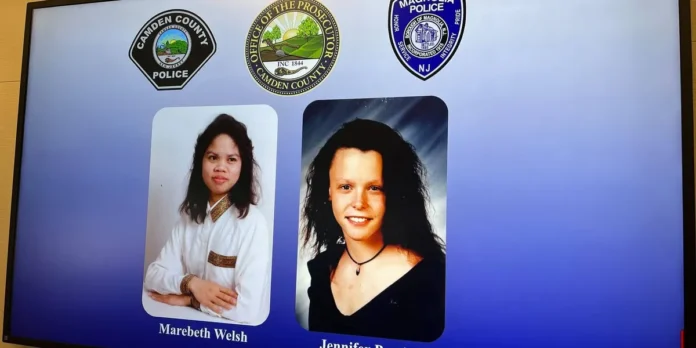

In a landmark development that underscores the evolving power of forensic science and the persistence of modern law enforcement, the Camden County Prosecutor’s Office has officially identified Francis T. Schooley of Mantua Township as the individual responsible for two brutal murders that haunted South Jersey for more than 30 years. The cases—long considered among the region’s most troubling unsolved crimes—have now been definitively linked through advanced DNA analysis and investigative genetic genealogy, closing a chapter that remained unresolved since the early 1990s.
The announcement represents a pivotal moment not only for the families of Marebeth Welsh and Jennifer Persia, but for the broader trajectory of cold case investigations in New Jersey. It signals a new era in which time is no longer the barrier it once was, and where technological advancement is rewriting the limits of what is solvable. As ongoing reporting across the Law & Order section of Sunset Daily continues to highlight, law enforcement agencies across the state are increasingly turning to science-driven methodologies to revisit cases once thought beyond reach.
Francis T. Schooley, who died by suicide in 2000 at the age of 39, has now been conclusively identified as the perpetrator in both killings. While his death prevents prosecution, authorities have made clear that, based on the strength of the evidence, he would have faced multiple charges including murder had he been alive today. For investigators, the identification is not simply symbolic—it is a legally and scientifically supported conclusion that delivers long-awaited answers in cases defined by uncertainty and loss.
The victims, Marebeth Welsh and Jennifer Persia, were young women whose lives were cut short under deeply violent circumstances. Welsh, 24 years old at the time, was discovered in November 1993 on a Camden sidewalk, the victim of strangulation and sexual assault. Months later, in April 1994, 16-year-old Jennifer Persia was found inside her Magnolia home, having suffered both stabbing and strangulation. Despite intensive investigations at the time, both cases remained unsolved, leaving behind unanswered questions and a lingering sense of injustice that spanned generations.
What ultimately changed the trajectory of these investigations was the formation of a dedicated cold case unit within the Camden County Prosecutor’s Office—an initiative designed specifically to reexamine legacy cases through the lens of modern forensic capabilities. Central to this effort was the application of investigative genetic genealogy, a method that combines traditional DNA profiling with genealogical research to identify suspects through familial connections.
The breakthrough began with renewed analysis of physical evidence from the Welsh case. Clothing recovered at the scene, preserved for decades, was subjected to advanced DNA testing last year, yielding a viable genetic profile. That profile was then matched to an unknown DNA sample previously collected in connection with the Persia homicide. For the first time, investigators had a definitive link between the two cases, confirming that a single individual was responsible for both crimes.
From there, the investigation moved into the realm of kinship analysis. By comparing the DNA profile to samples obtained from Schooley’s family members, including a parent and sibling, forensic experts were able to establish a conclusive biological connection. This step transformed what had been a statistical association into a confirmed identification, meeting the evidentiary standards required for law enforcement to formally name a suspect.
The case was further strengthened by investigative findings that placed Schooley in proximity to both victims. Authorities confirmed that he had performed construction work at the home of Jennifer Persia’s stepfather, establishing a direct connection to the location of one of the crimes. Additionally, witnesses had reported seeing him in the company of Marebeth Welsh prior to her death, adding a critical layer of circumstantial evidence that aligned with the forensic conclusions.
Taken together, the DNA evidence, genealogical analysis, and corroborating investigative details form a comprehensive case that leaves little ambiguity. For prosecutors and investigators, this represents the culmination of years of work, both past and present, bridging the gap between initial investigations in the 1990s and the technological capabilities available today.
Beyond the specifics of this case, the implications are far-reaching. The successful resolution of these murders demonstrates the transformative potential of integrating forensic science with strategic investigative frameworks. It validates the investment in cold case units and highlights the importance of preserving evidence, even when immediate leads have been exhausted. In an era where data and biology intersect, cases once considered dormant are increasingly being reactivated with measurable results.
For the families of Marebeth Welsh and Jennifer Persia, the identification of Schooley brings a measure of closure that had long seemed unattainable. While it cannot undo the loss, it replaces decades of uncertainty with clarity, affirming that the pursuit of justice did not end with the passage of time. It also reinforces a broader message—that law enforcement’s commitment to solving violent crimes extends indefinitely, adapting to new tools and methodologies as they become available.
Within New Jersey’s evolving law enforcement landscape, this case stands as a defining example of how legacy investigations can be successfully revisited. It reflects a growing emphasis on collaboration between forensic scientists, genealogists, and investigators, as well as a willingness to invest in specialized units capable of handling the complexities of cold case work. As more jurisdictions adopt similar approaches, the number of unresolved cases is expected to decline, reshaping the narrative around long-term criminal investigations.
The identification of Francis T. Schooley closes a painful chapter in Camden County’s history, but it also opens a new one—one defined by capability, accountability, and the understanding that even after decades, the truth can still be uncovered. In the broader context of public safety and justice, it serves as a powerful reminder that the evolution of technology is not just advancing industries—it is restoring answers, delivering accountability, and redefining what justice looks like in the modern era.