


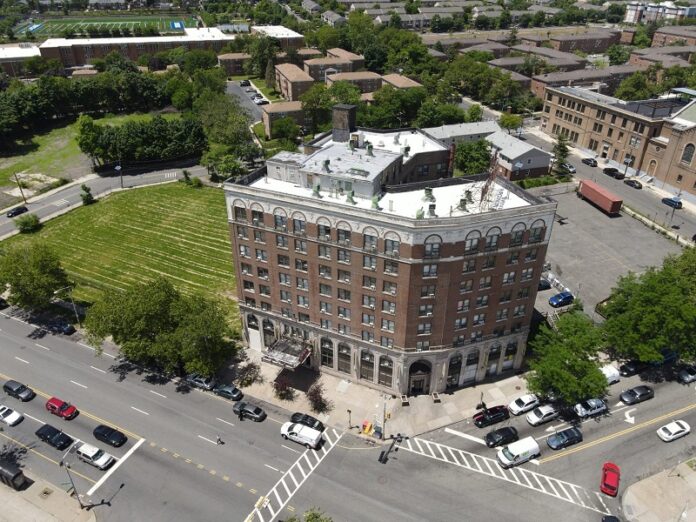

Newark is once again at the center of a defining urban redevelopment story—one that merges history, housing policy, social services, and community identity into a single, consequential project. The long-vacant Hotel Riviera at 169 Clinton Avenue, a property deeply rooted in both architectural and cultural significance, has officially received approval to be transformed into a homeless shelter with integrated transitional housing, signaling a major shift in how the city approaches housing insecurity and neighborhood revitalization.
The decision, finalized after years of stalled proposals, public debate, and shifting development strategies, represents more than a reuse of an aging structure. It reflects a broader policy evolution unfolding across New Jersey—one where adaptive reuse, affordability, and wraparound social services are increasingly intersecting as municipalities confront the realities of homelessness, economic disparity, and rising housing costs.
Governor Mikie Sherrill’s administration has consistently emphasized housing access and affordability as central pillars of its policy agenda, and the Hotel Riviera project now stands as one of the most visible examples of how those priorities are being operationalized at the local level. As detailed across ongoing coverage in the politics section, New Jersey’s leadership continues to balance fiscal responsibility with targeted investments in infrastructure, education, and housing stability—making projects like this both politically and economically significant.
Originally constructed in 1922 as a luxury hotel, the Hotel Riviera once embodied the elegance and ambition of early 20th-century Newark. Its ornate façade, which developers have committed to restoring, still hints at that era. But the building’s most defining chapter began in 1949, when it was purchased by the controversial yet influential religious leader Father Divine, who transformed it into the Divine Hotel Riviera—headquarters for his expanding ministry.
Father Divine’s legacy remains one of the most fascinating and complex in Newark’s history. At a time when segregation defined much of American life, he broke racial barriers by integrating his properties, including the hotel, and offering food, shelter, and community to followers during the Great Depression and World War II. His work, often unconventional and frequently scrutinized, nonetheless positioned the building as a place of refuge and inclusion—a historical parallel that has not been lost on city officials and planners evaluating its future.
That legacy is now being reinterpreted through a modern lens.
The newly approved redevelopment plan will convert the lower levels of the building into a fully operational homeless shelter, while the upper floors will provide transitional housing units designed to move residents toward long-term stability. Unlike traditional shelter models, this approach integrates services directly into the living environment—an “all-in-one” system that aims to address not just housing, but the underlying challenges that contribute to homelessness.
Luis Ulero, director of Newark’s Office of Homeless Services, has described the model as both innovative and necessary. On-site psychiatric care, access to substance abuse treatment partnerships, and coordinated pathways into permanent housing are all central to the project’s design. The goal is not simply to provide temporary shelter, but to create a structured environment where individuals can stabilize, receive care, and ultimately transition into independent living.
This integrated approach reflects a broader statewide and national shift toward service-based housing solutions—one that aligns with policy conversations happening at the highest levels of government.
At the same time, the approval process revealed the persistent tensions that accompany projects of this scale and purpose.
Community members voiced concerns during Planning Board hearings, particularly around how a walk-in shelter would function within a mixed-use residential building and what impact it might have on neighborhood safety, infrastructure, and quality of life. Issues related to mental health, substance use, and capacity management were raised repeatedly, underscoring the complexity of implementing such a project in a densely populated urban environment.
These concerns are not unique to Newark—they reflect a broader national dialogue about how cities can equitably distribute social services while maintaining neighborhood stability. What distinguishes the Hotel Riviera project is the extent to which it attempts to bridge that gap through design, partnerships, and long-term planning.
The current proposal also represents a significant departure from earlier attempts to redevelop the site. A 2022 plan that included a higher number of residential units faced strong opposition from local residents, who cited overcrowding and displacement concerns. That proposal ultimately collapsed, leading to the building’s sale and a reimagined development strategy that places greater emphasis on service integration and reduced density.
With 69 housing units now planned—down from the previously proposed 99—the revised project aims to strike a more sustainable balance between capacity and livability. The inclusion of comprehensive services on the ground floor appears to have been a decisive factor in securing approval, signaling a shift in both community expectations and municipal priorities.
Another point of contention—and reflection—has been the building’s historical identity.
Some residents expressed concern over the removal of signage associated with Father Divine, arguing that it risks erasing an important chapter of Newark’s cultural history. In response, Planning Board Chair Kalenah Witcher has called for a formal recognition of the building’s past, encouraging developers to incorporate elements that honor Father Divine’s legacy within the redesigned space.
That recommendation carries symbolic weight. In many ways, the building’s new purpose echoes its former role—not as a religious center, but as a place of refuge, support, and community for those in need. The parallels are not exact, but they are difficult to ignore.
As Newark continues to evolve, projects like the Hotel Riviera redevelopment highlight the city’s willingness to confront difficult issues head-on while preserving the narratives that have shaped its identity. They also underscore the broader policy environment in New Jersey, where housing, economics, and social services are increasingly interconnected.
The approval of this project is not the end of the conversation—it is the beginning of a new phase. Implementation, oversight, and community engagement will determine whether the vision outlined in planning documents translates into real-world success.
For now, the transformation of 169 Clinton Avenue stands as a powerful example of adaptive reuse with purpose—where history is not erased, but recontextualized, and where a landmark building is given a second life aligned with the urgent needs of the present.
In a state navigating fiscal challenges, housing shortages, and evolving political dynamics, Newark’s latest redevelopment effort offers a glimpse into what the future of urban policy might look like: integrated, intentional, and deeply rooted in both past and possibility.