



Corrections, reentry and health leaders roll out statewide partnership to deliver benefits, housing and treatment for justice-involved veterans
New Jersey has taken a major step to strengthen public safety and honor the service of justice-involved veterans with the launch of a new, coordinated reentry initiative designed to dramatically reduce re-arrest and reincarceration among former service members returning to their communities.
The New Jersey Department of Corrections has formally launched a strategic partnership with the New Jersey Reentry Corporation and Education and Health Centers of America to create a veteran-centered reentry pathway that begins inside correctional facilities and continues seamlessly after release.
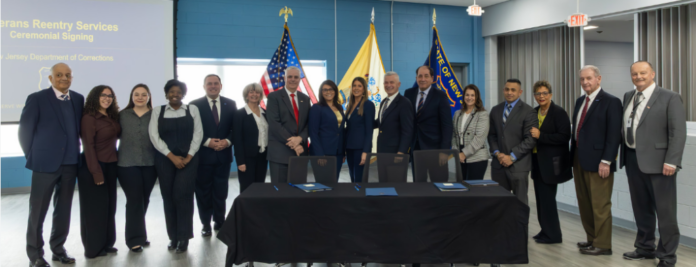
The agreement was signed on January 28 and establishes what state officials describe as a true continuum of care for incarcerated veterans—one that follows individuals from the point of identification during incarceration through the critical transition period after release and into long-term community stabilization.
At its core, the initiative is built to close one of the most persistent gaps in the reentry process: the disconnect between a person’s release from custody and their ability to immediately access housing, medical care, benefits, and legal assistance.
Under the new framework, incarcerated veterans will receive immediate verification of military service, allowing program staff to rapidly determine eligibility for state and federal veteran benefits. Once verified, participants are enrolled directly into appropriate benefit programs and connected with case managers who coordinate medical care, mental health treatment, and substance use services prior to release.
The model also emphasizes continuity—ensuring that clinical providers, reentry specialists and housing partners are prepared to receive participants as soon as they return to the community.
Officials say the partnership is specifically designed to address the unique challenges faced by justice-involved veterans, including untreated trauma, service-related disabilities, disrupted family networks and employment barriers created by criminal records.
Beyond benefits and health care, the initiative includes individualized case management, legal assistance to address licensing and employment obstacles, and direct housing referrals to prevent homelessness during the reentry period—a factor widely recognized as one of the strongest predictors of reoffending.
Acting Department of Corrections Commissioner Victoria Kuhn said the program reflects a broader commitment to building smarter, more targeted public safety strategies.
“This initiative honors our commitment to those who have served by ensuring they receive the community services necessary to reenter civilian life,” Kuhn said. “By partnering with the New Jersey Reentry Corporation and Education and Health Centers of America, we are creating a specialized pathway that combines legal advocacy, health care access and career support to help veterans succeed after incarceration and to strengthen public safety across New Jersey.”
The veteran reentry effort also brings the New Jersey Department of Military and Veterans Affairs into closer alignment with corrections and community-based providers.
Acting Commissioner Vincent Solomeno said the transition from incarceration back into civilian life should not disrupt a veteran’s access to the services they have earned.
Supporting veterans, he said, must extend beyond the courtroom and prison gates. Through coordinated action, agencies can ensure veterans return home with direct access to benefits, housing support and treatment resources that stabilize their lives and reduce the likelihood of future justice involvement.
Although accurately measuring the number of incarcerated veterans nationwide remains challenging due to inconsistent identification practices, New Jersey has emerged as a national leader in tracking veteran status in its correctional system.
The state is one of only 16 nationwide to participate in the Veterans Re-Entry Search Service, a federal verification system that confirms military service using Social Security records. Based on those records, New Jersey reports the smallest proportion of veterans in state prison in the country—slightly more than two percent of the incarcerated population.
Advocates say that reliable identification is essential, because veterans who are not recognized as such often miss access to specialized benefits, trauma-informed treatment and housing programs that can significantly alter reentry outcomes.
The operational backbone of the new partnership is the New Jersey Reentry Corporation, a Jersey City–based nonprofit that operates ten service locations across Central and North Jersey and provides reentry support to individuals returning from state prisons, county jails and addiction treatment facilities.
The organization reports outcomes that sharply outperform statewide averages.
According to program data, participants served through New Jersey Reentry Corporation programs experience a re-arrest rate of just 19.7 percent, compared with 51.4 percent for the broader reentry population in New Jersey. Reincarceration rates also drop substantially, with roughly 10 percent of participants returning to custody, compared with more than 30 percent statewide.
James McGreevey, executive director and chairman of the New Jersey Reentry Corporation, credited Governor Mikie Sherrill and state leadership for prioritizing veterans within the broader reentry system and for supporting data-driven strategies that focus resources on populations with distinct service needs.
Education and Health Centers of America, the third partner in the initiative, brings a statewide network of veteran-focused support services into the collaboration.
EHCA Chief Executive Officer Steve Johnson said his organization has already served more than 700 incarcerated veterans across New Jersey during the past seven years and expects the new partnership to expand both reach and effectiveness.
EHCA provides documentation assistance, veterans affairs referrals, housing placement support, transportation services, food and clothing assistance, and other basic necessities for both incarcerated and formerly incarcerated veterans throughout the state.
The formal partnership now integrates those services directly into the corrections reentry process rather than relying on referrals after release.
Criminal justice reform experts say the initiative reflects a broader shift toward population-specific reentry strategies—programs tailored to the distinct risks, health needs and service histories of individuals leaving custody.
Veterans, in particular, often face complex challenges related to post-traumatic stress, service-related injuries and disrupted employment histories, which can complicate traditional reentry models designed for the general population.
By aligning corrections, health providers and reentry specialists into a single coordinated system, state officials believe the program can deliver faster access to care, reduce administrative barriers and shorten the time between release and stabilization.
State leaders say the new veteran reentry initiative is also expected to play a role in reducing long-term correctional costs by lowering recidivism and decreasing emergency health and housing interventions after release.
As the partnership begins enrolling participants statewide, officials say its outcomes will be closely monitored and may serve as a model for future targeted reentry programs across New Jersey’s broader [law and order] landscape.
For veterans returning home after incarceration, the message behind the new initiative is clear: New Jersey is building a reentry system that recognizes military service, responds to individual needs and replaces fragmented support with a coordinated pathway back into stable civilian life.



