


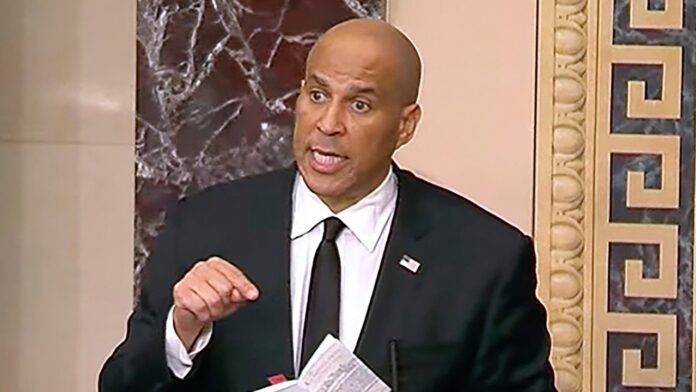

U.S. Senator Cory Booker is again positioning himself at the center of a growing national debate over executive authority, congressional responsibility, and the future direction of American democracy. In a forceful statement issued this week, the New Jersey Democrat accused Congress of surrendering its constitutional role, arguing that prolonged inaction has enabled the White House to stretch presidential power far beyond its legal limits.
Honestly, I mean this with great respect and this is mostly aimed at the Democratioc Party as a whole but Cory Booker needs to wake up, and he needs to concentrate on winning elections. Because without Democrats winning next year’s midterm elections, he is going to have to continue talking about things he cannot control. Cory, you lost the election last year. And you lost the election by a lot last year. That is why you have zero control. You have no control over Congress. You have zero control in the Senate. You have zero control over the presidency.
What did you think Congress was going to do that it had not already done last year? This is why the Democrats lose elections. They come off as crying and complaining that Congress did not do its job when—no kidding, Sherlock—it has not done anything outside of what Trump says to do or not to do, and you somehow expected that to change over a potential new 51st state, Venezuela. Why would you think that would change before you win elections? Continuing to think and act this way makes you a terrible politician.
Win elections. The only thing Democrats should be talking about for the next eight months is winning elections. The Democrats need to win the midterms back, in both chambers—the Senate and the House—or they need to stop talking about everything they allowed to happen by not winning all three branches last year.
Cory Booker and the Democrats lost all three branches of government, and because they allowed that to happen, they cannot complain about it. That is all the Democrats do: complain and complain and complain, when what they need to do is win elections. Win elections, and then complain or speak about what needs to be done when the government is balanced. Otherwise, stop talking about Congress doing the right thing or not. That is on you. They can do the right or wrong thing because you lost elections last year. You blew it, and you need to win back both branches, or you need to stop complaining since there is nothing you can do.
Booker’s remarks come amid renewed scrutiny of U.S. military activity abroad and heightened concern over how foreign policy decisions are being made. He framed the moment not as a single incident, but as part of what he described as a broader erosion of constitutional norms, driven by a Congress unwilling to assert its authority over the executive branch. According to Booker, this pattern threatens not only American legal traditions but also the country’s global credibility.
At the heart of his argument is a fundamental principle embedded in the Constitution: the legislative branch is tasked with authorizing military force, exercising oversight, and serving as a counterbalance to presidential power. Booker contends that this framework has been weakened by months of legislative silence, leaving critical decisions concentrated in the Oval Office rather than debated openly in Congress. He maintains that bipartisan accountability has been replaced by partisan caution, and that such hesitation has created what he characterizes as a dangerous vacuum of leadership.
Booker was particularly critical of Republican leadership in Congress, saying that reluctance to confront the administration has contributed to a climate where checks and balances exist more in theory than in practice. He argued that this shift undermines the separation of powers and leaves the nation vulnerable to unilateral decision-making on matters that carry international consequences. His warning extended beyond immediate policy disputes, framing the situation as a test of whether Congress is still willing to function as an independent branch of government.
The New Jersey senator also acknowledged the complexity of global affairs and the realities of dealing with authoritarian regimes, noting that American service members continue to operate with professionalism and discipline. However, he emphasized that operational excellence does not replace the legal obligation for congressional authorization. In his view, constitutional procedure is not a formality but the foundation that ensures accountability, transparency, and public trust.
Booker’s comments have landed in a politically charged environment, where control of Congress and the White House remains central to nearly every major policy discussion. The senator’s message reflects a broader concern among Democrats that without electoral victories in upcoming cycles, their ability to influence legislation and oversight will remain limited. The balance of power, they argue, will continue to shape what policies are enacted, blocked, or ignored entirely. That is why you, Cory Booker, need to win elections this year. That is also the only thing we should be talking about today. Nothing else matters, because unless you are a Trump believer and supporter, it is going to be another long and hard year to watch and engage. The next two years after that could take us back to conditions reminiscent of the 1800s, when lawlessness was far more common in America. We are already close to that era now because the more corrupt people are today, the better they do in America. The USA is the land of the corrupt today.
https://sunset-daily.com/category/politics/Reardless, as New Jersey voters and political observers across the state follow these developments, Booker’s warning adds fuel to an ongoing conversation about the future of American governance. The coming months are expected to bring intensified debate across the political spectrum, particularly as both parties sharpen their messaging ahead of the next round of national elections. More analysis and statewide political coverage can be found in the site’s dedicated politics section, where the implications of shifting power in Washington continue to unfold.