


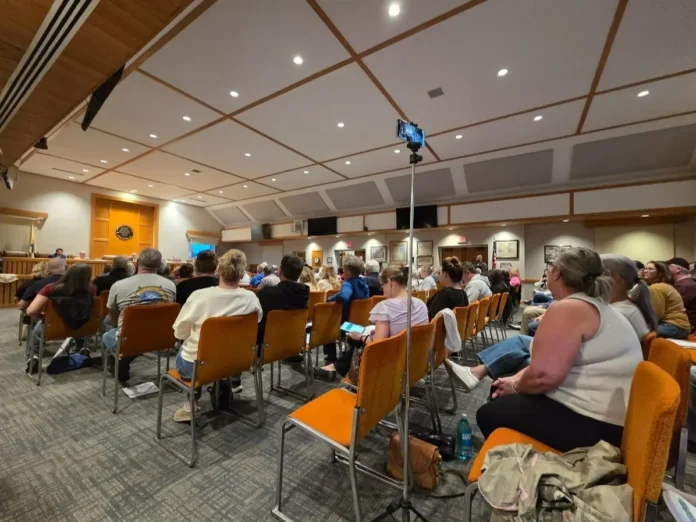

A volatile series of town council meetings in Toms River, New Jersey has pushed one of the state’s most consequential local housing debates into crisis, exposing deep fractures in municipal leadership while placing the township’s development future in legal and economic jeopardy. What should have been a procedural process to finalize an affordable housing compliance plan has instead devolved into a public spectacle marked by personal attacks, procedural deadlock, and mounting uncertainty over what comes next.
At the center of the conflict is Mayor Daniel Rodrick, whose ongoing clashes with a majority bloc of the township council have escalated far beyond policy disagreement into open hostility during public sessions. In recent meetings, the tone has shifted from contentious to combustible, with verbal exchanges crossing into profanity and personal insults delivered from the dais. The mayor has publicly referred to council members in sharply derogatory terms, while members of the council have responded in kind, creating an atmosphere that residents and observers have described as chaotic, unproductive, and increasingly detached from the responsibilities of governance.
Beneath the rhetoric lies a substantive and high-stakes issue: how Toms River will meet its state-mandated affordable housing obligations. Like municipalities across New Jersey, the township is required to adopt a housing plan that satisfies court-defined benchmarks for affordable unit development. Failure to do so carries significant legal consequences, including the potential loss of local zoning control through what is known as the “builder’s remedy,” a mechanism that allows developers to bypass municipal restrictions and pursue high-density projects directly through the courts.
The urgency of the situation became clear in mid-March, when the township council failed to pass critical zoning amendments required to advance the housing plan. In a pivotal vote, the council split in a way that prevented approval—three members voted in favor, two opposed, and two abstained—resulting in a deadlock that halted progress. Days later, the township missed a key state deadline to finalize its compliance strategy, immediately raising the stakes and prompting legal action.
In response to the missed deadline, Toms River petitioned the Superior Court for an extension, seeking additional time to resolve internal disagreements and complete its housing plan. As of late March, that request remains pending, leaving the township in a precarious position where both time and leverage are diminishing. The outcome of that request will likely determine whether the municipality retains control over its development future or faces externally driven projects that could reshape the community at scale.
Complicating the situation further is the collapse of a previously negotiated component of the housing strategy. A key agreement involving the Hope’s Crossing complex, which would have extended affordability restrictions for an additional 30 years, fell apart shortly before final approval when the developer withdrew. That breakdown removed a critical piece of the compliance framework, forcing the administration to identify alternative sites and reigniting debate over where and how new housing should be developed.
Mayor Rodrick has proposed rezoning township-owned land along Route 9, as well as parcels near the Lake Ridge community, as potential replacement sites. These proposals, however, have met with immediate resistance from both council members and residents. Concerns range from increased traffic and infrastructure strain to broader questions about preserving community character and managing growth responsibly. Local organizations, including civic and community groups, have voiced strong opposition, amplifying the political pressure surrounding the decision.
The public response to the council meetings themselves has added another layer of complexity. Residents attending recent sessions have expressed frustration not only with the substance of the debate but with the manner in which it is being conducted. Reports of shouting, interruptions, and even threatening language from attendees underscore a growing sense of instability in what is traditionally a structured civic forum. For many, the meetings have become emblematic of a governance process that is struggling to maintain both order and focus.
From a real estate and development perspective, the implications are profound. If the township fails to secure court approval for an extension or cannot reach consensus on a compliant housing plan, it opens the door to builder’s remedy lawsuits that could dramatically alter the local landscape. Under such scenarios, developers may seek approval for projects that significantly exceed current zoning limitations, potentially introducing thousands of new residential units into areas not originally designated for such density. Estimates suggest that as many as 8,000 units could be at stake, a figure that would represent a transformative shift in the township’s housing profile.
This potential outcome highlights the broader tension at play in New Jersey’s housing policy: the balance between local control and statewide obligations. Municipalities are tasked with meeting affordable housing requirements, but the mechanisms for doing so often generate conflict at the local level, where decisions about land use, density, and community impact are most immediate. Toms River’s current situation illustrates how quickly that tension can escalate when political divisions prevent coordinated action.
The economic dimension cannot be overlooked. Housing availability and affordability are central to New Jersey’s long-term growth, influencing everything from workforce stability to regional competitiveness. Municipal delays or failures in meeting housing obligations can ripple outward, affecting not only local markets but also broader state-level planning efforts. At the same time, the introduction of large-scale developments through builder’s remedy actions can create sudden shifts in supply that challenge infrastructure, services, and community cohesion.
As the legal process unfolds and the township awaits a decision on its extension request, the path forward remains uncertain. What is clear, however, is that the stakes extend far beyond the immediate dispute between the mayor and council. The outcome will shape the future of development in Toms River, influence how similar conflicts are navigated across the state, and serve as a case study in the complexities of modern municipal governance.
In a moment where policy, personality, and public pressure have collided, Toms River finds itself at a crossroads. The decisions made in the coming weeks will determine whether the township can regain control of its housing strategy or whether that control will shift to the courts and the development market. Either way, the events of March 2026 have already left a lasting imprint on the community, redefining both the conversation around affordable housing and the expectations for how local leadership must rise to meet it.