


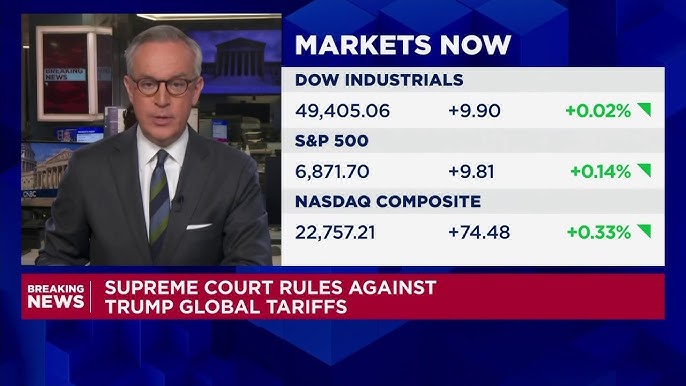

A landmark decision by the United States Supreme Court is reshaping the national trade landscape and sending immediate economic and political shockwaves through New Jersey’s globally connected economy. In a decisive 6–3 ruling issued February 20, 2026, the Court determined that the International Emergency Economic Powers Act (IEEPA) does not grant the president authority to impose broad tariffs on imported goods—marking a defining moment in the balance of power between Congress and the executive branch.
The decision invalidates a central component of President Donald Trump’s signature tariff program, while leaving open the possibility of alternative trade actions under separate statutes. For New Jersey—home to one of the nation’s most globally integrated economies, major port operations, and extensive international supply chains—the ruling carries immediate and long-term implications for businesses, consumers, and economic policy.
For continuing coverage of statewide political developments and federal policy impacts, readers can follow the Sunset Daily News Politics section.
A Landmark Constitutional Decision on Taxing Authority
At the center of the case was whether the president could use emergency powers under the International Emergency Economic Powers Act to impose sweeping tariffs on imports. Businesses challenged the administration’s actions, arguing that while the law allows regulation of economic transactions, it does not explicitly authorize taxation through duties or tariffs.
Chief Justice John Roberts, writing for the majority, emphasized that the Constitution clearly assigns taxing authority to Congress under Article I. The Court ruled that any delegation of such authority to the executive branch must be explicit, particularly when economic consequences are far-reaching.
The opinion concluded that the statutory authority to “regulate” importation does not include the power to levy tariffs. The Court expressed skepticism that Congress would delegate its core taxing authority through broad or ambiguous language.
The ruling establishes a significant precedent reinforcing congressional authority over taxation and trade policy, while narrowing the scope of executive emergency powers in economic matters.
Importantly, the decision applies only to tariffs imposed under IEEPA and does not invalidate tariffs authorized under other trade statutes, including Section 232 of the Trade Expansion Act or Section 301 of the Trade Act of 1974.
Presidential Response and New Trade Strategy
President Trump strongly criticized the ruling and announced plans to pursue alternative trade actions using different statutory authorities. The administration indicated it would move forward with new tariffs under other legal frameworks, including a proposed 10 percent global tariff under Section 122 of the Trade Act.
The president described the case as symbolically important to national security and economic policy while emphasizing that additional legal tools remain available to advance his trade agenda.
The administration’s response signals continued federal trade policy volatility, raising new questions about regulatory stability and economic planning for businesses nationwide.
Governor Mikie Sherrill Praises Decision
New Jersey Governor Mikie Sherrill welcomed the Court’s ruling, framing it as a victory for working families and small businesses facing rising costs.
The governor argued that the tariffs had placed significant financial pressure on residents, increasing consumer expenses and creating economic strain for local employers. She emphasized the state’s focus on reducing costs for households and improving affordability across New Jersey.
State leadership views the decision as an opportunity to ease economic pressure on families and restore stability in pricing for imported goods.
New Jersey’s Business Community Weighs Economic Impact
Business leaders across the Garden State are closely evaluating how the decision will affect supply chains, investment strategies, and operational costs.
The New Jersey Business & Industry Association noted that while tariffs may have offered long-term benefits for certain manufacturers, many employers experienced significant short-term cost increases. Industry representatives pointed to recent layoffs at Saddle Brook-based Arrow Fastener as evidence of economic pressure linked to the tariff regime.
Survey data from business leaders indicated widespread supply chain disruptions and rising input costs across multiple sectors. Many companies faced higher expenses that were ultimately passed along to consumers or absorbed by businesses operating on tight margins.
The New Jersey Chamber of Commerce emphasized the complexity of predicting the ruling’s full impact, citing the state’s diverse economic structure and global trade connections. Leaders noted that major policy changes can influence pricing, investment decisions, and competitiveness across industries.
Business groups also highlighted the importance of policy stability, noting that uncertainty surrounding trade rules can slow hiring, delay expansion plans, and discourage long-term investment.
Direct Economic Impact on New Jersey’s Global Trade Network
New Jersey’s economy is uniquely sensitive to shifts in federal trade policy due to its position as a major gateway for international commerce. The state’s logistics networks, pharmaceutical sector, manufacturing base, and retail economy rely heavily on global supply chains.
The Port Newark–Elizabeth complex serves as one of the nation’s busiest shipping hubs, handling massive volumes of imported goods each year. Changes in tariff policy directly affect shipping costs, import pricing, and distribution operations across the region.
For New Jersey importers, the ruling could reshape pricing strategies and operational planning while potentially triggering complex legal processes related to previously collected tariffs.
The decision may also influence future logistics investment, port activity, and international trade flows through the state.
Potential Consumer Relief for New Jersey Families
Economic analysts suggest the ruling could eventually reduce prices for certain imported goods, providing potential relief for consumers. New Jersey households had experienced rising costs for everyday products due to increased import expenses under the tariff regime.
Retailers and small businesses in communities across the state had been absorbing some of these cost increases to remain competitive. With tariffs lifted under IEEPA authority, prices for imported products—including food, household goods, and consumer items—may stabilize or decline over time.
State leaders estimate that previous tariff policies increased annual costs for many families, reinforcing the significance of the Court’s decision for household budgets.
Impact on Manufacturing, Jobs, and Investment
The ruling carries complex implications for New Jersey’s manufacturing sector. While some domestic producers benefited from reduced foreign competition under the tariff structure, others faced higher input costs for imported materials and components.
The removal of certain tariffs may lower production expenses for manufacturers dependent on global supply chains while increasing competitive pressure in other sectors.
Industry leaders emphasize that trade policy shifts can reshape employment patterns, investment decisions, and industrial strategy across the state’s manufacturing base.
Small Businesses and Local Economies
Small businesses throughout New Jersey had been particularly vulnerable to tariff-related cost increases. Many local retailers and service providers operate with limited financial flexibility, making sudden price increases difficult to absorb.
Business advocates suggest the Court’s ruling may provide greater economic predictability and encourage renewed investment among small and mid-sized enterprises.
However, ongoing uncertainty surrounding future trade actions continues to influence business planning.
Legal and Financial Questions Remain
One of the most significant unresolved issues involves the billions of dollars collected under the now-invalidated tariff program. The Court did not address whether businesses that paid tariffs under IEEPA authority will receive refunds or how such a process would operate.
Legal experts anticipate complex litigation and administrative procedures as companies seek to recover previously paid duties. For New Jersey importers, potential reimbursement claims could involve substantial financial stakes.
The outcome of these proceedings may shape future trade litigation and federal policy enforcement.
Federal-State Policy Tensions and Political Implications
The decision highlights ongoing tension between federal trade authority and state economic interests. New Jersey’s leadership has emphasized consumer protection and economic stability, while federal policymakers continue pursuing aggressive trade strategies.
The ruling reinforces constitutional boundaries governing federal economic authority while setting the stage for continued legal and political debate over trade policy.
For New Jersey, the outcome underscores the importance of federal decisions in shaping state economic performance and business competitiveness.
A Turning Point for Trade Policy and Economic Governance
The Supreme Court’s decision represents a defining moment in the evolution of U.S. trade policy, clarifying constitutional limits on executive authority while reshaping the national economic landscape.
For New Jersey, the implications extend far beyond legal doctrine. The ruling affects supply chains, consumer prices, business investment, manufacturing competitiveness, and global trade operations that form the backbone of the state’s economy.
As federal leaders pursue new trade strategies and markets respond to shifting policy frameworks, New Jersey businesses, workers, and consumers will continue adapting to a rapidly changing economic environment.
Sunset Daily News remains committed to delivering comprehensive analysis of the political decisions, economic developments, and policy changes shaping the future of New Jersey and the nation.