



New Jersey’s transition into spring is unfolding in real time, and this week’s weather pattern offers a clear look at how atmospheric dynamics are shaping conditions across the region. A largely zonal flow at the upper levels of the atmosphere is setting the tone, creating a sequence of temperature swings, passing fronts, and evolving pressure systems that will carry the state from a brief cooldown into a much more pronounced spring-like stretch. As highlighted across Sunset Daily Weather, even weather trends are increasingly relevant to business activity, commuting patterns, and regional planning, making this week’s forecast more than just a daily update, it is part of a broader operational landscape across New Jersey.
At approximately 250 millibars, the jet stream is maintaining a relatively flat, west-to-east orientation, but subtle shifts within that pattern are driving meaningful changes at the surface. Early in the week, a slight dip in the jet stream is lowering atmospheric heights, allowing cooler air to filter into the region. This aligns with the passage of a high-pressure system that is influencing conditions through midweek. The leading edge of that system is pulling colder air southward, reinforcing a cooler feel across the state through Wednesday.
By late week, the pattern begins to reverse. A gradual rise in the jet stream lifts atmospheric heights, and the backside of the high-pressure system introduces a warmer air mass from the south. This transition is expected to produce a noticeable warming trend, particularly on Thursday and Friday, before another frontal boundary moves through and resets conditions heading into the weekend. These oscillations are typical of late March in New Jersey, where winter’s residual influence competes with the advancing energy of spring.
The week began with a cold front that brought rain across much of the state overnight and into the early morning hours. As that system exits, conditions improve, but the pattern remains active. The next meaningful chance for precipitation arrives late in the week, as another cold front approaches on Friday. This system is expected to bring additional rain, followed by a return to cooler temperatures for the weekend.
From a day-to-day perspective, Monday sets the tone with cooler conditions statewide. High temperatures are expected to reach the mid-to-upper 40s, with a few locations briefly touching the low 50s. Cloud cover dominates much of the day, particularly in the morning as lingering rain gives way to gradual clearing by late afternoon and evening. Winds begin light but increase out of the north and northwest, adding a noticeable chill. Overnight temperatures drop to around 30 degrees across much of New Jersey, with a persistent breeze carrying into Tuesday.
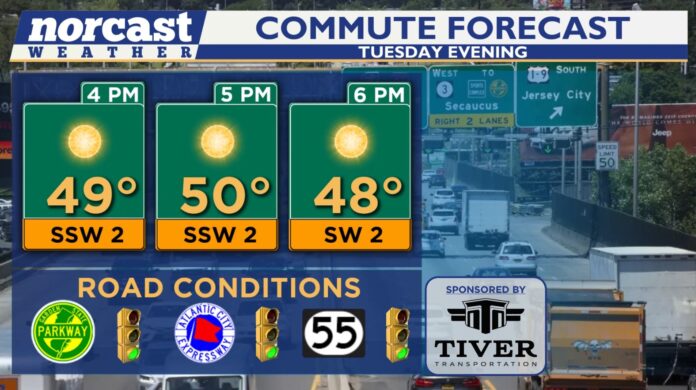
Tuesday brings a modest rebound, though temperatures remain seasonably cool. Highs climb to around 50 degrees for most inland areas, with coastal regions holding in the mid-40s. Skies feature a mix of sun and clouds, and winds, while breezy in the morning, ease as the day progresses, shifting to a lighter west-northwest flow. Overnight lows settle into the 30s and low 40s, marking a gradual moderation compared to the previous night.
By Wednesday, the warming trend becomes more apparent. Temperatures rise into the mid-to-upper 50s across the state, supported by a shift in wind direction to the south and southwest. Skies remain partly cloudy, and while the day is largely dry, there is a slight chance of a passing shower overnight as moisture begins to increase ahead of the next system. Overnight lows hold in the 40 to 45 degree range, reflecting the influence of the incoming warmer air mass.
Thursday stands out as the warmest day of the week, offering a preview of the spring conditions that are beginning to take hold. High temperatures approach 70 degrees in many locations, with parts of central and southern New Jersey potentially reaching the mid-70s away from the moderating influence of the ocean. Northern elevations and coastal areas remain slightly cooler, generally in the 60s. Skies continue to feature a mix of sun and clouds, with somewhat greater cloud cover in northern areas. Winds remain light out of the southwest, and overnight temperatures stay mild, ranging from the low to mid-50s, as the next round of showers begins to move in.
Friday introduces the next shift, as a cold front brings renewed chances for rain and a drop in temperatures. Highs fall back into the mid-to-upper 50s, with some locations briefly reaching 60 degrees. Skies turn mostly cloudy, and winds shift to the north and northwest behind the front. Overnight temperatures drop sharply, ranging from the mid-20s in northern areas to the mid-30s in southern parts of the state, setting up a cooler weekend.
Looking ahead to the weekend, conditions stabilize but remain below average for late March. High temperatures are expected to stay primarily in the 40s, with a few spots reaching just above 50 degrees. Despite the cooler air, both Saturday and Sunday appear dry, offering a break from the active pattern that defines the workweek.
Beyond the immediate forecast, longer-range signals suggest a more sustained warming trend as April begins. Persistent ridging across the eastern United States between April 1 and April 7 is expected to support milder temperatures at the surface, reinforcing the transition into a more consistent spring pattern. While forecasting beyond this window carries greater uncertainty, the overall trajectory points toward improving conditions and a gradual departure from winter’s influence.
Notably, there are no significant indicators of late-season snowfall in the current outlook. As March comes to a close, the likelihood of meaningful snow events diminishes rapidly. While isolated, non-accumulating snow or mixed precipitation can occasionally occur in higher elevations of northern New Jersey during April, such events are rare and typically short-lived. The concept of a true synoptic snowstorm at this stage of the season is even more uncommon, making it increasingly likely that the state will move forward without another winter weather event.
In practical terms, this means that New Jersey is entering the final phase of its seasonal transition. The fluctuations of this week, from cooler early conditions to a brief warm surge and back to a weekend cooldown, are characteristic of this period. They serve as a bridge between the colder months and the more stable, warmer patterns that define spring.
For residents, businesses, and communities across the state, this evolving weather pattern carries both immediate and longer-term implications. From planning outdoor activities to managing operations that are sensitive to temperature and precipitation, understanding these shifts is essential. As the atmosphere continues to adjust, one thing is becoming increasingly clear, spring is no longer just a date on the calendar, it is beginning to take hold across New Jersey.



