


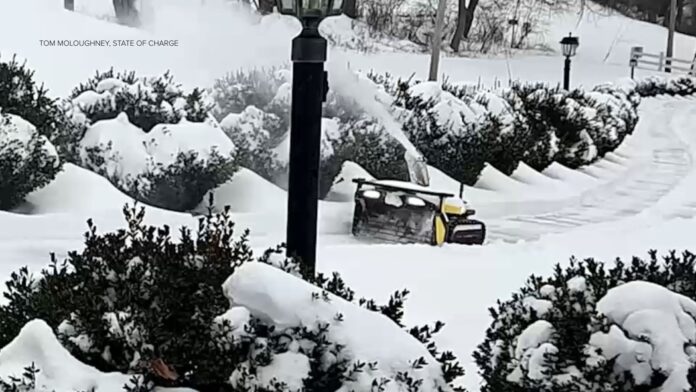

A futuristic snow-clearing robot carving a pristine path through a sprawling Chester driveway has captured the attention of millions across the country—just as New Jersey finds itself locked in a dangerous deep freeze and facing another active stretch of winter weather.
The viral video, now surpassing seven million views across social platforms, shows an autonomous Yarbo snow blower methodically clearing an estimated 6,000-square-foot residential driveway during the height of Winter Storm Fern in late January. While the machine works uninterrupted through heavy snowfall and gusting winds, the homeowner remains comfortably indoors, monitoring the operation remotely.
Behind the camera is well-known technology reviewer Tom Moloughney, host of the popular YouTube channel State of Charge, who documented the real-world performance of what is being described as one of the first consumer-ready autonomous snow blowers to reach the market.
The unit featured in the video is a first-generation Yarbo robotic snow blower with a price tag hovering around $5,000. Designed to operate independently once programmed, the machine uses onboard sensors, obstacle detection technology, and GPS-guided navigation to follow custom routes defined by the homeowner.
What viewers did not immediately see on screen was the extensive preparation required before the robot could begin clearing snow on its own. Moloughney explained that the installation process took close to 30 hours, including full assembly, mapping and programming the perimeter of the driveway, configuring chute direction, and carefully adjusting settings to accommodate the property’s slopes and changing elevations.
Once configured, however, the system runs continuously while snow is falling. The robot navigates around obstacles, adjusts its clearing path in real time, and automatically returns to its docking station to recharge before resuming work—creating a near-hands-free experience for the homeowner.
The video has triggered a statewide conversation about how automation could reshape winter maintenance in New Jersey, particularly in regions where repeated storms, ice accumulation, and extreme cold place heavy demands on homeowners and municipal crews alike.
Several viewers initially assumed the technology was part of a government pilot program or a public works upgrade. In reality, the system remains a privately owned consumer product, highlighting what may eventually become scalable for larger applications such as condominium associations, school campuses, and even municipal Department of Public Works operations.
Industry analysts say the interest generated by the Chester video reflects a broader shift in how homeowners view outdoor maintenance technology. Autonomous lawn equipment has already become more common, but winter-specific robotics capable of operating safely in snow, ice, and low-visibility conditions represent a much more complex engineering challenge.
The timing of the viral moment could not be more fitting. New Jersey is currently enduring one of its harshest prolonged cold stretches in recent memory, with meteorologists ranking the ongoing run of below-freezing days among the five longest such streaks on record for the state.
As of Sunday, February 1, temperatures across much of New Jersey are struggling to climb out of the 20s. Actual daytime readings are hovering between 22 and 27 degrees in many inland communities, while persistent winds are driving wind-chill values into the single digits—and in some areas, below zero.
Along the coast, conditions are even more severe. A Wind Advisory remains in effect for portions of southern and coastal New Jersey, including Cape May County, where wind gusts are approaching 50 miles per hour. In addition, a Coastal Flood Advisory continues for Atlantic and Cape May counties through the early afternoon hours, with minor tidal flooding expected in vulnerable shore communities.
The brutal cold is being fueled by a powerful system now pushing offshore, drawing frigid air across the region and maintaining dangerous exposure conditions for anyone spending prolonged time outdoors.
For residents tracking the rapidly changing situation, local and regional updates are being monitored closely through Sunset Daily’s ongoing New Jersey weather coverage, which provides community-specific outlooks and storm developments throughout the state.
Looking ahead, the coming days offer little immediate relief.
Monday, which also marks Groundhog Day, is expected to remain sunny but bitterly cold. High temperatures are forecast to reach only the low 30s, generally between 30 and 33 degrees across most of New Jersey.
By Tuesday, clouds are expected to increase, and daytime highs may finally push into the mid-30s. Forecasters say temperatures between 34 and 36 degrees could bring an end to the current multi-day streak of sub-freezing highs—a milestone many residents will welcome after weeks of persistent cold.
However, winter weather is far from finished.
Meteorologists are closely monitoring two separate weather systems that could bring additional snow to the region later this week. The first potential disturbance may arrive Wednesday, bringing scattered snow showers or light accumulations. A second system, still developing offshore and over the central United States, could impact New Jersey again on Friday, raising the possibility of another round of snow before the weekend.
Overnight conditions remain especially dangerous. Tonight’s forecast calls for clear to partly cloudy skies, with temperatures plunging into a frigid range between 8 and 14 degrees across much of the state. With lingering wind, frostbite can occur in a matter of minutes for exposed skin.
The combination of extreme cold, repeated snow threats, and high winds is forcing many residents to rethink how they handle winter maintenance—especially older homeowners and those with large properties.
That is precisely where the Chester driveway video has struck a nerve.
While a $5,000 autonomous snow blower remains out of reach for most households today, the footage offers a compelling glimpse into what winter preparedness may look like in the coming decade. Advocates of automation argue that robotic equipment could eventually reduce physical strain, lower injury risk, and help municipalities manage staffing shortages during prolonged storm cycles.
At the same time, experts caution that current systems still require extensive setup, technical familiarity, and regular monitoring—making them best suited for early adopters rather than mass deployment, at least for now.
Still, as New Jersey continues to battle a relentless winter and prepares for another potential round of snow later this week, the sight of a tireless robot carving through drifts in Chester has become a powerful symbol of how technology may soon reshape even the most physically demanding parts of everyday life.
You can watch the viral video of the Yarbo robot in action here and on Tom Moloughney’s YouTube channel, State of Charge, or see the news coverage from ABC7NY.
How the Robot Navigates NJ Terrain
The machine, specifically the Yarbo S1 model, uses a combination of advanced sensors and satellite data to handle complex residential properties.
- RTK-GPS Navigation: It uses dual-antenna Real-Time Kinematic (RTK) GPS for centimeter-level accuracy. This requires a base station (the “Data Center”) with a clear 120° view of the sky to maintain a strong signal.
- AI Vision & Smart Sensors: To avoid obstacles like pets, cars, or pedestrians, it uses binocular cameras, ultrasonic sensors, and a millimeter-wave radar. It features an automatic pause safety function that stops the unit until a safe distance is reached.
- Route Planning: Through the Yarbo app, users map out specific “work zones” and “no-go zones.” The robot’s AI then calculates the most efficient path and adjusts the chute angle to throw snow exactly where you’ve designated.
Performance Specs
According to specifications from Yarbo.com and Lowe’s, the unit is built for heavy-duty winter work.
| Feature | Specification |
|---|---|
| Cleaning Width | 24 inches |
| Intake Height | 12 inches per pass |
| Throw Distance | 6 to 40 feet |
| Slope Capacity | Up to a 36% (21°) incline |
| Battery Life | ~90 to 120 minutes per charge |
| Weather Rating | IPX5 (operates down to -13°F/-25°C) |
Buying Options
The
Yarbo S1 is a modular system, meaning you can swap the snow blower for a lawn mower or leaf blower module.
| Merchant | Product | Price |
|---|---|---|
| Yarbo | Yarbo 2-Stage Snow Blower | $4,599 |
| Lowe’s | Yarbo Snow Blower Robot | $4,999 |
| Best Buy | Yarbo Mower & Snow Blower | $6,199 |



