


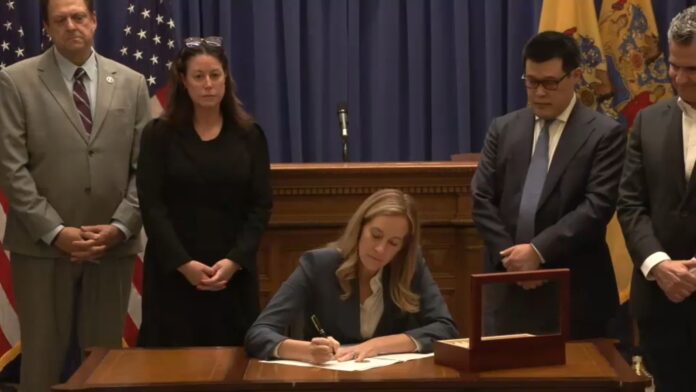

TRENTON — Gov. Mikie Sherrill has signed a significant executive order aimed at restricting how New Jersey state agencies interact with U.S. Immigration and Customs Enforcement (ICE), a move that intensifies the state’s ongoing debate over immigration enforcement and civil rights protections. The action coincides with momentum in the State Legislature to enshrine the governor’s policies into law, part of a broader legislative effort that has drawn sharp partisan clashes and heightened public attention.
The governor’s executive order directs all relevant state departments to limit assistance and data sharing with federal immigration enforcement beyond what is already required under existing law, signaling a decisive shift in New Jersey’s approach to cooperation with ICE agents operating within the state. According to aides in the governor’s office, the directive is intended to protect immigrants’ rights, build trust between law enforcement and immigrant communities, and ensure that local resources are not diverted toward federal immigration enforcement actions.
Supporters of the order say it will help safeguard due process and community safety by preventing local agencies from acting as de facto immigration enforcers. The governor’s order also outlines clear protocols for how state law enforcement should respond to federal detainer requests, emphasizing that compliance should be limited to circumstances outlined under state statutes and constitutional protections.
Parallel to the governor’s executive action, the New Jersey Legislature is actively advancing a package of bills designed to codify the Immigrant Trust Directive, the policy framework that governs state dealings with federal immigration authorities. Proponents argue that codification will provide permanence and clarity, ensuring that protections for immigrant residents cannot easily be rolled back with future administrative changes.
However, the push for legislative action has not proceeded without controversy. On Thursday, Assemblyman Paul Kanitra (R-Ocean) engaged in a heated exchange with Democratic lawmakers during an Assembly committee hearing focused on the sanctuary state and anti-ICE legislation. Kanitra, one of the most vocal opponents of the bills, argued that limiting cooperation with federal immigration enforcement could undermine public safety and hinder law enforcement’s ability to remove dangerous individuals from communities.
Kanitra’s comments drew sharp rebuttals from Democrats serving on the committee, including the panel’s chairman, who defended the proposed legislation as a necessary response to what he described as “overreach and threats from our own federal government.” The chairman underscored the need for local governments to assert autonomy over how and when federal immigration authorities can access state and municipal resources.
Despite opposition from Republican lawmakers, the Assembly panel approved several immigration-related bills, including measures similar to ones recently vetoed by former Gov. Murphy. The legislative advances indicate strong support among Democratic majorities to reframe New Jersey’s immigration policy landscape, even as debates intensify over jurisdiction, public safety and the boundaries of state authority.
The bills advanced by the committee include provisions that would further codify limits on ICE detainer compliance, restrict access to certain state databases by federal immigration agents, and enhance legal protections for immigrant residents. Sponsors argue these protections are vital for building trust between immigrant communities and local authorities, encouraging cooperation with community policing efforts without fear of immigration consequences.
Opponents of the legislation emphasize the need for balance, asserting that public safety should not be compromised and that local and state agencies should maintain the ability to work with federal partners when threats to public safety are present.
The policy dispute taps into a broader national conversation over immigration enforcement and the role of states in defining how federal priorities are implemented on the ground. In New Jersey, which is home to a diverse immigrant population and major urban centers, the stakes are particularly high for both supporters and critics of tighter limits on ICE cooperation.
As the legislative session progresses, lawmakers are expected to continue refining the bills, with additional committee hearings and public testimonies likely in the coming weeks. The governor’s office has signaled its support for the legislative effort to codify the Immigrant Trust Directive, framing the collaboration between the executive and legislative branches as a unified strategy to protect residents’ rights and clarify enforcement boundaries.
Residents and community groups have been actively weighing in on both sides of the debate, with immigrant advocacy organizations applauding the governor’s directive and proposed legislation as affirmations of inclusion and civil liberties. At the same time, several law enforcement associations and conservative advocacy groups have echoed concerns raised by Assemblyman Kanitra, calling for greater safeguards to ensure that law enforcement retains appropriate tools to address serious criminal activity.
For ongoing updates on statewide policy developments and legislative actions in Trenton, including immigration reform and law enforcement directives, check Sunset Daily News’ legislation coverage.
With the turf battle over immigration enforcement now unfolding in both the executive chambers and the Legislature, New Jersey is poised to become a focal point for how states assert control over federal immigration interactions while navigating complex questions of public safety, civil rights and community trust.



