


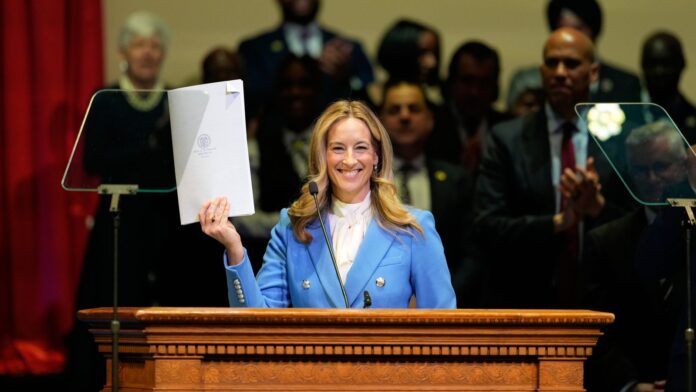

In a moment that blended symbolism, history, and immediate action, Democrat Mikie Sherrill was sworn in on January 20, 2026, as New Jersey’s 57th governor, becoming the second woman to lead the state and the first female Democrat to hold the office. The ceremony marked both a political milestone and a strategic reset for Trenton, as Sherrill signaled from day one that her administration intends to move quickly on the issues shaping everyday life across the Garden State.
Breaking with decades of tradition, the inauguration was held at the New Jersey Performing Arts Center in Newark, the first time in nearly 30 years the ceremony took place outside of Trenton. The choice of venue was widely viewed as intentional, reflecting Sherrill’s emphasis on accessibility, regional inclusion, and the economic and cultural significance of New Jersey’s largest city. The setting underscored her broader message that state government must meet residents where they live, rather than remain confined to the walls of the State House.
Chief Justice Stuart Rabner administered the oath of office as Sherrill placed her hand on a bound collection of the New Jersey and United States Constitutions, along with the Declaration of Independence. The historic volume once belonged to William Paterson, New Jersey’s second governor, adding another layer of continuity between the state’s early leadership and its modern political evolution. The moment reinforced the weight of the office at a time when public trust, affordability, and governance remain central concerns for voters.
Sherrill wasted little time translating ceremony into action. Immediately following her inaugural address, she signed two executive orders aimed at addressing New Jersey’s ongoing energy challenges. Central among them was a freeze on utility rate hikes, designed to provide short-term financial relief for residents facing rising living costs. The move was widely interpreted as a signal that her administration plans to prioritize cost-of-living pressures while longer-term energy and infrastructure strategies are developed.
Her swearing-in also marked a rare political achievement. With Sherrill’s victory, Democrats secured a third consecutive term in the governor’s office for the first time in more than six decades, an outcome that reflects shifting voter coalitions and a sustained realignment in statewide elections. The result places heightened expectations on the new administration to deliver measurable results across economic, social, and regulatory fronts.
Sherrill enters the governor’s office with a résumé that spans military service, law enforcement, and federal legislation. A former Navy helicopter pilot and federal prosecutor, she represented New Jersey’s 11th Congressional District for four terms before launching her successful bid for governor. Supporters point to her background as evidence of a leadership style rooted in discipline, operational focus, and an understanding of complex systems, while critics will be watching closely to see how those traits translate into state-level governance.
Joining her on the inaugural stage was Lieutenant Governor Dr. Dale G. Caldwell, who made history of his own as the first African American man to serve in the role. A former president of Centenary University, Caldwell brings experience in higher education leadership and policy development, positioning him as a key figure in the administration’s efforts to address workforce readiness, educational outcomes, and institutional accountability.
Policy priorities outlined by the new administration point toward a broad, ambitious agenda. Sherrill has pledged to tackle affordability across housing, energy, and healthcare; strengthen transparency and ethics in government; and confront the growing concerns surrounding children’s exposure to and dependency on social media platforms. Each of these initiatives is expected to generate significant debate within the evolving landscape of New Jersey politics, particularly as lawmakers weigh regulatory reform against economic competitiveness.
As the inaugural celebrations conclude, attention now shifts to execution. Cabinet appointments, legislative negotiations, and early policy outcomes will shape perceptions of Sherrill’s leadership in the months ahead. What is already clear is that New Jersey has entered a consequential new chapter, one defined not just by historic firsts, but by the urgency of governing in a state where expectations are high and the margin for error is narrow.
New Jersey officially entered a new chapter in its political history on January 20, 2026, as Mikie Sherrill was sworn in as the state’s 57th governor, becoming only the second woman to hold the office. Her inauguration, alongside Lieutenant Governor Dale Caldwell, marked a generational and ideological transition in Trenton, setting the tone for what many hope will be a period of pragmatic leadership, economic focus, and renewed trust in state government.
Sherrill’s ascent to the governorship represents more than a ceremonial milestone. A former federal prosecutor, Navy helicopter pilot, and member of Congress, she arrives in the executive office with a résumé that blends public service, national security experience, and legislative credibility. Her oath of office symbolized continuity in democratic institutions while also underscoring the changing face of leadership in New Jersey, a state long defined by its diversity, economic complexity, and political influence.
Lieutenant Governor Dale Caldwell’s swearing-in further reinforced that message. Caldwell brings a background rooted in policy development, organizational leadership, and civic engagement, positioning the administration as one that intends to balance vision with operational discipline. Together, Sherrill and Caldwell begin their tenure at a moment when New Jersey faces both significant challenges and substantial opportunities, from affordability pressures and infrastructure demands to workforce development and business competitiveness.
The New Jersey Chamber of Commerce issued a formal statement congratulating Governor Sherrill and Lieutenant Governor Caldwell on their inauguration and assumption of office, extending well wishes as they begin serving the people of the Garden State. The Chamber emphasized the importance of collaboration between the public and private sectors, signaling an expectation that the new administration will engage constructively with employers, entrepreneurs, and industry leaders across the state.
Business leaders are watching closely as Sherrill outlines her governing priorities. New Jersey’s economy remains one of the most dynamic in the nation, anchored by finance, logistics, life sciences, technology, and higher education. At the same time, companies continue to raise concerns about taxes, regulatory complexity, energy costs, and workforce retention. Early signals from the incoming administration suggest a focus on stability, predictability, and long-term planning—qualities often cited by businesses as essential to sustained growth.
Beyond economics, Sherrill’s inauguration carries broader political significance. Her election reflects shifting voter coalitions and evolving expectations around leadership style, transparency, and accountability. As only the second woman to serve as governor, her tenure is likely to be viewed through both a historical and policy-driven lens, with heightened attention on how her administration governs rather than merely who occupies the office.
As the new governor begins assembling her cabinet and advancing her legislative agenda, attention will increasingly turn to how campaign themes translate into governing realities. Issues such as affordability, public safety, education, transportation, and climate resilience are expected to dominate early discussions in Trenton, shaping debates within the broader landscape of New Jersey politics.
For now, the inauguration of Governor Mikie Sherrill and Lieutenant Governor Dale Caldwell stands as a moment of transition and possibility. The formal ceremonies have concluded, but the substantive work of governing has begun—work that will define not only this administration, but New Jersey’s trajectory in the years ahead.
Overall, as New Jersey entered a new chapter in its political history on January 20, 2026, as Mikie Sherrill took the oath of office as the state’s 57th governor, becoming only the second woman to hold the position. Her inauguration signaled a shift in leadership, blending experience, pragmatism, and a commitment to addressing urgent issues affecting residents across the Garden State. Sherrill’s ascent to the governorship marks a historic milestone, not only for women in New Jersey politics but also for Democrats, as she inherits the office following a period of significant political and economic challenges.
Immediately upon assuming office, Governor Sherrill addressed the pressing issue of rising energy costs that have burdened families and businesses across the state. In a decisive first act, she declared a State of Emergency on Utility Costs, implementing a freeze on select rate increases and directing state agencies to identify measures that provide immediate relief to residents. The move reflects Sherrill’s focus on affordability and her understanding that energy stability is a critical component of economic security. Analysts note that this proactive step positions her as a governor willing to act decisively on issues that affect daily life, reinforcing her reputation as a hands-on leader.
Beyond economic concerns, Sherrill faced complex challenges regarding immigrant protections. Outgoing Governor Phil Murphy vetoed two bills aimed at safeguarding immigrant rights, leaving the new administration to determine its path forward. Sherrill has indicated that immigrant communities will remain a priority, and her team is reviewing options for reintroducing legislation to restore and expand these protections. Advocates emphasize that this decision will have lasting impacts on New Jersey’s reputation as a welcoming state and on the lives of thousands of residents who rely on clear and fair policies.
Sherrill’s inauguration also reflected her broader approach to leadership, one that combines historical respect with forward-looking action. In her speech, she highlighted the importance of government accountability, transparency, and responsiveness, promising to engage directly with communities across the state. Observers note that her immediate attention to energy affordability and immigrant rights signals a willingness to tackle complex, high-stakes issues from the outset, rather than waiting for political consensus or prolonged legislative negotiations.
Her early actions underscore a commitment to balancing short-term relief with long-term policy planning. While the utility emergency declaration provides immediate respite for residents, Sherrill has also directed state agencies to explore systemic reforms to energy regulation and pricing, reflecting an understanding that sustainable solutions require both urgency and strategic foresight. Similarly, her approach to immigrant protections demonstrates a recognition that New Jersey’s diverse population requires careful, legally sound policies that uphold fairness while strengthening community trust.
As Governor Sherrill begins her tenure, attention will focus on how her administration navigates these twin priorities of economic relief and social equity. The combination of decisive first actions and measured policy planning positions her to make a significant impact on state governance in the coming months. Her leadership style, emphasizing action, inclusivity, and responsiveness, is already distinguishing her from predecessors and signaling a proactive, solutions-oriented approach to challenges that affect every New Jerseyan.
The inauguration and early policy decisions also have broader political implications. Sherrill’s administration is expected to influence debates in the legislature, shape public discourse on critical issues, and serve as a benchmark for Democratic leadership in the state. For ongoing coverage of Governor Sherrill’s policy initiatives and broader developments in New Jersey politics, her administration’s first months will be closely watched by residents, businesses, and civic leaders alike, as she defines the trajectory of the Garden State’s government for the next term.
Sherrill’s immediate attention to energy and immigrant issues, combined with her promise of transparency and engagement, positions her as a governor committed to acting decisively while building a foundation for sustainable, long-term governance. New Jersey watchers and residents alike are poised to evaluate her effectiveness not just on symbolic milestones, but on tangible results that affect daily life and community well-being.



