


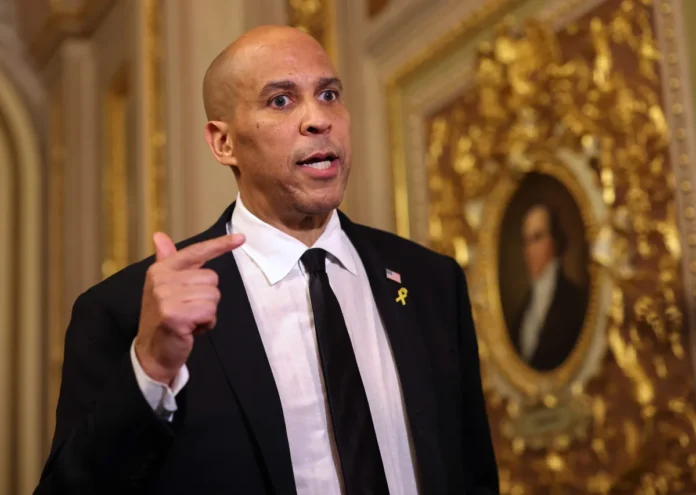

New Jersey’s voice on the national stage is once again commanding attention as U.S. Senator Cory Booker delivers a forceful stance on two of the most consequential issues shaping the current political landscape: federal funding for Immigration and Customs Enforcement and the future of voting legislation tied to the controversial SAVE America Act. In a moment defined by heightened partisan tension and a prolonged Department of Homeland Security impasse, Booker’s remarks signal both a policy position and a broader ideological line that is resonating far beyond Washington.
Appearing on a nationally televised interview, Booker made clear that his position on ICE funding is unequivocal, stating that he will not support additional appropriations for what he characterized as an agency operating outside acceptable bounds. His refusal to back further funding reflects a growing faction within Democratic leadership that is demanding structural reforms before committing taxpayer dollars to enforcement operations. The statement lands at a critical juncture, as the Department of Homeland Security faces an extended shutdown exceeding five weeks, leaving lawmakers under increasing pressure to reach a resolution.
The standoff in Washington has been shaped by rapidly shifting negotiations, with Republican senators recently attempting to advance a narrower funding package that would exclude more polarizing provisions. However, momentum behind that approach quickly dissolved as Democratic leaders, including Booker, rejected proposals that did not sufficiently address concerns surrounding ICE oversight and broader immigration policy reforms. The resulting deadlock underscores the difficulty of forging consensus in a political environment where both sides are navigating internal divisions as well as external pressure from constituents.
At the same time, Booker has emerged as a prominent voice in the debate over voting rights legislation, particularly in response to the SAVE America Act, which has been championed by former President Donald Trump. While acknowledging support for voter identification measures—pointing to existing frameworks in New Jersey—Booker has drawn a sharp distinction between widely accepted safeguards and what he describes as restrictive policies that could limit access to the ballot.
Central to his argument is the concern that the proposed legislation would impose logistical barriers on voters, particularly in geographically expansive or rural regions. Booker amplified remarks made by Republican Senator Lisa Murkowski of Alaska, who warned that certain provisions could force voters to undertake significant travel simply to participate in elections. By highlighting bipartisan skepticism, Booker has sought to reframe the debate as one that transcends party lines and centers on the fundamental accessibility of democratic participation.
The rhetoric surrounding voter fraud has also become a focal point of Booker’s critique. He has emphasized that instances of in-person voter fraud remain exceedingly rare, challenging narratives that suggest widespread irregularities. In doing so, he positions the current legislative push as less about election security and more about shaping public perception of electoral integrity. His argument reflects a broader Democratic strategy aimed at countering claims that could undermine confidence in the voting process.
This debate is unfolding against a backdrop of increasingly polarized political discourse, where statements from national leaders carry significant weight in shaping public opinion. Booker’s comments on the potential consequences of restrictive voting measures—paired with his critique of efforts to cast doubt on election outcomes—highlight the stakes involved as lawmakers consider policies that could redefine how Americans engage with the electoral system.
Within New Jersey, Booker’s position reinforces the state’s longstanding emphasis on accessible voting practices and balanced regulatory frameworks. The Garden State has implemented voter ID requirements alongside measures designed to expand participation, including mail-in voting and early voting options. By referencing these systems, Booker underscores a model that he argues achieves security without sacrificing accessibility, offering a counterpoint to more restrictive proposals at the federal level.
The intersection of immigration policy and voting rights within this broader debate reflects the complexity of the current political moment. Both issues touch on fundamental questions about governance, accountability, and the role of federal institutions in shaping daily life. For Booker, the linkage is clear: policies that affect who can vote and how agencies operate must be evaluated through the lens of fairness, transparency, and long-term impact on democratic norms.
Coverage within the politics landscape continues to track these developments closely, as lawmakers navigate an environment where legislative outcomes are uncertain and public scrutiny remains intense. The ongoing DHS funding impasse, combined with the contentious debate over voting legislation, has created a scenario in which individual voices—particularly those of high-profile senators—play a critical role in shaping the direction of policy discussions.
As negotiations continue, the path forward remains unclear. Efforts to bridge the divide will require not only policy concessions but also a willingness to address the underlying concerns driving each side’s position. For Democrats, that includes demands for accountability and reform within federal agencies, while Republicans face pressure to balance security priorities with the need to maintain broad voter access.
Booker’s stance reflects a broader strategic positioning within the Democratic Party, one that seeks to align policy decisions with core principles around equity, access, and institutional oversight. His willingness to take a firm position on both ICE funding and voting legislation signals an approach that prioritizes long-term implications over short-term political expediency.
For New Jersey residents, these debates carry tangible significance. Federal policies on immigration enforcement and voting rights have direct and indirect effects on communities across the state, influencing everything from local governance to civic engagement. As one of the state’s most prominent political figures, Booker’s role in these discussions ensures that New Jersey remains at the center of national conversations about the future of American policy.
In a political climate defined by rapid developments and high stakes, the positions taken today will shape the contours of governance for years to come. Booker’s recent remarks offer a clear indication of where one influential voice stands, contributing to a broader dialogue that will ultimately determine how the nation addresses some of its most pressing challenges.