


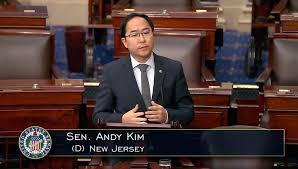

New Jersey’s voice on the Senate floor carried a message that cut through partisan noise and geopolitical rhetoric: Congress must reclaim its constitutional authority before another open-ended Middle East conflict reshapes a generation. Senator Andy Kim rose to demand passage of a bipartisan War Powers Resolution led by Tim Kaine and Rand Paul—a resolution Kim co-sponsors—to end what he called President Donald Trump’s unconstitutional war in Iran.
From the outset, Senator Kim framed the debate not as a clash of personalities, but as a constitutional reckoning. “Let’s be clear, Donald Trump chose this war – but it was not his choice to make,” Kim declared. “It is the American people who deserve to have a say.” The statement reflected a core argument underpinning the War Powers Resolution: that the power to declare war resides with Congress, not the executive branch acting unilaterally.
The stakes of that assertion extend far beyond Washington procedure. For New Jersey families, military communities, and taxpayers, decisions made on the Senate floor translate into deployments, defense spending, and long-term global commitments.
In a state with deep ties to military service and veteran communities, the question of congressional authorization is not abstract—it is personal.
Kim’s remarks were delivered against the backdrop of fresh military strikes in Iran and escalating rhetoric from the White House.
Since the first strikes Saturday morning, he has consistently echoed widespread public concern about entering another prolonged conflict in the Middle East without a defined strategy or explicit congressional authorization. Over the weekend, he expanded on these concerns in a published op-ed detailing what he described as the lasting and dangerous consequences of war in Iran.
“I rise today to give voice to the American people,” Kim said. “It’s the American people who have had their sons and daughters sent to war…It’s the American people whose voice has not been listened to as we woke up yet again this weekend to a new war in the Middle East.”
The senator’s reference to history was deliberate. He invoked parallels to 2003, when President George W. Bush sought congressional approval before launching the Iraq War. Kim argued that even that flawed process at least recognized Congress’s constitutional role. “Unlike 2003,” he said, “President Trump refused to make the case to the American people and refuses to seek approval from Congress for the use of military force.”
The War Powers Resolution before the Senate would require the administration to terminate hostilities in Iran absent explicit congressional authorization. It represents one of the most direct institutional checks available to lawmakers seeking to reassert Article I authority over war-making powers.
Kim’s remarks also scrutinized the administration’s strategic posture. He asserted that no serious diplomatic pathway had been pursued, no robust coalition had been assembled, and no targeted sanctions strategy had been deployed in a manner that distinguished between regime pressure and civilian suffering. In his view, the absence of a clearly articulated endgame creates the conditions for mission creep—a dynamic that defined previous American engagements in the region.
“This morning, the President refused to rule out the use of American ground troops in Iran,” Kim noted, quoting Trump’s remark: “I don’t have the yips with respect to boots on the ground.” For many observers, the possibility of ground forces signaled an escalation beyond limited airstrikes into a potentially protracted conflict. Kim warned that such ambiguity heightens risks for American servicemembers and destabilizes broader regional dynamics.
The senator’s critique extended beyond immediate battlefield considerations. He emphasized the downstream consequences of regime-change efforts and prolonged occupations, referencing the historical costs of Iraq: more than 4,400 American service members killed, tens of thousands wounded, and trillions of dollars expended. For Kim, these figures are not historical footnotes—they are cautionary metrics.
“Donald Trump may think that ‘might makes right,’” Kim stated, “but history proves him wrong.” He argued that military force without a sustainable diplomatic and political framework can erode America’s global credibility, create power vacuums, and ultimately generate new threats.
For New Jersey, the implications intersect with both foreign policy and domestic governance. The state’s economy is intertwined with federal spending priorities, defense contracts, and the broader fiscal landscape shaped by wartime expenditures. Open-ended conflicts reverberate through federal budgets, affecting infrastructure funding, education investments, and social services. In that sense, the constitutional debate over war powers becomes inseparable from economic stewardship.
Sunset Daily News New Jersey’s Politics coverage has consistently examined how federal decisions translate into local impact. This moment exemplifies that dynamic. As the Senate considers the bipartisan resolution, New Jersey’s representation is actively shaping the national conversation. Kim’s leadership positions the state at the forefront of a constitutional debate with profound international ramifications.
The bipartisan nature of the War Powers Resolution is itself notable. In a polarized era, cooperation between Senators Kaine and Paul underscores a rare convergence across ideological lines around constitutional principles. Kim’s co-sponsorship reflects a willingness to prioritize institutional integrity over partisan alignment.
Critics of the resolution argue that limiting executive flexibility could constrain rapid response capabilities in volatile regions. Supporters counter that unchecked authority risks entangling the nation in conflicts lacking public consent or strategic clarity. Kim’s argument centers squarely on democratic accountability: military action of this magnitude, he contends, demands congressional authorization and public debate.
“Trump’s shifting objectives raise questions about when it will be enough,” Kim said, pointing to previous claims that Iranian nuclear capabilities had been “obliterated,” only to resurface as justification for renewed strikes. The concern is not merely rhetorical inconsistency—it is strategic unpredictability.
For veterans and active-duty families across New Jersey, the question of “when it will be enough” carries lived experience. Deployments, repeated tours, and long-term health consequences form part of the human ledger that accompanies foreign policy decisions. Kim’s invocation of these realities seeks to ground the Senate’s deliberations in tangible cost.
The constitutional architecture at the heart of this debate traces back to the War Powers Resolution of 1973, enacted to clarify and constrain presidential authority following the Vietnam War. Over decades, tensions between Congress and successive administrations have persisted, often with limited enforcement. The current resolution represents an attempt to operationalize those statutory guardrails in real time.
As the Senate prepares to vote, the broader political narrative will hinge on whether lawmakers are prepared to reassert congressional prerogatives in matters of war. Kim’s floor speech positions him as a leading voice advocating that course correction.
For New Jersey voters, the issue resonates beyond partisan lines. It touches on service, sacrifice, fiscal responsibility, and constitutional governance. In elevating the War Powers Resolution debate, Senator Kim has reframed the conversation from tactical military calculus to democratic principle.
The coming days will determine whether Congress acts to curtail the administration’s military engagement in Iran or allows executive discretion to prevail. What is clear is that New Jersey’s senior senator has placed himself squarely in the center of a defining foreign policy debate—one that will shape America’s global posture and test the resilience of its constitutional checks and balances.