


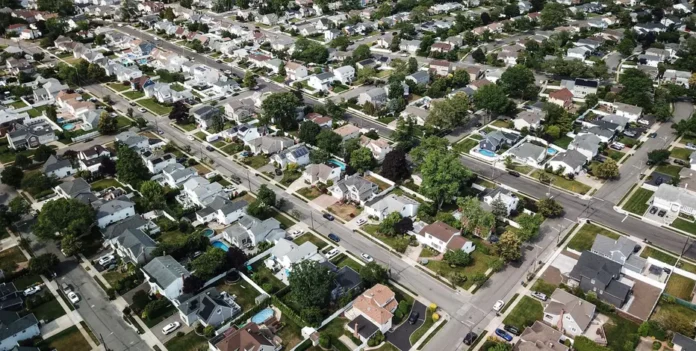

North Jersey’s real estate market entered 2026 navigating a complex mix of stabilizing home prices, slowly improving inventory levels, and a mortgage rate environment that is beginning to tilt cautiously back in favor of buyers. February’s housing data paints a picture of a market that is no longer experiencing the intense volatility that defined the immediate post-pandemic years, but one that is still working through structural supply challenges that continue to shape the state’s housing landscape.
Across New Jersey—and particularly throughout the densely populated counties of North Jersey—the housing market in February remained broadly consistent with trends that have been developing over the past year. Inventory levels are gradually increasing compared with the same period last year, but the pace of that recovery has slowed considerably. At the same time, home prices are showing signs of stabilization rather than the dramatic increases that characterized the market during the early 2020s.
What is emerging is a housing environment defined by cautious equilibrium: buyers are beginning to regain leverage, sellers are adjusting expectations, and mortgage rates have reached a three-year low, potentially signaling the start of a more balanced market cycle.
February’s data reveals that the number of homes available for sale across the United States continued to grow for the 28th consecutive month. Active housing inventory nationwide rose 7.9 percent compared with the same time last year. However, the speed of that growth has been slowing steadily for nine straight months, indicating that the inventory rebound may be leveling off.
Even with nearly two and a half years of incremental increases, the national housing supply still remains well below historical norms. Current inventory levels sit roughly 16.8 percent below pre-pandemic benchmarks, underscoring the long-term supply shortage that continues to shape the American housing market.
In New Jersey, February’s housing statistics reflect many of those same national patterns while also highlighting unique characteristics of the state’s high-demand real estate environment.
The Garden State recorded 13,201 active residential listings during February. That represents an 11.39 percent increase compared with the same period in 2025, suggesting that more homeowners are gradually entering the market after several years of tight inventory conditions.
However, the month-to-month data tells a more nuanced story. Active listings actually declined slightly from January 2026, falling 2.93 percent as the winter season continued to influence listing activity. Seasonal slowdowns are typical during the early months of the year, with inventory levels often rising again as the spring home-buying season approaches.
Within those overall numbers, 6,476 homes were newly listed for sale across New Jersey during February. The steady appearance of new listings reflects the typical seasonal rhythm of the housing market, where early-year inventory growth builds momentum ahead of the highly competitive spring and summer buying seasons.
While supply has begun to inch upward, demand across North Jersey remains resilient. The region’s proximity to New York City, strong employment base, and highly regarded suburban communities continue to drive sustained interest from both in-state and out-of-state buyers.
Housing affordability, however, remains a central challenge.
The median listing price for homes across New Jersey stood at $529,000 in February. That figure represents a 2.93 percent decrease compared with the same period last year, suggesting that the explosive price increases of recent years are beginning to moderate.
Yet on a month-to-month basis, the median listing price actually rose slightly—up 2.02 percent compared with January—illustrating the delicate balance between supply and demand currently shaping the market.
In practical terms, the numbers suggest that while home prices are no longer accelerating rapidly, they are not falling dramatically either. Instead, the market is settling into a phase of relative price stability.
One indicator that the market is adjusting is the rising number of price reductions.
During February, 2,210 New Jersey listings saw their asking prices reduced. That represents an 8.76 percent increase compared with last year and a striking 19.59 percent increase compared with January.
Price reductions often signal that sellers are adapting to evolving buyer expectations, particularly in markets where affordability concerns have constrained demand.
Buyers who spent much of the past several years navigating bidding wars and rapidly escalating prices may now be encountering slightly more negotiating power.
Another sign of shifting dynamics can be seen in the time homes are spending on the market.
Across the United States, properties remained listed for roughly 70 days on average during February—four days longer than the same time last year. That marks the 23rd consecutive month in which homes have taken longer to sell on a year-over-year basis.
In New Jersey specifically, homes remained on the market for approximately 45 days before going under contract.
Although still relatively fast compared with historical norms, the gradual increase in market time indicates that the frenzy of pandemic-era home buying has cooled.
For buyers who previously faced intense competition and lightning-fast sales cycles, the extra time on the market provides an opportunity to evaluate properties more carefully and negotiate purchase terms.
Perhaps the most significant development influencing the February housing landscape is the movement of mortgage interest rates.
Mortgage rates have recently dropped to their lowest level in three years, offering a potentially meaningful shift in affordability for prospective buyers.
Lower borrowing costs can dramatically affect purchasing power, enabling buyers to qualify for larger loans or reduce monthly payments on existing price levels.
For many buyers who paused their home search during periods of higher interest rates, this change could reignite activity as the 2026 spring housing season begins.
Real estate professionals across North Jersey are closely watching how this development may influence buyer behavior in the coming months.
If mortgage rates remain stable or continue to decline, the combination of slightly higher inventory and improved financing conditions could lead to a more active market during the second quarter of the year.
North Jersey’s housing market has long been defined by strong demand driven by several key factors.
The region offers direct access to New York City employment centers, extensive commuter rail and highway networks, top-rated school systems, and a diverse mix of suburban and urban communities.
These advantages have historically supported home values even during periods of broader national housing volatility.
Cities such as Jersey City, Hoboken, and Newark continue to attract buyers seeking proximity to Manhattan, while suburban towns throughout Bergen, Essex, Morris, and Passaic counties remain highly desirable for families seeking space, schools, and neighborhood amenities.
At the same time, new residential development and redevelopment projects are gradually expanding housing supply in certain areas, particularly along transit corridors and within mixed-use redevelopment zones.
Many of these developments are part of broader urban planning strategies designed to accommodate population growth while revitalizing downtown districts and transportation hubs.
Throughout New Jersey, real estate activity continues to intersect with infrastructure investment, transportation expansion, and commercial development.
Projects highlighted across the region’s real estate landscape—including those covered within the evolving property market insights on the Sunset Daily News real estate section—illustrate how housing, economic development, and regional planning are increasingly interconnected.
For homeowners considering selling their properties, the current market conditions offer a mixed but potentially favorable environment.
Inventory levels are still historically constrained, meaning well-priced homes in desirable neighborhoods continue to attract attention.
At the same time, buyers are demonstrating greater selectivity, which means sellers must pay close attention to pricing strategy, property condition, and marketing presentation.
For buyers, February’s data provides cautious optimism.
More listings are gradually becoming available, price growth is stabilizing, and lower mortgage rates may improve affordability for those who have been waiting for a more favorable entry point into the market.
The coming months will likely provide clearer signals about where the market is headed.
As spring approaches, real estate activity traditionally accelerates across North Jersey and the broader metropolitan region.
If inventory levels continue to grow modestly while borrowing costs remain favorable, 2026 could mark the beginning of a more balanced housing market—one in which buyers and sellers operate on more equal footing than they have in recent years.
For now, February’s data shows a market in transition.
North Jersey’s housing sector is no longer experiencing the rapid escalation that once defined the post-pandemic boom, but it remains resilient, competitive, and central to the economic vitality of New Jersey.
With mortgage rates falling, inventory gradually improving, and demand continuing to flow into the region, the next phase of the Garden State’s real estate cycle is beginning to take shape.