


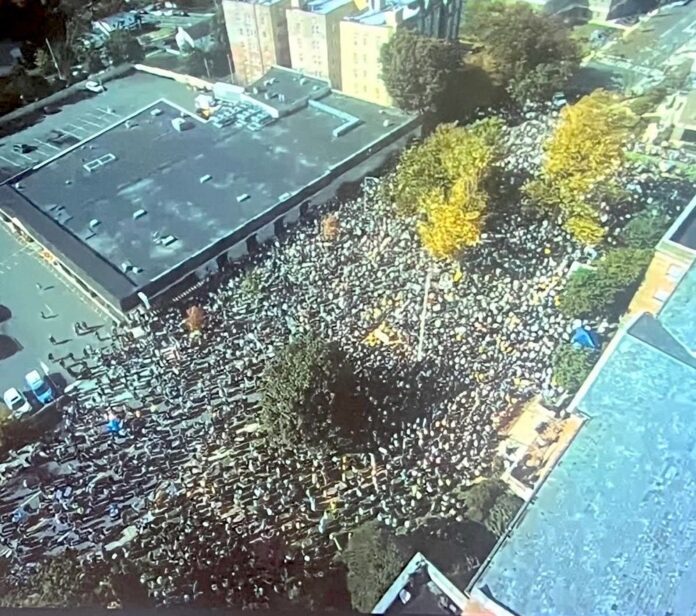

New Jersey is emerging today as one of the most active and visibly engaged states in a sweeping national day of protest, as more than 65 coordinated rallies and marches unfold from Bergen County to the southern shoreline under the banner of “No Kings! III.” What began as a loosely organized response to growing concerns over executive authority has now evolved into a fully scaled, highly coordinated civic mobilization, drawing tens of thousands of participants into streets, parks, and town centers across the Garden State. From major urban corridors like Newark and Jersey City to suburban hubs and smaller municipalities, the breadth and density of today’s demonstrations reflect a moment that is as much about political identity as it is about policy, governance, and the future direction of American democracy.
The movement behind today’s actions is not spontaneous, but rather the product of an expanding coalition of advocacy organizations that have steadily built infrastructure, messaging discipline, and grassroots reach over the past several election cycles. Anchored by nationally recognized progressive networks, the “No Kings” coalition has framed its mission around what organizers describe as resistance to centralized executive power, a defense of institutional checks and balances, and a broader push for civic accountability. In New Jersey, that message has resonated across a diverse cross-section of communities, producing one of the most geographically widespread protest turnouts the state has seen in recent years.
The largest gatherings have anchored themselves in key population centers, with Newark serving as a focal point for North Jersey. A major march beginning at the Lincoln Statue on Springfield Avenue drew early crowds that quickly expanded into a sustained afternoon presence, blending organized speeches, coordinated chants, and visible signage that underscored the protest’s central themes. In Morristown, demonstrators assembled at Town Hall, transforming a traditionally civic space into an active platform for political expression, while in Jersey City, a later rally at Berry Lane Park is expected to draw continued participation well into the afternoon and early evening.
Across Central and South Jersey, the scale of engagement has been equally notable. Trenton, as the state’s political epicenter, has seen consistent turnout near government buildings, reinforcing the symbolic connection between protest activity and legislative oversight. In Camden, Roosevelt Plaza Park has become a gathering point for participants seeking to align local concerns with national discourse, while additional events in Atlantic City, Lacey Township, and Rahway extend the day’s footprint into coastal and suburban regions. Evening visibility actions, including a scheduled demonstration in Secaucus, ensure that the momentum of the day will carry beyond daylight hours.
What distinguishes today’s mobilization is not only the size of individual events, but the density of participation across smaller municipalities that are often absent from large-scale protest narratives. Towns such as Teaneck, Weehawken, Paramus, Bloomfield, Glen Ridge, Princeton, Highland Park, Glassboro, and Ocean City are all hosting their own rallies, signaling a level of distributed engagement that reflects deep organizational reach. These localized demonstrations, while smaller in scale, contribute to a broader statewide presence that amplifies the movement’s visibility and reinforces its claim to represent a wide-ranging constituency.
At the core of the debate surrounding today’s protests is a fundamental disagreement over the role and limits of executive power. Organizers have framed the demonstrations as a necessary response to what they characterize as overreach, positioning the movement within a larger national conversation about constitutional norms, institutional independence, and democratic accountability. Participants on the ground are articulating a range of concerns that extend beyond a single policy or directive, encompassing issues such as electoral integrity, judicial independence, civil liberties, and the balance of power between federal branches.
At the same time, the protests are unfolding within a politically complex environment, particularly in a state like New Jersey where diverse ideological perspectives coexist within close geographic proximity. For some residents, the demonstrations represent a critical exercise of First Amendment rights and civic participation, reinforcing the state’s longstanding tradition of political engagement. For others, the scale and tone of the protests raise questions about polarization, the effectiveness of public demonstrations in shaping policy, and the broader trajectory of political discourse in the United States.
Law enforcement agencies and municipal officials across New Jersey have spent the past several days preparing for the logistical demands of such a widespread mobilization. Traffic management, public safety coordination, and crowd control measures have been implemented in major event zones, with an emphasis on maintaining orderly conditions while respecting the rights of participants. Early reports from across the state indicate that events have proceeded largely without incident, reflecting both effective planning and the generally peaceful nature of the gatherings.
The timing of “No Kings! III” is also significant, arriving at a moment when political energy is building ahead of key electoral cycles and legislative debates. Movements of this scale often serve as both a barometer and a catalyst, capturing existing sentiment while also shaping future engagement strategies among advocacy groups, political campaigns, and policy stakeholders. In New Jersey, where voter participation and civic activism have historically played a decisive role in shaping statewide outcomes, today’s events are likely to reverberate beyond the immediate moment.
From a strategic perspective, the distributed nature of today’s protests offers insight into how modern political movements are evolving. Rather than concentrating exclusively in major cities, organizers have prioritized simultaneous actions across a wide geographic area, leveraging digital coordination tools and local networks to maximize reach. This approach not only increases visibility but also lowers barriers to participation, enabling individuals to engage within their own communities rather than traveling long distances to centralized events.
As the day continues to unfold, the full scope of participation and its potential impact will become clearer. What is already evident, however, is that New Jersey has positioned itself at the center of a national moment, demonstrating both the scale and intensity of contemporary civic engagement. Whether viewed as a powerful expression of democratic participation or as a reflection of deepening political divisions, the “No Kings! III” protests represent a defining snapshot of where the public conversation stands today—and where it may be headed next.
For continued coverage of political developments shaping New Jersey and the broader national landscape, readers can explore ongoing reporting in the Politics section of Sunset Daily News, where the intersection of policy, public sentiment, and real-time events is examined with depth, clarity, and a focus on what it means for communities across the state.



