


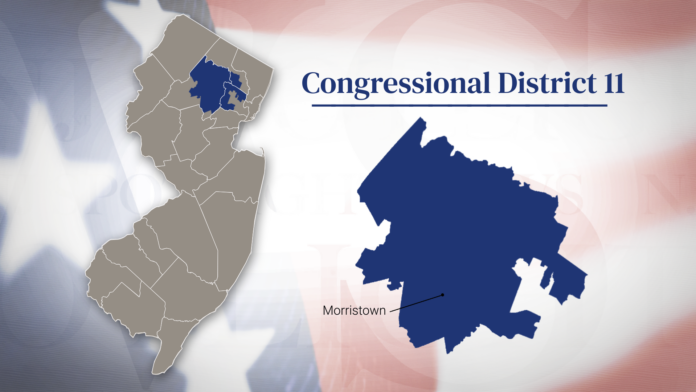

New Jersey’s 11th Congressional District is once again at the center of a consequential political moment, as voters prepare to decide who will fill a vacant seat in a special election scheduled for April 16. What might otherwise be a routine off-cycle contest has quickly evolved into something far more significant, a live referendum on political messaging, party alignment, and the direction of voter sentiment in a state that has long served as a microcosm of national political trends. As highlighted in a recent feature on NJ Spotlight News, journalist Joanna Gagis brings into focus a race that is drawing attention well beyond district lines, with Republican Joe Hathaway and Democrat Analilia Mejia stepping into a contest that carries implications extending into 2027 and beyond. Watch Now!
The stakes are unusually high for a seat that will be held for less than two years. The winner of this April election will serve through January 2027, but the symbolic and strategic value of the outcome is immediate. For Republicans, it represents an opportunity to extend momentum following recent electoral gains and reinforce a narrative of continued expansion into districts that were once considered reliably Democratic. For Democrats, it is a test of whether recalibration efforts are taking hold, or whether the same vulnerabilities that surfaced in recent cycles continue to persist in real time.
The 11th District itself is uniquely positioned for this kind of political confrontation. Historically competitive, with a mix of suburban voters, working families, and highly engaged civic communities, the district reflects the evolving priorities of a broader electorate that is increasingly less predictable and more responsive to immediate concerns. This is not a district where messaging can rely on legacy assumptions. It demands precision, clarity, and an ability to connect directly with voters who are evaluating candidates not just on ideology, but on perceived effectiveness and relevance.
Joe Hathaway enters the race with a campaign that is centered on directness and clarity, two attributes that have become increasingly valuable in a fragmented media environment. His approach reflects a broader Republican strategy that prioritizes concise communication, strong positioning on economic and public safety issues, and a willingness to engage in high-visibility media spaces where voters are already paying attention. This is not incidental. It is strategic, and it aligns with a larger pattern of candidates who understand that visibility and message discipline are now inseparable from electoral success. Watch Now!
Analilia Mejia, representing the Democratic side of the race, carries a different set of expectations, along with the weight of a party that is actively working to reestablish alignment with key voter blocs. Her campaign is operating within a context that requires more than traditional outreach. It requires a recalibration of how issues are framed, how priorities are communicated, and how authenticity is conveyed in an environment where voters are increasingly skeptical of political language that feels disconnected from their daily experience.
What makes this race particularly compelling is not just the contrast between the candidates, but the broader narrative it represents. This is not simply a contest between two individuals. It is a real-time test of competing theories about what voters are responding to in 2026. Are they prioritizing economic messaging above all else, or are broader social and institutional themes still resonating? Are they rewarding clarity and decisiveness, or are they still open to more layered, policy-driven communication? These are not abstract questions. They are being answered, in measurable terms, through voter turnout and ballot choices.
The timing of the election adds another layer of urgency. Special elections often serve as early indicators of political momentum, offering insights into how parties are performing outside the traditional November cycle. They can reveal shifts in enthusiasm, engagement, and organizational effectiveness that are not always visible in polling alone. For New Jersey’s 11th District, this means that April 16 is not just about filling a seat. It is about signaling direction. Watch Now!
The role of media coverage in shaping this moment cannot be overlooked. Platforms like NJ Spotlight News provide a critical space for candidates to articulate their positions and for voters to evaluate those positions in a structured format. Joanna Gagis’s conversation with Hathaway and Mejia underscores the importance of direct engagement, where candidates are required to move beyond campaign slogans and address the specific concerns of the district. In an era where soundbites often dominate, these longer-form discussions offer a clearer view into how candidates think, how they respond under pressure, and how effectively they communicate their priorities.
For voters in the 11th District, the decision ahead is both immediate and consequential. The individual they choose will represent them in Congress for the remainder of the term, but the implications of that choice extend further. It will influence how each party approaches future races, how resources are allocated, and how messaging strategies are refined in the months leading up to larger electoral contests.
This is where the race transcends its geographic boundaries. Political observers across the state, and indeed across the country, are watching closely. The outcome will be analyzed not just for who wins, but for how they win, which messages resonated, which strategies proved effective, and which assumptions were challenged.
New Jersey has long been a proving ground for political narratives, a place where national trends are tested against local realities. The 11th Congressional District special election is the latest chapter in that ongoing story, one that continues to evolve with each cycle. As April 16 approaches, the focus sharpens, the messaging intensifies, and the voters ultimately decide which vision aligns most closely with their expectations.
In a political environment defined by rapid shifts and heightened scrutiny, one thing remains constant. Elections are the clearest expression of voter intent. And in New Jersey’s 11th District, that expression is about to take center stage. Watch Now!