



Unfinished Count Keeps NJ-11 in Limbo as Voters and Campaigns Await Final Democratic Primary Results
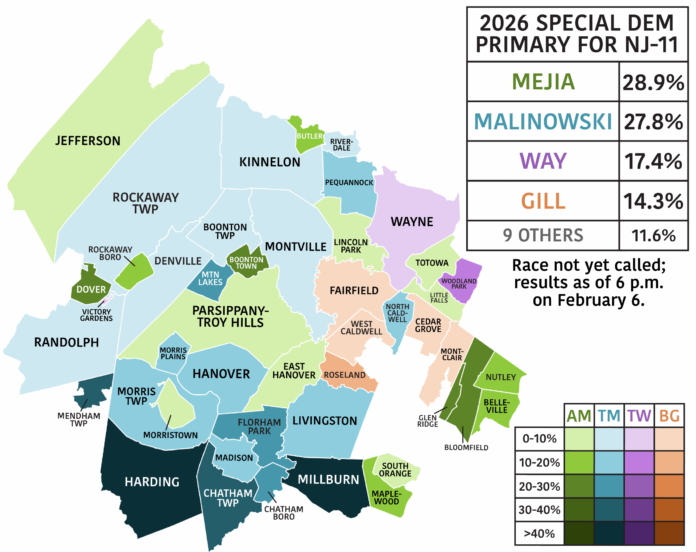
The race to determine the Democratic nominee for New Jersey’s 11th Congressional District remains unresolved, with election officials continuing to count ballots days after polls closed in a contest that has emerged as one of the closest and most closely watched congressional primaries in the state this cycle.
The open seat, previously held by Mikie Sherrill, has drawn intense attention from party leaders, national strategists and voters across Morris, Essex and Passaic counties, where turnout exceeded many early projections and placed immediate pressure on local election boards to process a high volume of ballots.
As of February 6 through February 8, the margin separating the leading Democratic candidates remains razor thin, leaving the outcome officially too close to call and prolonging uncertainty for both campaigns and party officials preparing for the general election.
According to officials overseeing the tabulation process, thousands of votes remain under review, including mail-in ballots postmarked by Election Day, provisional ballots cast by voters whose eligibility must still be verified, and ballots requiring standard curing procedures. Each category must be carefully examined before final totals can be certified, a process that is now central to determining who will advance as the Democratic standard-bearer in one of New Jersey’s most politically influential districts.
The delay has placed the NJ-11 contest at the center of broader statewide political conversation, with analysts closely tracking how prolonged ballot processing may shape future election administration and campaign strategy in competitive districts. More ongoing coverage of New Jersey elections and public affairs can be found in Sunset Daily News’ dedicated politics reporting.
The primary is being watched well beyond district boundaries, in part because NJ-11 has long served as a bellwether for shifting suburban voting patterns. The district’s changing demographics and evolving priorities have made it a focal point for party leaders attempting to refine messaging on economic stability, public safety, education funding and infrastructure investment.
Campaigns involved in the tight race have maintained public confidence in the counting process while simultaneously preparing for every possible scenario. Staff members continue to monitor daily updates from county election offices, while legal and compliance teams stand ready should recount thresholds be triggered once unofficial results are finalized.
Election administrators emphasize that the slow pace is not the result of irregularities but of standard safeguards built into New Jersey’s voting system. Provisional ballots must be cross-checked against voter registration databases, signature verification must be completed for vote-by-mail submissions, and any ballot requiring voter correction must follow strict timelines before it can be added to the official total.
For voters across the district, the uncertainty has extended an already emotionally charged election season. Community groups, local party organizations and civic leaders have continued urging patience as officials work through what they describe as an unusually complex post-election review period.
The significance of this race is amplified by the political weight carried by the seat itself. NJ-11 has been a major voice in federal discussions affecting transportation funding, economic development and public safety initiatives tied directly to North Jersey communities. With the district set to send a new representative to Washington, the identity of the Democratic nominee is expected to play a decisive role in shaping policy priorities for the region over the next several years.
Political observers note that the extremely narrow margin between the candidates highlights how deeply competitive the primary field became in the final weeks of campaigning. Both contenders invested heavily in voter outreach, digital advertising and ground operations, particularly targeting independent-leaning Democratic voters and high-turnout suburban precincts that ultimately proved decisive.
The continuing count has also renewed debate around election logistics in densely populated counties, where mail-in participation remains high and provisional ballot usage has increased steadily since the pandemic-era expansion of alternative voting options. State and county officials have acknowledged that while these systems have broadened access, they also require more time-intensive post-election verification.
At this stage, no timeline has been set for a final certified result. Election officials caution that certification can only occur after every outstanding ballot category is processed and all statutory review requirements are met.
Until then, the future of the Democratic nomination in New Jersey’s 11th Congressional District remains unsettled — and one of the most closely monitored unresolved races in the state as the 2026 election cycle continues to take shape.



