


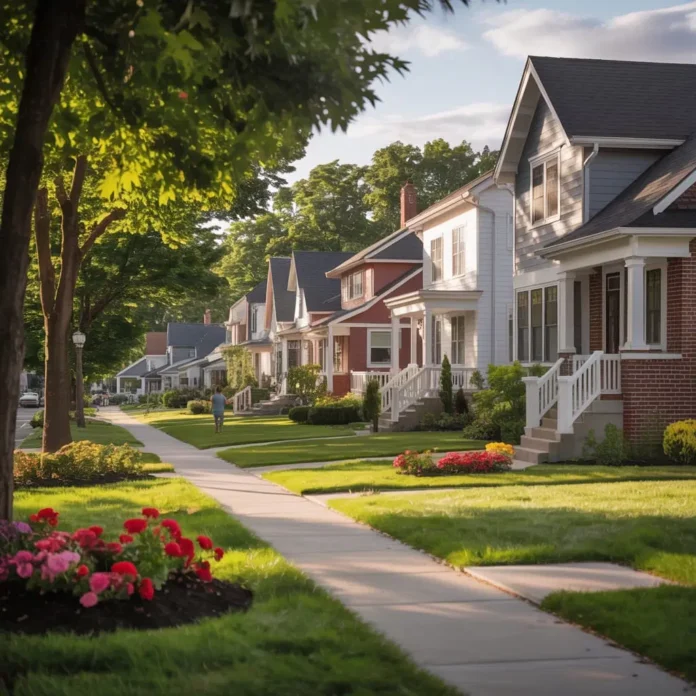

The U.S. housing market has entered what many economists are now calling a “two-speed” phase—an environment where some regions are cooling while others continue to accelerate. Across much of the country, price growth has slowed to modest levels, reflecting the combined pressures of high mortgage rates, affordability challenges, and limited inventory. Yet in the Northeast, the story is dramatically different.
New Jersey is now emerging as one of the strongest housing markets in the United States, leading the nation in annual home price growth and demonstrating remarkable resilience in an otherwise uneven national landscape. New data shows that home prices in the Garden State climbed approximately 5.6 percent year over year, placing New Jersey among the top-performing real estate markets in the country.
This surge is not happening in isolation. Connecticut has also joined New Jersey among the country’s fastest-appreciating housing markets, reinforcing a broader trend across the Northeast where limited supply, strong employment centers, and renewed urban investment are driving sustained demand.
While national home price growth averaged roughly 0.7 percent, the Northeast—particularly New Jersey—has dramatically outpaced the broader housing market. For buyers, sellers, developers, and investors, the implications are enormous.
The forces reshaping the Garden State’s real estate landscape reveal a deeper transformation that is unfolding across metropolitan corridors like Newark, Jersey City, Camden, and surrounding communities.
New Jersey’s Housing Market Defies National Slowdown
Across the United States, the housing market is adjusting after the rapid pandemic-era surge in prices. Mortgage rates remain elevated compared to historic lows, and many regions are seeing slower appreciation or even price stabilization.
But in New Jersey, the dynamics look fundamentally different.
Home prices statewide now carry a median listing price approaching $520,000, a figure that reflects the strong demand for housing near major employment centers, transportation networks, and urban revitalization zones.
Unlike some parts of the country where price growth has stalled, New Jersey continues to experience competitive bidding environments and strong buyer interest.
The factors driving this strength are both structural and regional.
Demand for housing near New York City and Philadelphia remains extremely high, particularly as professionals continue to seek homes that offer proximity to employment centers while delivering greater affordability and quality of life than neighboring urban cores.
At the same time, the state’s limited housing inventory continues to exert upward pressure on prices. Fewer homes on the market mean that buyers often find themselves competing for a small pool of available properties.
When desirable homes appear, the result is often a rapid escalation of offers.
In many cases, homes priced competitively are selling above asking price within days of listing.
Newark: The Epicenter of a New Real Estate Boom
Few cities illustrate New Jersey’s real estate momentum more clearly than Newark.
The city, long viewed as an underappreciated real estate market with significant long-term potential, is now experiencing a wave of investment, redevelopment, and buyer demand that is transforming the local housing market.
Real estate professionals describe the pace of activity in Newark as extraordinary.
One recent listing for a Newark home priced at $750,000 attracted seven offers almost immediately, with the winning bid climbing to $850,000.
Stories like this are becoming increasingly common across the city.
Buyers ranging from first-time homeowners to institutional investors are recognizing Newark’s unique combination of proximity to Manhattan, extensive transportation infrastructure, expanding cultural amenities, and major redevelopment initiatives.
Projects such as the Lionsgate film and television studio complex are injecting new energy into the city’s economic future, bringing creative industry jobs and reinforcing Newark’s role as one of the Northeast’s most exciting urban growth centers.
As a result, neighborhoods that once attracted primarily local buyers are now drawing attention from across the broader metropolitan region.
This momentum is transforming Newark from a secondary housing option into a central player in the region’s real estate future.
Metro-Driven Demand Fuels North Jersey Growth
The broader North Jersey region continues to benefit from powerful economic fundamentals that support long-term housing demand.
The state’s strategic location within the New York metropolitan area places millions of jobs within commuting distance of communities across Essex, Hudson, Bergen, and Union counties.
For professionals who work in Manhattan but seek more attainable housing options, New Jersey offers an appealing alternative.
Cities such as Jersey City, Hoboken, and Newark have evolved into dynamic urban environments with growing residential populations, thriving restaurant scenes, expanding cultural districts, and direct rail connections to New York City.
This transformation has been documented extensively in regional real estate coverage, including ongoing market analysis featured in the Sunset Daily News real estate section, where evolving trends across the Garden State’s housing landscape are regularly explored in depth through reporting and commentary on the state’s most significant development corridors.
As housing demand continues to spill outward from major metro areas, suburban and secondary markets are also seeing increased attention.
Communities that were once considered relatively affordable are now emerging as new hotspots for buyers seeking value while remaining within commuting distance of major employment centers.
Supply Constraints Keep Pressure on Prices
One of the defining forces behind New Jersey’s housing surge remains a persistent shortage of inventory.
For years, housing construction has struggled to keep pace with population growth and demand across the region.
The result is a structural imbalance between the number of buyers seeking homes and the number of properties available on the market.
In many communities, homes priced below $1 million are particularly scarce.
This scarcity often triggers competitive bidding situations that push final sale prices above listing levels.
The shortage of inventory also extends into higher-end markets, where luxury homes in desirable communities continue to attract strong demand from buyers relocating from New York City and other major metropolitan areas.
For developers and investors, these dynamics create both opportunity and pressure.
New housing construction has the potential to relieve supply constraints, but regulatory hurdles, zoning limitations, and construction costs often slow the pace of development.
As a result, demand frequently outpaces new supply.
This imbalance is likely to remain a defining feature of the New Jersey housing market for years to come.
Camden and South Jersey Join the Momentum
While North Jersey markets often dominate the headlines, South Jersey is also experiencing growing interest from homebuyers and investors.
Cities such as Camden are benefiting from renewed investment and strategic redevelopment efforts that are reshaping the region’s economic outlook.
Proximity to Philadelphia, combined with lower home prices compared to northern counties, is drawing buyers seeking affordability without sacrificing access to major job centers.
As infrastructure improvements and economic development initiatives continue to take shape, South Jersey markets may increasingly mirror the growth patterns seen in Newark and other northern cities.
For buyers priced out of North Jersey’s hottest neighborhoods, South Jersey represents a compelling alternative.
The Two-Speed Housing Market Explained
The concept of a “two-speed” housing market reflects the growing divergence between regions experiencing strong price growth and those where housing activity has slowed.
In slower markets—often in parts of the South and West—higher mortgage rates have cooled buyer demand and limited price appreciation.
But in supply-constrained markets like New Jersey, housing demand remains intense.
The limited availability of homes ensures that even modest increases in demand can trigger sharp price movements.
This dynamic explains why the Northeast continues to outperform national averages in housing appreciation.
For real estate professionals, the trend underscores the importance of understanding regional market conditions rather than relying solely on national statistics.
While the broader housing market may appear to be stabilizing, local markets such as Newark, Jersey City, and Camden are continuing to experience rapid growth.
What This Means for Buyers and Sellers
For sellers, the current environment presents significant opportunities.
Well-priced homes in desirable neighborhoods are often attracting multiple offers, allowing sellers to negotiate from a position of strength.
For buyers, however, the market remains challenging.
Limited inventory means that buyers must often move quickly and be prepared to compete in bidding situations.
Financial readiness, strong pre-approval credentials, and flexible offer terms can make the difference between securing a property and losing out to competing buyers.
Real estate agents across the state increasingly emphasize the importance of preparation and strategic negotiation in today’s competitive environment.
Looking Ahead: The Future of New Jersey Real Estate
The outlook for New Jersey’s housing market remains strong.
Population shifts, urban revitalization, infrastructure investment, and sustained economic activity continue to support long-term housing demand.
At the same time, the state’s strategic position between New York City and Philadelphia ensures that it will remain one of the most desirable real estate regions in the Northeast.
Cities like Newark are redefining their role in the regional economy, while suburban and emerging markets across the state continue to attract new residents seeking opportunity and stability.
The combination of strong demand, limited supply, and ongoing redevelopment is creating a housing environment that is unlike anything the state has seen in decades.
As the national housing market moves through its next phase, New Jersey appears poised not only to weather the shifts but to lead them.
For homeowners, investors, and residents alike, the Garden State’s real estate market is entering a new chapter—one defined by growth, transformation, and opportunity across every corner of the state.



