


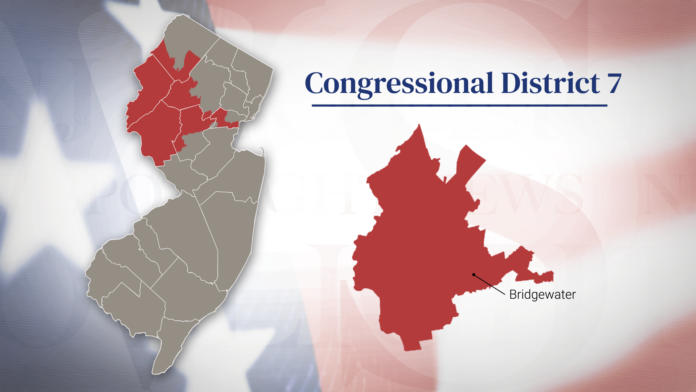

The political landscape in New Jersey’s 7th Congressional District has entered a decisive new phase, as the candidate field consolidates and the contours of one of the nation’s most closely watched House races begin to sharpen. Following the latest filing deadline, two Democratic contenders have exited the race, transforming what was once a crowded and fluid contest into a more focused battle among a smaller group of candidates now vying for the opportunity to challenge incumbent Republican Thomas Kean Jr. in November.
Stretching across Hunterdon, Morris, Somerset, Sussex, Union, and Warren counties, CD-7 remains a district defined by geographic diversity and political complexity. It is a region where suburban growth, rural identity, and commuter economics intersect, creating a competitive environment that has consistently drawn national attention. While the district leans Republican by a measurable margin, recent election cycles have demonstrated that it remains firmly in play under the right conditions, making the Democratic primary not just a procedural step, but a strategic proving ground for viability in a general election.
The departure of Beth Adubato and Megan O’Rourke marks a turning point in the race. Adubato’s campaign never fully gained traction, hampered by limited engagement and an inconsistent presence across key county conventions. O’Rourke’s exit, however, carries more strategic weight. A climate scientist with a professional background shaped by federal service, she positioned herself as a candidate capable of bridging ideological and geographic divides within the district. Her emphasis on rural engagement and agricultural concerns signaled an effort to expand Democratic appeal into traditionally Republican-leaning areas such as Warren County. Despite securing a local endorsement, her campaign ultimately failed to achieve the organizational momentum required to sustain a district-wide operation, culminating in her decision not to file the necessary nominating petition.
With those departures, the Democratic field has effectively crystallized around a smaller group of contenders, each bringing a distinct profile and pathway to potential nomination. Among them, Rebecca Bennett has emerged as a formidable presence, consolidating institutional support across multiple counties. Her endorsements from Hunterdon, Morris, Somerset, and Union counties represent a significant organizational advantage, providing both structural backing and a signal of confidence from party leadership. Bennett’s background as a former Navy helicopter pilot introduces a narrative of service and discipline that has proven electorally resonant in New Jersey politics, inviting comparisons to prior successful candidates who leveraged similar credentials to build broad-based appeal.
Brian Varela, meanwhile, has carved out a different lane, emphasizing visibility, grassroots engagement, and a willingness to confront contentious issues directly. Based in Long Valley, Varela has been a consistent presence at rallies and demonstrations, particularly those centered on immigration enforcement and local concerns surrounding federal detention infrastructure. His campaign has leaned into a message of accessibility and responsiveness, positioning him as a candidate willing to engage where others may not. With O’Rourke’s departure, Varela has also gained additional support in Warren County, strengthening his foothold in a region that often plays a pivotal role in district-wide outcomes.
Michael Roth represents yet another dimension of the race, combining policy experience with a message centered on momentum and electability. A former official with the U.S. Small Business Administration, Roth has highlighted his near-win at the Morris County convention as evidence of growing support and organizational strength. Securing approximately 48 percent of the vote in that contest, he has framed his campaign as one on the rise, emphasizing grassroots energy and the ability to compete effectively in one of the district’s most influential counties. His messaging reflects a broader effort to position himself as both a pragmatic policymaker and a candidate capable of unifying disparate factions within the party.
Also remaining in the race is Tina Shah, an ICU physician from Westfield, whose candidacy underscores the diversity of professional backgrounds represented in the field. While she has yet to secure significant institutional endorsements, her continued presence introduces an additional variable into a race that, while narrowing, remains dynamic. In a district where voter sentiment can shift rapidly, particularly in response to national developments, even candidates without early organizational advantages can find opportunities to gain traction as the campaign progresses.
The evolving Democratic primary is unfolding against the backdrop of an incumbent who has demonstrated a consistent electoral strategy centered on discipline and message control. Kean’s approach, characterized by limited media engagement and a focus on targeted voter outreach, has proven effective in prior cycles. In a district with a Republican registration advantage of roughly 20,000 voters, that strategy has allowed him to secure victories without overexposure, maintaining a controlled narrative while avoiding the risks associated with high-profile public confrontations.
However, the broader political environment continues to introduce new variables into the equation. Issues such as immigration policy, federal infrastructure decisions, and economic pressures are increasingly shaping voter priorities across CD-7. Local debates, including concerns surrounding proposed federal facilities and their impact on communities, have begun to intersect with national political dynamics, creating a layered context in which the eventual Democratic nominee will need to operate. The ability to translate local engagement into district-wide resonance will likely prove निर्णative in determining not only the outcome of the primary, but the competitiveness of the general election.
As the June 2 primary approaches, the race is transitioning from a phase of exploration to one of consolidation and contrast. Candidates are no longer simply introducing themselves; they are defining their differences, refining their messages, and building the coalitions necessary to secure victory in a district that demands both breadth and depth of support. Organizational strength, geographic reach, and narrative clarity are emerging as the key metrics by which campaigns will be judged in the weeks ahead.
For New Jersey and for national observers, CD-7 remains a district to watch—not only because of its competitive history, but because of what it represents in the broader political landscape. It is a microcosm of the challenges facing both parties: how to connect with diverse constituencies, how to navigate shifting voter expectations, and how to translate policy positions into electoral success. With the field now more clearly defined, the race has entered its most consequential stage, setting the stage for a contest that will carry implications well beyond the boundaries of the district itself.