


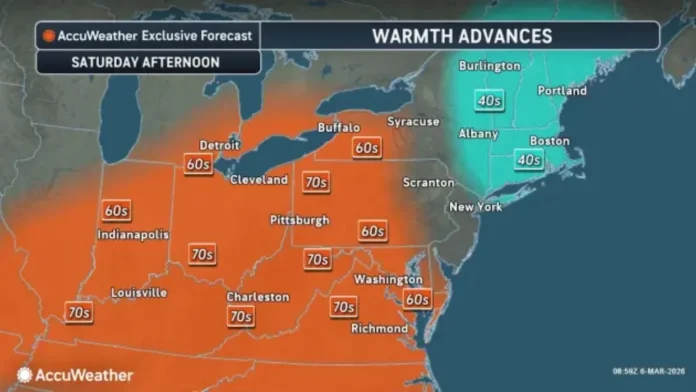

New Jersey is experiencing a dramatic early-March weather transition this weekend, shifting from gray skies, damp conditions, and lingering fog into a stretch of unseasonably warm temperatures that could push the Garden State into the 70s by early next week. For residents across North, Central, and South Jersey, the coming days represent a classic example of what meteorologists often describe as a “false spring”—a brief burst of warm weather that arrives before winter fully loosens its grip on the region.
The evolving forecast highlights the dynamic nature of early March weather across the Mid-Atlantic and Northeast. As winter’s last remnants fade and atmospheric patterns begin to reorganize for the spring season ahead, New Jersey’s climate is moving through a transitional phase marked by rapid temperature swings, shifting fronts, and increasingly mild conditions.
The weekend began under gray and damp skies, with patchy fog and drizzle lingering across much of the state throughout Saturday. Visibility remained limited in some areas, particularly along coastal communities and the Jersey Shore where earlier dense fog advisories prompted caution for drivers navigating roadways during the morning hours.
Across North Jersey, temperatures struggled to climb out of the upper 40s to around 50 degrees during the day, reinforcing the lingering chill from the previous cold pattern. Meanwhile, residents in Central and South Jersey experienced slightly milder conditions, with afternoon highs reaching the mid-50s and some locations briefly approaching the low 60s.
Despite the gloomy start, the weather pattern is already shifting.
A warm front advancing toward the region is gradually altering atmospheric conditions across the state. As the system moves through, temperatures are expected to actually rise overnight Saturday into early Sunday—an unusual but not uncommon occurrence during spring transition periods.
Later Saturday evening and into the early overnight hours, a line of showers accompanied by isolated thunderstorms is expected to sweep through New Jersey. Meteorologists anticipate this band of precipitation will pass through the state roughly between 9:00 p.m. and 2:00 a.m., ahead of a cold front moving across the broader Mid-Atlantic region.
While the storms are not expected to be severe, the passing showers will mark the final stage of the current damp weather pattern before the warmup begins.
By Sunday morning, conditions across the Garden State will begin to noticeably improve.
Cloud cover will gradually break apart as the day progresses, allowing for a mix of sunshine and passing clouds. Temperatures will respond accordingly, climbing well into the mid-60s in many inland locations.
For much of New Jersey, Sunday is expected to be the warmest day of the weekend, providing a welcome taste of spring following months of colder winter conditions.
Coastal communities, however, may experience slightly cooler temperatures due to the influence of ocean waters that remain in the mid-30s. This marine effect often keeps immediate shoreline areas several degrees cooler than inland regions, particularly during early-season warmups.
Sunday will also bring another notable change that signals the approach of spring: the return of Daylight Saving Time.
At 2:00 a.m. Sunday morning, clocks will “spring forward” one hour, extending daylight into the evening hours and gradually shifting the region’s daily rhythm toward longer days and brighter afternoons.
While the time change often takes a day or two for residents to fully adjust to, it also marks an important seasonal milestone as the Northeast moves closer to the official start of spring later in March.
Looking ahead to the start of the workweek, the warming trend is expected to accelerate significantly.
Monday will usher in mostly sunny skies across much of New Jersey, accompanied by temperatures climbing toward 70 degrees in many areas. For early March, these readings are well above seasonal norms.
Tuesday and Wednesday are expected to bring the peak of the warmup.
Under abundant sunshine and favorable atmospheric conditions, high temperatures across inland portions of the state could reach the mid-to-upper 70s—levels more commonly associated with late April or early May than the first half of March.
This warm stretch will be driven by a change in the large-scale weather pattern affecting the eastern United States.
As a high-pressure system moves eastward across the Canadian border, a warmer southwest flow of air will develop across the Mid-Atlantic region. This circulation pattern, often associated with the influence of the Bermuda High pressure system in the Atlantic, will transport milder air northward into New Jersey and surrounding states.
The result will be a multi-day period of spring-like warmth that stands in sharp contrast to the cooler conditions experienced earlier in the week.
The recent rainfall that moved through the region has also played an important role in the seasonal transition.
Over the past 24 hours, steady precipitation helped melt much of the remaining snowpack across parts of North Jersey and higher elevations throughout the region.
For water resources and groundwater recharge, this rainfall has been beneficial. Meltwater and precipitation draining into rivers, reservoirs, and underground aquifers helps replenish water tables after winter’s colder and drier stretches.
Any remaining snow accumulations across the state are now largely confined to plowed snowbanks and isolated mounds. With temperatures rising steadily through the weekend and into next week, those remnants are expected to disappear entirely.
For residents eager to get outdoors after the long winter season, the coming days offer an ideal opportunity.
Parks, trails, boardwalks, and downtown districts across New Jersey are likely to see increased activity as warmer weather encourages residents to step outside.
Across the state’s diverse landscapes—from the hills of North Jersey to the waterfront communities along the Shore—this early warmup provides a preview of the milder conditions that typically begin to dominate the region’s weather by mid-to-late spring.
However, meteorologists caution that the upcoming warmth should be viewed as a temporary break rather than a permanent shift into spring.
A cold front expected to move through the region later next week will likely bring temperatures back closer to seasonal averages.
Longer-range outlooks also suggest that another trough of colder air could arrive around the middle of March, potentially restoring below-average temperatures for a period before the true spring pattern takes hold.
At the moment, there are no indications of a significant snowstorm returning to the region. Any colder pattern developing later in the month appears unlikely to produce daytime snowfall events, although forecasters will continue monitoring conditions as the month progresses.
This type of fluctuating weather pattern is typical for early March in New Jersey.
The state’s climate sits at the crossroads of several atmospheric influences, including cold air masses descending from Canada, warm air surging northward from the Gulf of Mexico, and maritime conditions shaping coastal weather along the Atlantic.
These competing forces often produce dramatic temperature swings as winter transitions into spring.
Residents of the Garden State are accustomed to these rapid shifts—moving from chilly mornings and foggy skies one day to near-summerlike warmth the next.
For now, the upcoming stretch of warmer weather offers a welcome break from winter’s lingering chill.
With sunshine returning, temperatures climbing toward the 70s, and daylight hours growing longer, New Jersey is poised to experience a brief but unmistakable preview of the spring season just ahead.
For continuous regional weather coverage, forecasts, and statewide updates, readers can explore the latest insights in the Sunset Daily News Weather Report section, where evolving conditions across the Garden State are tracked as winter gradually gives way to spring.