


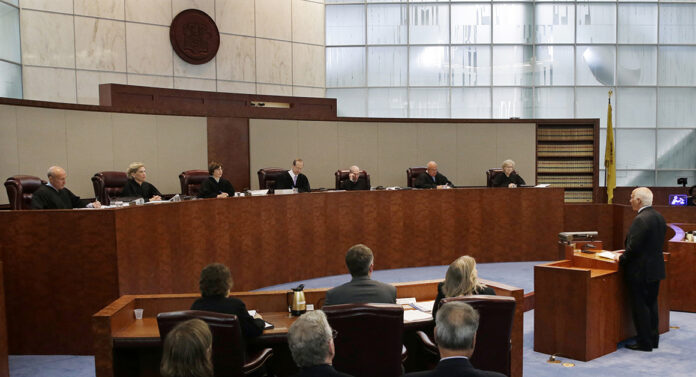

The New Jersey Supreme Court has issued a significant decision affirming that teachers were classified as essential employees during the COVID-19 public health emergency, entitling them to enhanced workers’ compensation protections if they contracted the virus in the course of their employment.
In a unanimous ruling, the Court upheld lower court decisions in the case brought by Giuseppe Amato against the Township of Ocean School District, confirming that a teacher who became ill during the pandemic was covered by a rebuttable presumption that her COVID-19 infection was work-related and therefore fully compensable under state workers’ compensation law.
The case stemmed from the death of Denise Amato, a longtime teacher in the Ocean Township School District, who died from respiratory failure caused by COVID-19. Following her death, her husband filed a claim with the Division of Workers’ Compensation, arguing that her illness should be presumed to have been contracted through her work as an educator during the height of the pandemic.
That presumption is rooted in legislation enacted during the public health crisis, which granted essential workers the benefit of assuming workplace exposure unless an employer could prove otherwise. In 2024, a Judge of Compensation agreed with that interpretation, concluding that teachers met the definition of essential employees under the statute and that Denise Amato’s illness therefore qualified for compensation.
The Appellate Division later affirmed that ruling, finding that teachers were explicitly included as essential workers through the state’s emergency response framework. The appellate court pointed to the governor’s delegation of authority to emergency management officials and their adoption of federal guidance identifying educators as critical to maintaining public infrastructure during the crisis. The court also rejected arguments that additional factual affidavits were required, noting that the issue turned on statutory interpretation and official public records rather than disputed facts.
In its decision, the New Jersey Supreme Court agreed and adopted much of the lower court’s reasoning. Writing in a per curiam opinion, the justices emphasized that teachers were designated as essential not only through emergency management directives, but also through actions taken by the Department of Health, which issued multiple vaccination plans explicitly identifying educators as essential employees during the pandemic response.
The Court further addressed and dismissed the school district’s claim that it was denied due process when the Judge of Compensation ruled without requiring sworn affidavits. The justices explained that procedural rules only require affidavits when a motion relies on facts outside the record. Because the claim relied entirely on public documents and legal interpretation, no additional testimony was necessary.
According to the Court, the central question was purely legal: whether teachers fell within the statutory definition of essential employees during the declared state of emergency. The answer, the justices concluded, was unequivocally yes.
The ruling carries broader implications for educators and public employers across New Jersey, reinforcing how emergency-era legislation will be interpreted when disputes arise over workplace exposure and employee protections. Legal experts say the decision provides clarity for future workers’ compensation claims tied to public health emergencies, while also underscoring the weight courts give to official emergency declarations and agency guidance.
For teachers and their families, the decision stands as a definitive acknowledgment of the risks educators faced while maintaining instruction during unprecedented conditions—and affirms the legal protections afforded to them under state law.