



New Jersey remains on heightened winter weather alert as meteorologists continue tracking a volatile storm system that could bring a significant snow event to the Garden State late this weekend. While uncertainty remains high, new forecast data suggests the range of possible outcomes is beginning to narrow — offering clearer signals about potential impacts across North, Central, and South Jersey.
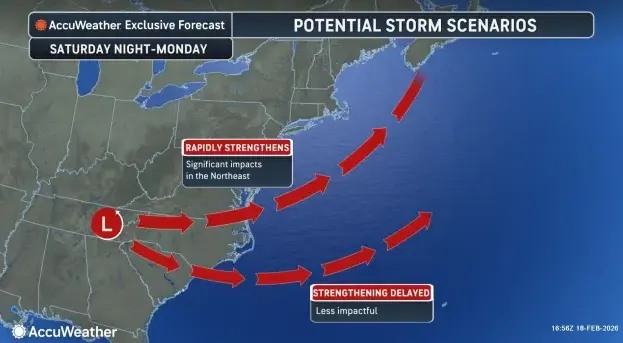
The developing system, currently projected for a Sunday–Monday timeframe, represents one of the most closely monitored winter weather scenarios of the season. Forecast models continue to fluctuate between a direct statewide snowstorm and a near miss out to sea, yet recent data indicates increasing momentum toward a scenario that favors snowfall across much of New Jersey, with South Jersey emerging as a potential focal point for the highest totals.
As regional forecasting analysis continues to evolve, the coming days — particularly Friday — are expected to provide the first meaningful clarity on storm track, timing, and accumulation projections.
This developing weather situation reflects the complex atmospheric interactions often seen in major Mid-Atlantic winter storms, where subtle shifts in upper-level energy can dramatically alter outcomes across short geographic distances.
Forecast Confidence Slowly Improves — But Uncertainty Remains
Despite the intensity of public interest and widespread monitoring, meteorologists emphasize that the state remains approximately four days away from any definitive forecast outcome. Atmospheric conditions remain dynamic, and multiple solutions remain possible.
However, the range of potential scenarios has begun to tighten.
Earlier forecast guidance suggested a broad spectrum of outcomes, including:
• Heavy snowfall jackpots across northwest New Jersey and eastern Pennsylvania
• Rain-dominant conditions in South Jersey
• A complete offshore storm miss producing minimal precipitation
Recent data increasingly points away from those extremes. Instead, current modeling favors a narrower range of possibilities that includes:
• A statewide snow event, potentially significant in South Jersey
• A close offshore track bringing lighter snow or mixed precipitation
• A grazing storm producing limited but measurable snowfall
The previously discussed scenario of heavy snowfall in northwest New Jersey paired with rain in southeastern regions appears to be losing support among current model runs.
Why South Jersey May Be the Snow Target
Emerging forecast guidance increasingly highlights South Jersey as the most likely region to experience the highest snowfall totals if the storm develops as projected.
Meteorological analysis suggests that the storm’s evolving energy structure and track could position southeastern areas of the state within the most favorable zone for sustained precipitation and colder atmospheric conditions.
This represents a notable shift from earlier projections that favored interior or northwestern regions.
Under the most snow-favorable scenario:
• South Jersey could see the highest accumulations
• Central Jersey could experience widespread snowfall
• North Jersey could receive lighter totals or, in some scenarios, minimal impact
Such geographic variability is typical of coastal winter systems affecting New Jersey, where storm track positioning relative to the coastline determines precipitation type and intensity.
The Critical Atmospheric Factor: Energy Separation
Meteorologists monitoring the system are focusing closely on a key atmospheric signal that will likely determine the storm’s outcome — the separation or connection of competing upper-level energy sources.
The forecast hinges on the interaction between:
• Residual energy from a Friday rain-producing system
• Incoming energy associated with the potential Sunday–Monday storm
When these energy systems remain connected, they tend to push the developing storm offshore, producing a weaker, more progressive system with limited impact.
When the energy streams separate, however, the storm can intensify and track closer to the coast, significantly increasing the likelihood of substantial snowfall across New Jersey.
Forecast models currently disagree on this interaction.
Some modeling solutions — including certain European and artificial intelligence projections — keep the energy connected, favoring an offshore track and limited impact.
Others — including several operational and international models — show separation between the systems, creating conditions more supportive of a significant snow event.
This technical atmospheric distinction will ultimately determine whether New Jersey experiences a major winter storm or only scattered snow showers.
Timing Window Remains Broad
Another major uncertainty involves the precise timing of the storm.
Current forecast guidance places the potential event broadly between Sunday morning and Monday night, but model disagreement prevents more specific predictions.
Some projections show:
• Early Sunday onset with Monday morning departure
• Sunday night development with precipitation continuing into Monday evening
Until forecast consensus strengthens, meteorologists recommend planning for possible impacts throughout the entire Sunday–Monday period.
Transportation planning, school scheduling, and municipal preparation may all be affected depending on when the system ultimately develops.
Model Volatility Typical of Major Winter Systems
Forecast fluctuations are not unusual for complex winter weather systems in the Mid-Atlantic region. Meteorologists note that model variability at this stage reflects the highly sensitive atmospheric setup driving the storm.
Weather models frequently oscillate between solutions as new data enters forecasting systems, especially when multiple energy streams interact within the jet stream.
This process — sometimes described as models “spraying” between outcomes — will likely continue until the system’s structure becomes more defined.
Confidence typically increases significantly within 48 to 72 hours of a storm event, making Friday a critical milestone for forecast reliability.
A Statewide Range of Possibilities
Based on current data trends, New Jersey’s potential outcomes fall within a refined range:
• A statewide snowfall event, potentially heavy in South Jersey
• A moderate coastal storm producing measurable snow
• A close offshore miss bringing scattered snow or rain showers
The earlier concern that southeastern New Jersey could experience primarily rain while northwestern areas received heavy snow appears less likely given recent atmospheric signals.
Instead, colder temperature profiles and storm dynamics now suggest that precipitation would fall primarily as snow if the storm tracks near the region.
Implications for New Jersey Infrastructure and Daily Life
Even moderate winter storms can produce significant disruptions across New Jersey due to the state’s dense population and interconnected infrastructure.
Potential impacts may include:
• Hazardous road conditions and travel delays
• Transit service disruptions
• School schedule changes
• Business interruptions
• Increased demand for municipal snow response operations
State and local agencies typically monitor developing systems closely in the days leading up to a potential storm to coordinate response planning.
New Jersey’s Winter Weather Pattern in Focus
This potential storm follows an active seasonal pattern that has featured frequent temperature swings and multiple precipitation events across the region. Meteorologists note that such volatility reflects broader atmospheric conditions shaping winter weather across the Northeast.
The evolving pattern has produced a mix of rain events, cold snaps, and storm threats — conditions that often precede major coastal winter systems.
The developing Sunday–Monday storm fits within this broader pattern of dynamic seasonal activity.
What to Watch Moving Forward
Forecasters emphasize that the next several days will prove critical in determining the storm’s trajectory and intensity. Key indicators to monitor include:
• Model agreement on energy separation
• Changes in storm track projections
• Temperature profile forecasts
• Timing consensus
• First official snowfall maps expected by Friday
These developments will provide the first meaningful guidance regarding accumulation ranges and geographic impact zones.
A High-Impact Storm Still on the Table
While uncertainty remains, the possibility of a significant winter storm affecting New Jersey remains very much alive. Forecast signals increasingly suggest that if the system tracks favorably, much of the state could experience snowfall, with South Jersey positioned for the greatest impact.
At the same time, a complete offshore miss — though less likely than earlier projections suggested — remains a plausible outcome.
For now, New Jersey remains in a holding pattern: monitoring model trends, awaiting stronger forecast consensus, and preparing for a range of winter weather possibilities.
As meteorologists continue analyzing evolving atmospheric data, one message remains consistent — confidence will increase with each passing day, and clearer answers are expected by the end of the week.
Until then, the Garden State watches and waits as the potential Sunday–Monday storm develops into what could become the season’s most consequential winter weather event.