


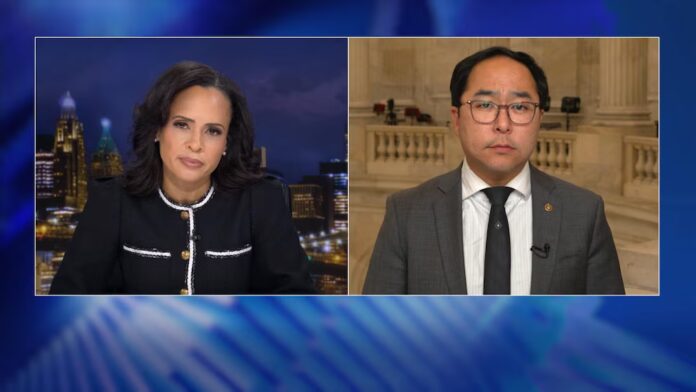

U.S. Senator Andy Kim of New Jersey delivered forceful remarks on the Senate floor this week, sharply criticizing the Trump administration’s recent military operations in Venezuela and raising concerns over what he described as a lack of coherent strategy or long-term planning. His comments come amid intense national debate in Washington over the scope of executive power, military engagement abroad, and the role of Congress in authorizing acts of war.
Speaking to colleagues in the upper chamber, Senator Kim condemned the administration’s decision to order military action without providing adequate briefing or justification for what comes next. “This Administration does not have a sound foreign policy – it has one that is rooted in bluster, built on extortion and extraction for the President’s own benefit, and without the best interests of the American people at heart…It’s for them that we must be a strong check on this reckless and feckless foreign policy,” Kim said during his floor speech.
Kim’s critique reflects broader unease among lawmakers about the legal and constitutional basis for recent operations in Venezuela, which included capturing Venezuelan President Nicolás Maduro and removing him to U.S. custody. Many senators have called for clearer articulation of objectives, costs, and potential consequences before further military action is undertaken. A bipartisan war powers resolution was advanced by the Senate this week with the aim of requiring congressional approval before additional engagements in Venezuela, a move that highlights the growing legislative push to rein in presidential authority on matters of military intervention.
While addressing the Senate, Kim emphasized the long-term implications of foreign engagement without a clear exit strategy or post-conflict plan. “I have worked on Iraq and Afghanistan, where our country has seen the risks of getting pulled into open-ended commitments trying to run other countries. And I’ve seen the importance of always having a plan for the day after – something this administration clearly did not do,” he said, drawing parallels to past U.S. military involvements and urging lawmakers to consider historical lessons.
The senator also warned that the Trump administration’s approach of asserting influence through military presence could inadvertently validate similar tactics by global competitors. “This approach of spheres of influence and ‘might makes right’ is one that our leading competitors and adversaries – China and Russia – have been asserting themselves. President Trump’s adoption of this approach endorses and advances their worldview – a move that could have dangerous global consequences,” Kim said in his speech.
In addition to strategic concerns, Kim highlighted the human and economic costs associated with protracted military action. “There is the cost for our servicemembers – more than 15,000 at last reports currently positioned in the Caribbean and focused on operations in and around Venezuela. Their lives are on the line. They’ve been taken away from their families. And there’s the cost to the American people…when people are about to lose their healthcare?” he asked, underscoring the domestic stakes tied to foreign policy decisions.
The senator’s remarks signal deepening tension between the legislative and executive branches over foreign intervention authority. Many lawmakers, including those across the political spectrum, have echoed calls for transparency, accountability, and adherence to constitutional standards in authorizing military actions overseas.
New Jersey residents and political observers tracking developments in federal policy and congressional oversight can explore broader coverage and analysis in the Politics section, where major legislative debates and government actions impacting the Garden State are continuously reported.
As debate unfolds in Washington, Senator Kim’s floor address underscores the drive among some legislators to ensure that U.S. foreign policy is not only decisive but deliberate, grounded in clear objectives and accountable to the people through their elected representatives.



