


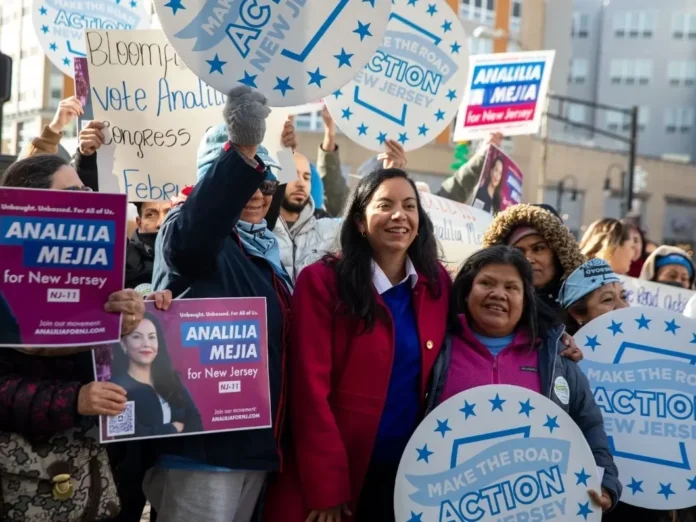

From Mejia’s Breakthrough Win to Sherrill’s First Executive Orders, a New Political Era Emerges Across New Jersey
New Jersey’s political landscape is undergoing one of its most consequential transitions in years, shaped by a new governor, high-profile special elections, rising labor-centered campaigns, and a growing confrontation between state leaders and federal immigration authorities.
At the center of the moment is a rapidly changing executive branch and a political environment increasingly defined by economic fairness, civil liberties, and a widening push to rebalance power away from entrenched institutions.
Progressive activist Analilia Mejia’s victory in the Democratic primary for the open 11th Congressional District is being widely viewed as a blueprint for how a candidate rooted in working-class advocacy can win decisively in a district that is neither majority Latino nor traditionally aligned with progressive grassroots organizing.
Her campaign emphasized a platform built around a living wage, paid sick leave, and sustained criticism of an economic system that, in her words, continues to reward only a narrow ruling class. That message resonated strongly with voters across racial, geographic, and ideological lines, demonstrating how labor-centered policy language and affordability issues have become a unifying political force in modern New Jersey elections.
Political observers say Mejia’s performance is already being studied by campaign strategists statewide as a model for how working-family economics can outperform traditional partisan messaging. Her general election matchup against Republican nominee Joe Hathaway on April 16, 2026, is now positioned as one of the most closely watched congressional races in the state.
The electoral shift is unfolding alongside a dramatic change in the Governor’s Office.
Governor Mikie Sherrill was sworn in as New Jersey’s 57th governor on January 20, 2026, following the conclusion of Phil Murphy’s administration. In her first weeks in office, Sherrill has moved swiftly to establish a policy posture focused on strengthening state oversight and limiting what her administration views as unchecked federal authority, particularly in immigration enforcement.
Just days into her tenure, Sherrill signed Executive Order No. 12, barring federal Immigration and Customs Enforcement agents from entering or operating on non-public state property without a judicial warrant. The restriction applies to a wide range of locations, including state offices, child-care facilities, and university residential housing. The order represents one of the strongest state-level limits on federal enforcement access adopted anywhere in the region.
At the same time, the administration launched a public reporting and transparency portal that allows residents to submit photos, videos, and documentation of ICE activity. Submissions are reviewed by the Attorney General’s office as part of a new oversight framework designed to track enforcement actions and identify potential civil rights concerns.
The governor’s early actions have reinforced New Jersey’s emerging identity as a state willing to challenge federal enforcement policy through administrative authority rather than legislative standoffs alone.
That policy pivot is arriving at a difficult fiscal moment.
Sherrill’s nominee for state treasurer, Aaron Binder, is now preparing to manage a projected one-billion-dollar budget shortfall tied largely to federal funding reductions. Binder and the governor’s budget team face the complex task of assembling the administration’s first spending plan, due in early March, while balancing education funding, public safety, transportation, and health services amid growing pressure to avoid deep municipal and school-aid cuts.
The shifting executive strategy is reverberating through statewide and federal races.
In the 2026 United States Senate contest, a new Republican challenger has entered the field. Former News 12 reporter Alex Zdan announced his candidacy after receiving the Passaic County Republican endorsement and is seeking to consolidate GOP support ahead of a general election challenge to Democratic incumbent Cory Booker later this year.
The congressional realignment continues with the special election in the 11th District, where Mejia’s nomination has reshaped expectations for turnout, coalition-building, and messaging in suburban and mixed-income communities.
At the municipal level, political tensions are playing out in city halls and council chambers across the state.
In Trenton, city leaders and business organizations are hosting a Merchant and Community Stakeholder Briefing focused on economic stability and rights awareness following recent federal enforcement activity in the region. The meeting is expected to bring together small business owners, community advocates, and municipal officials seeking clarity on workplace protections and compliance obligations during periods of heightened federal scrutiny.
In Piscataway, the Township Council has approved a controversial ordinance allowing the municipality to remove hotel occupants if they have been arrested or charged with a crime. The 5-2 vote immediately drew protests and public demonstrations from civil rights groups, who argue the policy undermines due process and could disproportionately affect vulnerable populations, including unhoused residents and immigrant families.
In Hudson County, newly elected progressive Assemblymembers Ravi Bhalla and Katie Brennan introduced legislation aimed at reforming how New Jersey finalizes its state budget. Their proposal would require any finalized budget to remain unchanged for 14 days before a final vote, effectively banning last-minute closed-door amendments. Supporters say the measure would dramatically increase transparency and limit backroom negotiations that often determine billions of dollars in public spending with little public scrutiny.
Legal and regulatory developments are further intensifying the political climate.
A 14-judge federal appellate panel in Philadelphia heard arguments this week challenging New Jersey’s prohibition on firearms in 25 designated “sensitive locations.” Gun-rights organizations argue the law is overly broad and conflicts with recent Supreme Court precedent. State officials maintain the restrictions are essential to public safety and constitutional under existing legal standards. The outcome of the case could reshape how New Jersey regulates firearms in public spaces statewide.
Meanwhile, the state’s gaming industry continues to demonstrate its expanding economic footprint. Preliminary data released by the Division of Gaming Enforcement shows that more than $126.5 million was wagered in New Jersey on Super Bowl LX, representing a sharp year-over-year increase and reinforcing the state’s position as one of the nation’s dominant sports betting markets.
Together, these developments reflect a state in political transition—where labor advocacy, immigration enforcement oversight, budget transparency, and public safety policy are increasingly intertwined across every level of government.
The rapid pace of change is also placing New Jersey squarely in the national spotlight for its evolving approach to executive authority, grassroots organizing, and institutional reform. Ongoing coverage of the state’s fast-moving politics continues to highlight how New Jersey’s leadership and voters are redefining power, accountability, and representation at a moment when economic pressure and federal-state tensions are reshaping the future of governance statewide.