



In a decisive affirmation of regulatory strength and institutional credibility, the New Jersey Department of Banking and Insurance has secured reaccreditation from the National Association of Insurance Commissioners, marking a critical milestone that underscores the state’s continued leadership in financial oversight, consumer protection, and insurance market stability. The achievement positions New Jersey at the forefront of regulatory excellence at a time when the financial services landscape is undergoing rapid transformation, heightened scrutiny, and increasing complexity.
This reaccreditation is not a procedural formality. It is the result of a rigorous, multi-layered evaluation conducted on a five-year cycle, designed to ensure that state insurance regulators meet and exceed nationally recognized benchmarks for solvency oversight, operational integrity, and enforcement capability. The process examines every dimension of regulatory performance, from financial analysis and examination practices to legal authority and inter-state coordination. For New Jersey, successfully navigating this comprehensive review sends a clear signal to markets, institutions, and consumers alike: the state’s regulatory infrastructure is both resilient and trusted at the highest levels.
At the core of the accreditation framework is the principle of reliance. When a state agency earns accreditation from the NAIC, it enables regulators across the country to depend on that state’s oversight of insurance companies operating beyond its borders. In practical terms, this means that insurers domiciled in New Jersey can operate with a level of national credibility that reduces redundancy, enhances efficiency, and strengthens the broader regulatory ecosystem. It is a designation that carries both operational significance and reputational weight, reinforcing New Jersey’s position as a key jurisdiction within the national insurance marketplace.
Leadership within the department has emphasized the broader implications of the reaccreditation, framing it as a reflection of sustained commitment rather than a singular achievement. Acting Commissioner Susan Ochs has highlighted the role of departmental staff in maintaining the standards required to meet national benchmarks, pointing to a culture of diligence, expertise, and accountability that underpins the agency’s day-to-day operations. This internal capacity—often unseen by the public—forms the backbone of a regulatory system that must continuously adapt to evolving risks, emerging technologies, and shifting economic conditions.
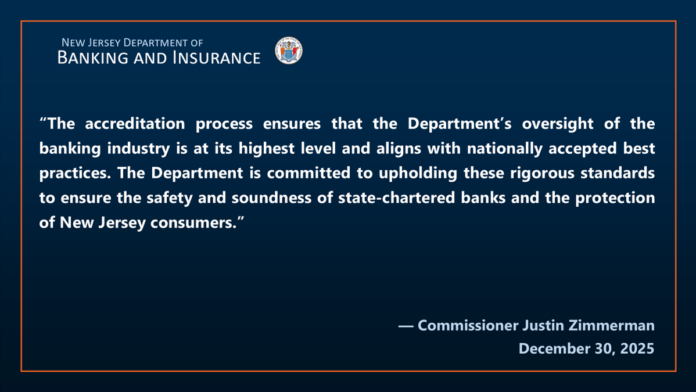
The reaccreditation also arrives within a broader context of institutional validation for the department. In December 2025, its banking division achieved a parallel milestone, securing reaccreditation from the Conference of State Bank Supervisors. Together, these dual recognitions establish a comprehensive endorsement of New Jersey’s regulatory framework across both insurance and banking sectors, creating a unified standard of excellence that spans the state’s financial oversight responsibilities.
For businesses operating in New Jersey, the implications are substantial. A strong regulatory environment provides a foundation for market confidence, enabling insurers and financial institutions to operate within a framework that is both predictable and aligned with national standards. This stability is particularly critical in an era defined by economic uncertainty, where regulatory clarity can influence investment decisions, operational strategies, and long-term planning. Companies domiciled in New Jersey benefit not only from the state’s geographic and economic advantages, but also from the credibility conferred by a regulatory system that meets the highest national benchmarks.
Consumers, meanwhile, experience the benefits in more direct and tangible ways. The department’s mandate extends beyond oversight to active protection, ensuring that insurance products are both financially sound and fairly administered. Accreditation reinforces the mechanisms that safeguard policyholders, from solvency monitoring that prevents insurer failures to enforcement actions that address unfair practices. In a state where millions of residents rely on insurance for health, property, and financial security, the importance of this regulatory assurance cannot be overstated.
The timing of the reaccreditation is particularly noteworthy given the accelerating pace of change within the financial services industry. Technological innovation, including the rise of digital insurance platforms and data-driven underwriting models, is reshaping how products are developed and delivered. At the same time, emerging risks—from climate-related events to cybersecurity threats—are introducing new challenges that require sophisticated regulatory responses. In this environment, accreditation serves as both a validation of current capabilities and a benchmark for future readiness, ensuring that the department is equipped to navigate the complexities of a rapidly evolving landscape.
From a broader economic perspective, the recognition enhances New Jersey’s competitiveness as a hub for financial services. States that demonstrate strong regulatory performance are better positioned to attract and retain businesses, particularly in industries where oversight and compliance are integral to operations. The reaccreditation sends a clear message to the market: New Jersey offers not only opportunity, but also a stable and well-regulated environment in which to pursue it.
Within the context of the state’s business ecosystem, this development aligns with a wider narrative of resilience and forward momentum. As New Jersey continues to balance growth with oversight, the role of institutions like the Department of Banking and Insurance becomes increasingly central. Their ability to maintain high standards while adapting to new realities is a defining factor in the state’s economic trajectory, influencing everything from consumer confidence to corporate strategy.
The reaccreditation is, ultimately, a reflection of sustained excellence rather than a singular moment of achievement. It represents years of consistent performance, continuous improvement, and a commitment to meeting the evolving demands of both the industry and the public. In an environment where trust is a critical currency, the New Jersey Department of Banking and Insurance has reaffirmed its standing as a guardian of that trust, ensuring that the systems underpinning the state’s financial landscape remain strong, reliable, and aligned with the highest national standards.



