


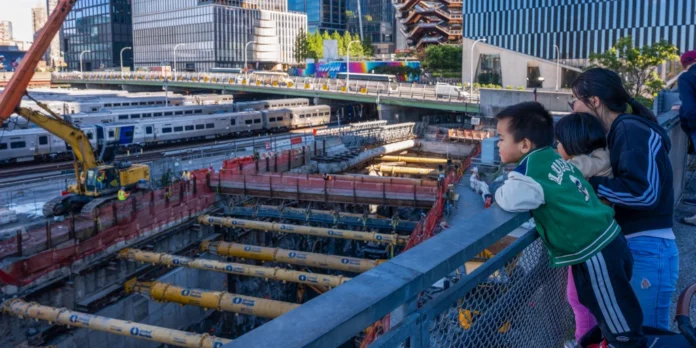

For anyone who has spent time commuting between New Jersey and New York City, the situation is painfully familiar: gridlocked highways, overburdened rail lines, unpredictable delays, and infrastructure that was built for a different century struggling to support a modern economy.
That reality is why the Gateway Program, a massive rail modernization effort designed to transform transportation between Newark and Manhattan, has become one of the most consequential infrastructure debates in the United States.
Over the past several weeks, the issue has erupted into a new wave of national attention. Court battles, political arguments, halted construction, and renewed federal opposition have pushed the project into the center of a high-stakes political showdown involving Washington, New Jersey, and New York.
But for commuters, business leaders, and infrastructure planners across the Garden State, the debate is not theoretical.
It is about something much simpler: whether the region will finally build the transportation capacity it desperately needs.
Coverage across the New Jersey Construction section has repeatedly highlighted how infrastructure investment remains one of the most important issues affecting the state’s economic future.
And few projects illustrate that reality more clearly than Gateway.
The Gateway Program: A Critical Rail Lifeline
The Gateway Program is a multi-billion-dollar initiative designed to modernize approximately 10 miles of the Northeast Corridor rail line between Newark and Manhattan.
At the heart of the project is the construction of new rail tunnels beneath the Hudson River, along with major upgrades to rail bridges and track infrastructure.
The existing tunnels — known as the North River Tunnels — were built in 1910.
More than a century later, they remain the only rail connection linking New Jersey to Penn Station in Manhattan.
Every weekday, roughly 450 trains pass through these tunnels, carrying hundreds of thousands of commuters traveling between New Jersey and New York City.
The tunnels were severely damaged during Hurricane Sandy in 2012, leaving saltwater corrosion that continues to threaten long-term reliability.
Transportation experts have warned for years that a serious tunnel failure could cripple rail travel across the entire Northeast Corridor, affecting cities from Boston to Washington, D.C.
Gateway was designed to prevent that scenario.
Yet the project’s path forward has been anything but smooth.
Construction Halts, Legal Battles, and Political Gridlock
In early February 2026, construction activity on the Gateway project came to a sudden halt after federal funding was frozen by the Trump administration.
The funding pause immediately forced layoffs affecting roughly 1,000 construction workers, creating uncertainty across multiple work sites tied to the project.
The situation escalated quickly into a legal battle.
In late February, a federal court ordered the release of $235 million in previously approved funding, allowing construction to resume at several locations.
But the conflict is far from resolved.
The U.S. Court of Appeals for the Second Circuit heard arguments on March 3 regarding the administration’s attempt to reinstate the funding freeze.
At the same time, President Trump has continued criticizing the project publicly, labeling it a potential financial “boondoggle” and suggesting it could become leverage in broader federal budget negotiations.
For infrastructure advocates, the uncertainty is deeply troubling.
Delays caused by legal disputes and political maneuvering could add anywhere from $720 million to more than $1.3 billion to the project’s final cost due to inflation and financing complications.
A Debate That Has Been Going On for Decades
The current Gateway conflict is not the first time New Jersey’s cross-Hudson rail future has been thrown into uncertainty.
The region has been here before.
Many residents still remember the ARC Tunnel project — short for Access to the Region’s Core — which was canceled by former New Jersey Governor Chris Christie in 2010.
ARC had already begun construction and was projected to cost approximately $8.7 billion.
Christie abruptly halted the project, arguing that potential cost overruns could leave New Jersey responsible for billions in additional expenses.
Critics strongly disagreed with that decision.
Some transportation experts later argued that canceling ARC represented one of the most significant infrastructure policy mistakes in modern state history.
If ARC had continued, the tunnels might have been operational by 2018.
Instead, the region remains dependent on the same century-old infrastructure.
The Gateway Program emerged as a successor to ARC, offering several improvements over the original plan.
Unlike ARC, which would have ended in a separate deep underground station in Manhattan, Gateway connects directly into Penn Station, allowing both NJ Transit and Amtrak trains to use the new tunnels.
The project also includes additional upgrades such as the Portal North Bridge replacement, which will improve rail reliability across the Hackensack River.
Why the Stakes Are So High for New Jersey
Infrastructure debates often feel abstract.
But the Gateway Program has direct implications for everyday life in New Jersey.
Traffic between New Jersey and New York is already among the most congested in the country.
Anyone who regularly travels between the two states understands the reality: whether by car, bus, or train, commuting can easily consume hours each day.
Adding rail capacity beneath the Hudson River would significantly increase the number of trains that can travel between the states.
More trains mean:
• Reduced congestion
• More reliable schedules
• Faster commuting times
• Greater economic connectivity
Without those improvements, the region risks hitting a transportation ceiling that limits future growth.
The Economic Impact: Beyond Commuting
The Gateway Program is not just about transportation.
It is deeply connected to the economic vitality of the entire tri-state region.
The Northeast Corridor — stretching from Washington, D.C. to Boston — represents one of the most economically productive regions in the world.
New Jersey sits directly at the center of that corridor.
Business districts, logistics hubs, office developments, and residential communities across the state depend on reliable transportation links to Manhattan and other major cities.
Recent economic data highlights just how strong that growth has become.
New Jersey’s commercial real estate sector continues expanding, particularly in industrial and logistics spaces tied to supply chain operations.
Residential construction has also surged, especially in North Jersey communities connected to regional rail lines.
At the same time, office leasing activity in Manhattan has rebounded significantly in the post-pandemic era as companies encourage employees to return to the workplace.
All of those economic trends depend on transportation infrastructure that works.
If rail capacity fails to keep pace with economic growth, the consequences will ripple across multiple industries.
Infrastructure and the Post-Pandemic Recovery
The pandemic dramatically reshaped commuting patterns across the United States.
But by 2025 and 2026, many companies had begun bringing employees back into offices.
As workers return to Manhattan and other major business centers, demand for reliable transit between New Jersey and New York has surged again.
The Gateway project was designed to accommodate exactly that kind of long-term growth.
Infrastructure planners view it as a generational investment that will support the region’s economy for decades.
Interrupting or delaying that investment could slow the economic recovery currently underway.
A Project That Serves the Entire Country
While Gateway is often framed as a regional issue, transportation experts emphasize that it is actually a national infrastructure priority.
The Northeast Corridor carries more passengers than any other rail line in the United States.
It supports commerce, tourism, and business travel across multiple states.
If the Hudson River tunnels were forced offline due to structural failure or emergency repairs, the impact would extend far beyond New Jersey and New York.
Train schedules from Boston to Washington could be disrupted, affecting millions of travelers and billions of dollars in economic activity.
The Reality Every Commuter Knows
Political debates often reduce infrastructure discussions to budgets, cost projections, and legislative negotiations.
But for everyday commuters, the situation is simpler.
Travel between New Jersey and New York is already stretched to the limit.
Bridges, tunnels, highways, and rail lines are operating near or beyond their intended capacity.
When delays happen — whether from aging infrastructure or accidents — the entire region feels the consequences immediately.
Anyone who regularly travels across the Hudson River understands the basic truth.
More capacity is needed.
Not just eventually.
Now.
The Future of Cross-Hudson Transportation
The coming months will determine whether the Gateway Program continues moving forward or becomes trapped in another cycle of political stalemate.
Court rulings, federal funding decisions, and negotiations between state and national leaders will shape the outcome.
For New Jersey residents, however, the broader message remains clear.
Infrastructure is not optional.
It is the foundation upon which economic growth, daily mobility, and regional cooperation depend.
New Jersey’s relationship with New York City has always been deeply interconnected.
Millions of people move between the two every week to work, study, visit family, or simply enjoy the opportunities both states provide.
Whether through rail tunnels, bridges, or expanded transit systems, strengthening those connections is essential.
Because if there is one thing everyone in the region can agree on, it is this:
When it comes to transportation between New Jersey and New York, there can never be too many ways to get across the Hudson.



