



From a Congressional Vacancy to a Statewide Emergency, Sherrill’s First Days Set a Fast and Unforgiving Pace
New Jersey’s political landscape shifted dramatically this week as Governor Mikie Sherrill, freshly sworn in and already tested by crisis, moved quickly to assert control during one of the most consequential openings of a new administration in recent memory. Within days of taking office, Sherrill confronted a convergence of events that would challenge even a seasoned executive: a looming historic winter storm, a sudden vacancy in Congress, internal party turbulence, and a slate of early policy actions aimed at signaling both urgency and direction.
The first major ripple came from Washington. Sherrill’s transition from Capitol Hill to Drumthwacket officially triggered the start of a special election cycle in New Jersey’s 11th Congressional District. With the seat now open, potential contenders from both parties have begun positioning themselves for what is expected to be a closely watched primary and general election. The district, long considered politically competitive, is likely to become a testing ground for broader national narratives as the mid-decade political realignment continues to take shape.
At the same time, the state’s Republican caucus is navigating its own internal strain. Now the smallest GOP caucus since the post-Watergate era, Republicans in Trenton are grappling with leadership disputes and the loss of key committee assignments by senior figures who challenged party leadership. The internal discord comes at a moment when cohesion could prove critical, particularly as Democrats consolidate power under a new governor who entered office with strong institutional support and a mandate for action.
Sherrill wasted little time setting the tone. One of her first executive actions was the signing of a 90-day regulatory freeze, temporarily halting new and pending rules across state agencies. The move was framed as a pause to review existing regulations, reduce bureaucratic drag, and identify opportunities to streamline government operations. Supporters see the freeze as a signal to businesses and municipalities that efficiency and accountability will be early priorities, while critics are watching closely to see how the pause affects ongoing initiatives.
That policy rollout was quickly eclipsed by events in the sky. As forecasters warned of one of the most significant winter storms to hit the region in nearly a decade, Sherrill declared a statewide State of Emergency covering all 21 counties. The declaration, effective Saturday evening, came as meteorologists projected a dangerous mix of heavy snow, ice, freezing rain, and high winds, with accumulation estimates ranging from eight to 12 inches in South Jersey to as much as 18 inches in parts of North Jersey, particularly in the northwest.
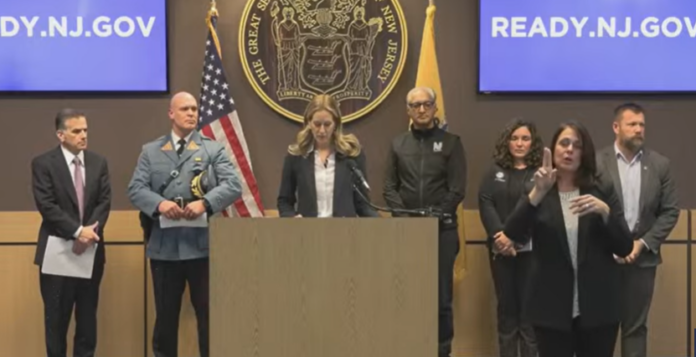
Speaking from the New Jersey Regional Operations and Intelligence Center in Ewing, the governor emphasized that the storm was not routine and urged residents to avoid travel from Saturday night through Sunday. Commercial vehicle restrictions were announced for major interstate highways to prevent accidents and ensure plows and emergency vehicles could operate without obstruction. State agencies, utilities, and local governments were placed on high alert, with snowplows pre-positioned and newly equipped with green flashing lights to improve visibility in whiteout conditions.
“This is not an average storm,” Sherrill said, stressing that preparation and caution would be critical to minimizing injuries, power outages, and prolonged disruptions. Airlines quickly followed suit, offering flexible rebooking options for travelers scheduled to depart from or arrive in New Jersey during the height of the storm.
As the emergency declaration took effect, Acting Attorney General Davenport issued a pointed warning to businesses statewide, making clear that price gouging during the State of Emergency would not be tolerated. The announcement served as a reminder that consumer protection laws remain fully enforceable during crises, and that violations would be aggressively investigated and prosecuted. The message was aimed at preventing inflated prices on essentials such as fuel, food, lodging, and snow removal services as demand spikes.
Together, these actions offered an early portrait of Sherrill’s governing style: rapid response, centralized coordination, and an emphasis on visible leadership during moments of uncertainty. For a governor just days into her term, the storm has become an immediate proving ground, testing not only logistical readiness but also public confidence.
Beyond the emergency response, the broader political implications are already unfolding. The special congressional race is expected to energize both parties, while the regulatory freeze and enforcement posture on price gouging hint at a balancing act between economic pragmatism and consumer protection. Meanwhile, legislative dynamics in Trenton remain fluid, with shifting alliances and leadership questions adding another layer of complexity to the months ahead.
As snowplows roll and campaigns quietly begin to organize, New Jersey finds itself at the intersection of governance and unpredictability. How the state navigates this moment—combining crisis management with long-term political recalibration—will help define the early legacy of its new governor and shape the tone of state politics well beyond this winter.