


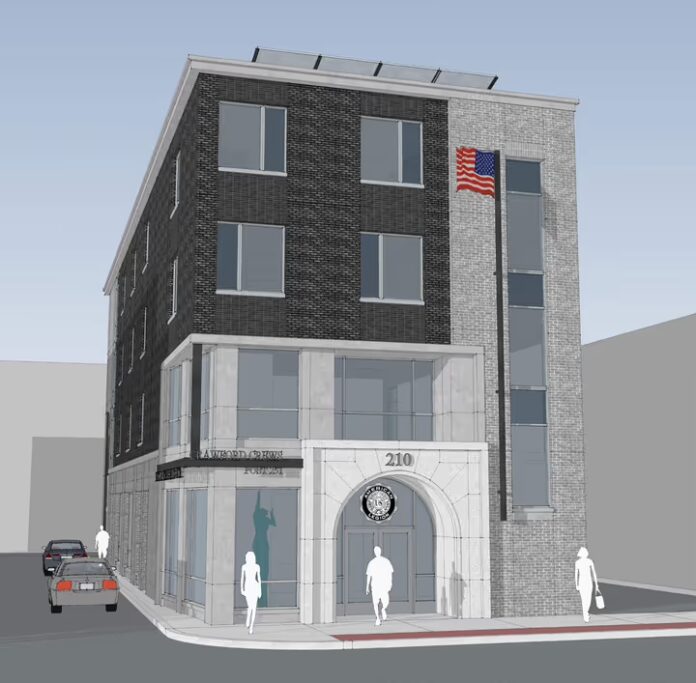

In Montclair, a historic address long tied to service, sacrifice, and civic leadership is entering a defining new chapter—one that aligns preservation with purpose and transforms legacy into tangible impact. The redevelopment of the American Legion Crawford Crews Post 251 at 210 Bloomfield Avenue is not simply a construction project; it is a strategic response to one of New Jersey’s most urgent challenges: veteran homelessness. With a design-led approach that integrates supportive housing, wraparound services, and community engagement into a single, thoughtfully planned facility, the project signals a broader shift in how the state approaches infrastructure, social responsibility, and long-term veteran care.
At the center of this transformation is a collaboration between DIGroup Architecture and project liaison James Evers, whose vision for the site extends well beyond replacing a deteriorating structure. Instead, the redevelopment introduces a fully realized Montclair Veterans Service Center—an environment designed to support not just housing needs, but the full continuum of transition for veterans navigating post-service life. The plan includes 11 supportive housing units, each intended to provide stability and dignity for veterans who are homeless, at risk, or aging out of traditional support systems. Yet the project’s scope is far more expansive than its residential component alone.
What is emerging on Bloomfield Avenue is a multi-story, multi-use facility that integrates education, outreach, and community programming into its core design. This is not housing in isolation—it is housing embedded within a network of services, creating an ecosystem where veterans can access the tools necessary to rebuild, reconnect, and thrive. The architectural philosophy guiding the project reflects that ambition, emphasizing accessibility, sustainability, and modern living standards while maintaining a deep respect for the site’s historical significance.
That balance between past and future is particularly important given the legacy of Crawford Crews Post 251, which has served Montclair since 1935. The building itself carries even deeper roots, originally constructed in the late 19th century as Washington Hose Company No. 3, an Italian Renaissance-style structure that has stood as a quiet landmark through generations of change. Over time, the building transitioned into a vital gathering space for African-American veterans, including those connected to the Harlem Hellfighters and the Tuskegee Airmen—units whose contributions were long underrecognized despite their extraordinary service.
Rather than erase that history, the redevelopment is designed to elevate it. Key architectural elements, including signature stonework, will be preserved and incorporated into the new structure, ensuring continuity between what the site has been and what it is becoming. Plans also include formal historical documentation and the installation of a commemorative plaque, reinforcing the project’s role as both a living facility and a permanent tribute.
This approach reflects a larger trend visible across New Jersey’s evolving development landscape—one that Sunset Daily News continues to track closely through its ongoing coverage of the state’s construction and infrastructure initiatives, including projects highlighted in the Explore New Jersey construction coverage. Increasingly, redevelopment efforts are being shaped by dual mandates: preserve cultural identity while delivering forward-thinking solutions to modern challenges. The Montclair project exemplifies that model at its highest level.
Equally critical to the project’s momentum is the network of partnerships supporting it. The redevelopment has already secured historic preservation review and key regulatory approvals at the state level, positioning it as one of the more advanced veteran housing initiatives currently in development. Collaboration with organizations such as Soldier On and Monarch Housing Associates ensures that the supportive housing component is not merely structural, but operationally effective—anchored by proven strategies in veteran outreach and housing stability. Additional backing from the U.S. Department of Veterans Affairs, combined with pre-development funding from the State of New Jersey, underscores the project’s alignment with broader policy goals.
Those policy goals are becoming increasingly urgent. New Jersey has intensified its focus on eliminating veteran homelessness, with state leadership identifying it as a core priority. Recent data has shown hundreds of veterans across the state still without stable housing, a reality that has driven renewed investment in programs designed to close that gap. Initiatives like Bringing Veterans Home, backed by significant state funding, are working to ensure that every known homeless veteran is identified, supported, and ultimately housed. Projects like the Montclair redevelopment are essential to achieving that objective, providing the physical infrastructure required to translate policy into real-world outcomes.
What makes this particular redevelopment especially significant is its scalability. Similar efforts are already underway in other municipalities, including Hoboken and Westfield, indicating a replicable model that could be expanded statewide. By combining permanent supportive housing with integrated services and community engagement, the American Legion redevelopment framework offers a blueprint for addressing veteran homelessness in a way that is both humane and sustainable.
At a design level, the Montclair Veterans Service Center is being positioned as more than a solution—it is being framed as a destination. Project leaders have described the vision as a “forward-thinking sanctuary,” a space where veterans are not only housed but empowered. That distinction matters. Too often, housing initiatives focus solely on shelter; this project is structured around opportunity, connection, and long-term success.
The cultural significance of the site adds another layer of importance. Named for Crawford Crews, one of several Montclair residents who served with distinction in the Harlem Hellfighters during World War I, Post 251 has long been a symbol of both military service and community leadership. Over decades, it has provided emergency shelter, supported local initiatives, and served as a gathering place for veterans whose stories might otherwise have gone unheard. The redevelopment ensures that this legacy is not only preserved but amplified, connecting past contributions to future impact.
As the project advances toward final zoning approvals and housing voucher allocations, the path toward construction is becoming increasingly clear. What follows will be closely watched—not just in Montclair, but across New Jersey and beyond—as communities look for effective ways to address veteran housing needs without sacrificing history or identity.
In a state where construction is often measured in square footage and timelines, this project stands apart by redefining success in human terms. It is about stability for those who have served, recognition for those whose contributions shaped history, and a commitment to building spaces that reflect both responsibility and respect.
Montclair’s American Legion redevelopment is not simply rebuilding a structure. It is reconstructing a promise—one that ensures the men and women who served are met with the same level of dedication when they return home.



