


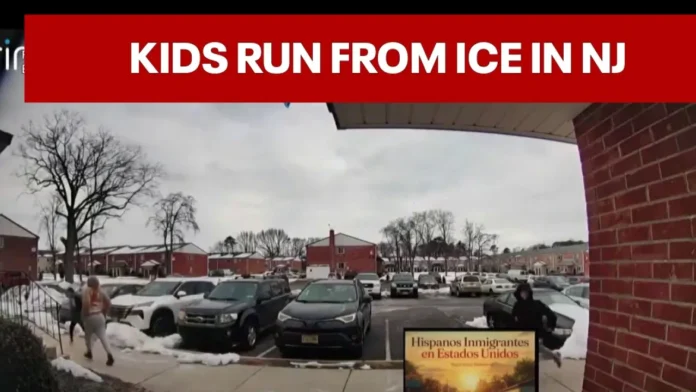

A significant and deeply unsettling incident unfolded in Lindenwold, New Jersey, when elementary school students fled in panic from a school bus stop after federal immigration agents arrived in their neighborhood during a targeted enforcement operation. The situation, which occurred near the Woodland Village Apartments on Clementon–Gibbsboro Road, has ignited widespread concern across South Jersey, prompting protests, school district intervention, and renewed calls for stricter protocols governing federal enforcement activity near children.
The event has quickly become a flashpoint in an ongoing national conversation about immigration enforcement practices, public safety, and the emotional impact of federal operations conducted in residential communities during school hours.
Morning Incident at Woodland Village Sends Children Running
On the morning of Thursday, February 12, 2026, dozens of fourth- and fifth-grade students were gathered at their regular bus stop outside the Woodland Village Apartments, waiting for transportation to Lindenwold School 5. What began as a routine school morning rapidly escalated into chaos when federal immigration agents arrived at the apartment complex.
Ring doorbell camera footage captured the moment students reacted to the sudden presence of enforcement vehicles. Children were seen running through the parking lot, shouting “ICE, ICE!” as multiple vehicles entered the area. The footage quickly circulated within the community, intensifying concern among parents and residents.
Witnesses described the scene as confusing and frightening for the young students, many of whom scattered in different directions in an attempt to avoid what they perceived as a threatening situation.
The incident highlights how enforcement operations in residential settings can produce unintended psychological effects, particularly when children are present and unaware of the context surrounding federal actions.
Bus Driver Praised for Quick Response and Student Safety
Amid the confusion, the school bus driver played a crucial role in ensuring student safety. According to district officials, the driver circled the apartment complex multiple times to locate and safely collect students who had fled in fear.
The Lindenwold School District publicly praised the driver’s actions, describing the response as calm, deliberate, and focused on protecting students during an unpredictable situation.
District officials stated that the driver’s decision to remain in the area and gather scattered children helped prevent further distress and ensured that all students reached school safely.
The response has been widely recognized within the community as an example of effective crisis management in a rapidly evolving situation involving minors.
Department of Homeland Security Details Targeted Enforcement Operation
Following widespread public reaction, the U.S. Department of Homeland Security provided clarification regarding the operation. Officials stated that the agents were conducting a “targeted enforcement action” and were not seeking to detain or interact with any children.
According to DHS, agents were attempting to apprehend Hugo Ariel Coello, a Honduran national with a criminal history that reportedly includes assault and strangulation.
Federal officials indicated that the suspect fled into the Woodland Village apartment complex after becoming aware of enforcement activity. Authorities further stated that Coello escaped after encountering school bus traffic in the area.
Officials emphasized that agents ultimately left the scene without making an arrest, citing the presence of children and the need to prioritize community safety.
The explanation has not fully quelled public concern, with many residents questioning how enforcement operations came to occur near an active school bus stop.
Emotional Impact on Students Prompts Immediate School Response
By the time students arrived at school, many were described by administrators as “upset and emotional” following the frightening experience.
The Lindenwold School District quickly implemented support measures at School 5, deploying both bilingual and English-speaking counselors to assist affected students. The district’s response focused on providing emotional support, addressing student concerns, and restoring a sense of safety within the school environment.
School officials emphasized their commitment to student well-being and noted that ensuring children feel secure remains a top priority.
Educational leaders also acknowledged that the emotional consequences of the incident extend beyond the immediate moment, particularly for young students exposed to high-stress situations involving law enforcement.
Community Protests Erupt Across Lindenwold
Public reaction to the operation was swift and highly visible. On February 13, approximately 300 protesters gathered along the White Horse Pike and at the borough building to voice outrage over the timing and location of the federal action.
Demonstrators called for stronger safeguards to prevent enforcement operations from taking place near children and school transportation areas. Community members expressed concern about the psychological impact on students and the broader implications for neighborhood safety.
The protests reflected a growing tension between federal enforcement authority and community expectations regarding the protection of children and educational environments.
Local residents, parents, and advocacy groups have continued to demand clearer guidelines and increased transparency regarding future operations.
Local and Federal Officials Call for Policy Changes
The incident has prompted calls for procedural reforms from local leaders and federal representatives. Lindenwold School District Superintendent Dr. Kristin O’Neil publicly urged the development of stricter protocols to prevent enforcement activity from occurring near active school bus stops.
Local officials have echoed those concerns, emphasizing the need for coordination between federal agencies and local communities when operations occur in residential areas.
U.S. Representative Donald Norcross also advocated for clearer standards designed to protect children and ensure that enforcement actions do not interfere with school-related activities.
The push for policy adjustments signals that the Lindenwold incident may influence future discussions about how federal enforcement agencies operate in populated residential environments.
A Broader Debate on Enforcement Practices Near Schools
The situation in Lindenwold reflects a broader national debate surrounding immigration enforcement in sensitive locations. Historically, federal agencies have maintained guidelines regarding enforcement near schools, healthcare facilities, and places of worship, though implementation practices and interpretations have evolved over time.
The Woodland Village incident has intensified scrutiny over how those policies function in real-world scenarios and whether additional safeguards are necessary to protect children from exposure to enforcement actions.
For many observers, the event underscores the need for clearer communication, improved operational planning, and stronger community engagement.
Community Recovery and Ongoing Conversations
In the days following the incident, Lindenwold residents, educators, and officials have continued working to restore a sense of stability for affected students and families.
School leaders remain focused on providing ongoing emotional support, while community discussions continue regarding the long-term implications of the event.
The situation has also raised broader questions about public trust, community safety, and the balance between law enforcement priorities and the protection of vulnerable populations.
Why the Lindenwold Incident Matters for New Jersey Communities
The events at Woodland Village represent more than a single morning of disruption. They highlight the complex intersection of federal policy, local community life, and the emotional well-being of children.
For New Jersey communities, the incident serves as a powerful reminder of how national policy decisions can directly impact everyday neighborhood experiences.
It also reflects the growing expectation among residents that enforcement actions be conducted with heightened awareness of community context, particularly when children are present.
As discussions continue, the Lindenwold incident is likely to influence future policy conversations, community advocacy efforts, and the evolving relationship between federal agencies and local communities.
The outcome of those discussions may ultimately shape how similar operations are conducted across New Jersey and beyond.



