



Veteran attorney positions himself as a culture-driven challenger to Sen. Cory Booker in a rapidly shifting New Jersey political landscape
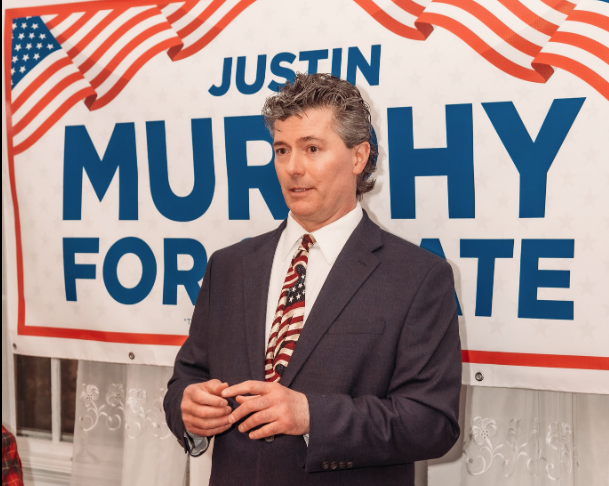
In a race that is already reshaping the contours of New Jersey’s 2026 U.S. Senate contest, Tabernacle attorney and military veteran Justin Murphy has formally entered full campaign mode, seeking the Republican nomination and a direct general-election challenge to incumbent U.S. Senator Cory Booker.
Murphy, a lifelong South Jersey resident who describes himself as a “son of the Pinelands,” is pitching his candidacy as both a cultural and economic reset for a state long dominated by Democratic leadership at the federal level. His campaign message is rooted in voter re-engagement, particularly among conservative and independent residents who, he argues, remain under-mobilized despite growing frustration with federal leadership and national policy direction.
Murphy has publicly pointed to the political energy generated during former President Donald Trump’s 2024 appearance in Wildwood as evidence that New Jersey’s Republican base is far larger—and more persuadable—than conventional political narratives suggest. In his view, the challenge is not turnout potential, but inspiration and infrastructure.
That motivation, Murphy says, is now being fueled by a wave of new county party leadership across the state. He credits several recently elected county chairs with pushing organizational reform and culture change inside the state Republican Party, creating what he believes is a viable foundation for a competitive statewide campaign.
Murphy is not a first-time candidate. He previously sought the Republican nomination for the U.S. Senate in 2024, a campaign that introduced him to a broader statewide audience and helped build early donor and grassroots networks. This cycle, his campaign is more sharply defined, more ideologically explicit, and far more focused on policy architecture rather than broad political rhetoric.
At the core of Murphy’s personal narrative is military service. He enlisted in the United States Navy at just 17 years old and served a four-year active-duty term aboard the USS Comte de Grasse, including deployment during the Iran-Iraq War in the Arabian and Persian Gulf. He was honorably discharged, an experience he routinely cites as the foundation of his views on national security, public service, and civic responsibility.
Following his military career, Murphy entered local government and Republican Party leadership. He was elected to the Tabernacle Township Committee in 2000 and served a three-year term, while simultaneously building a long résumé inside Burlington County Republican politics. His work included leadership roles with the Burlington County Young Republicans, county-level campaign coordination for the 1996 Dole-Kemp presidential ticket, service on the county committee, and later leadership of the Tabernacle Republican Organization. He also worked as a volunteer and organizer on statewide tax reform initiatives and gubernatorial campaigns in the early 2000s.
Since 2006, Murphy has practiced law, concentrating in estate planning, real estate transactions, contract law, energy consulting, and EB-5 economic development projects—professional experience that now shapes much of his economic and regulatory agenda.
Murphy’s campaign platform is organized around an expansive policy pledge that he says will serve as a written contract with New Jersey voters. His campaign, he emphasizes, is formally dedicated to active-duty service members and veterans.
On taxation, Murphy advocates dismantling the federal income tax system entirely, proposing the elimination of the Internal Revenue Code and the establishment of a flat national income tax in the range of 10 to 12 percent. His proposal also includes full repeal of capital gains taxes, estate and inheritance taxes, and the alternative minimum tax. He frames the overhaul as a structural correction designed to rebuild middle-class security, improve upward mobility, and increase domestic investment.
Housing policy has emerged as one of the central planks of his economic platform. Murphy argues that widespread homeownership is inseparable from political liberty and economic stability. He warns that an expanding concentration of residential property ownership among institutional investors risks transforming working families into permanent renters. His stated objective is to create labor and interest-rate conditions that allow middle-class households to enter and remain in homeownership, positioning housing equity as a primary driver of generational wealth.
Education policy and parental authority sit at the center of Murphy’s cultural agenda. He characterizes parental rights as the defining civil rights issue of the current era and calls for an expansion of school choice models and competitive funding structures across public, private, and charter systems. Murphy proposes abolishing the U.S. Department of Education and redistributing its annual federal budget directly to local school districts and school-choice programs. He argues that such decentralization would significantly reduce New Jersey’s reliance on property taxes for school funding while restoring local control over curriculum and policy.
On national security, Murphy supports maintaining a military capable of fighting and winning two simultaneous major conflicts. He identifies China, Iran, and North Korea as principal geopolitical threats and advocates removing diversity, equity, and inclusion policies from military command structures. His security platform emphasizes readiness, deterrence, and rapid response capacity.
Immigration and border enforcement remain another defining issue for his campaign. Murphy supports the completion of physical border infrastructure, expansion of visa-tracking systems, enforcement partnerships between local law enforcement and federal immigration authorities, and the withholding of federal funding from jurisdictions that declare sanctuary policies. He also supports deploying U.S. military resources to the southern border as part of a long-term security strategy.
Murphy describes himself as firmly pro-life, supporting legal protections for unborn children with exceptions for the life of the mother and cases of rape or incest. He also backs parental notification requirements, restrictions on late-term procedures, and expanded adoption programs, while opposing the use of public funds for abortion services.
Public safety and urban revitalization form another major component of his platform. Murphy links crime trends, homelessness, narcotics trafficking, and population out-migration to what he calls weak enforcement policies and inconsistent prosecutorial standards. His plan emphasizes border security, fentanyl interdiction, deportation of criminal non-citizens, and expanded federal prosecution authority when local systems fail to enforce existing criminal statutes.
Healthcare policy under Murphy’s campaign is centered on what he calls medical freedom. While he supports universal access to healthcare coverage, he rejects government-run healthcare systems and federal mandates. His proposals include universal ownership of portable Health Savings Accounts, a fully nationalized insurance marketplace allowing consumers to purchase coverage across state lines, and the creation of a specialized Medicare and Medicaid fraud enforcement unit. He estimates that tens of billions of dollars lost annually to fraud and waste could be reinvested directly into stabilizing entitlement programs.
Murphy is also a vocal supporter of Second Amendment protections, pledging to oppose firearm restrictions at both the domestic and international level and endorsing constitutional carry legislation.
On energy policy, he calls for aggressive expansion of domestic oil, gas, and nuclear production, arguing that energy independence would generate tens of thousands of union jobs and strengthen national security. He supports environmental safeguards but insists that nuclear energy must play a significantly expanded role in the country’s long-term power strategy.
Fiscal discipline rounds out his platform. Murphy supports making the federal Department of Government Efficiency a permanent operation and backs a constitutional balanced-budget amendment.
In a closing message that reflects both his faith-driven worldview and personal background, Murphy says his candidacy is rooted in a simple motivation: concern for the country’s security, culture, healthcare system, economic opportunity, and the future of American families. He also highlights environmental stewardship of the New Jersey Pinelands, opposition to offshore wind development near the Jersey Shore, and expanded protections for seniors and Medicare beneficiaries as state-specific priorities.
Murphy holds a bachelor’s degree in political science from Rowan University, a Juris Doctor from Widener University School of Law in Wilmington, Delaware, graduate-level political science coursework at Villanova University, and an LL.M. in Energy and Natural Resources Law from the University of Oklahoma College of Law. He is also the author of the 2021 book The Silent Crisis – How Judicial Activism Denigrates America’s Constitutional Republic.
With New Jersey having not elected a Republican to the U.S. Senate since 1972, Murphy is framing his campaign as a generational inflection point rather than a conventional partisan contest. His team says the campaign will emphasize grassroots organizing, small-business outreach, veteran advocacy, and sustained engagement with suburban and South Jersey voters who feel increasingly disconnected from Washington.
As the race develops, Murphy’s challenge to the state’s long-standing political order is expected to become a defining test for New Jersey’s evolving electoral identity within the broader national politics environment.



