

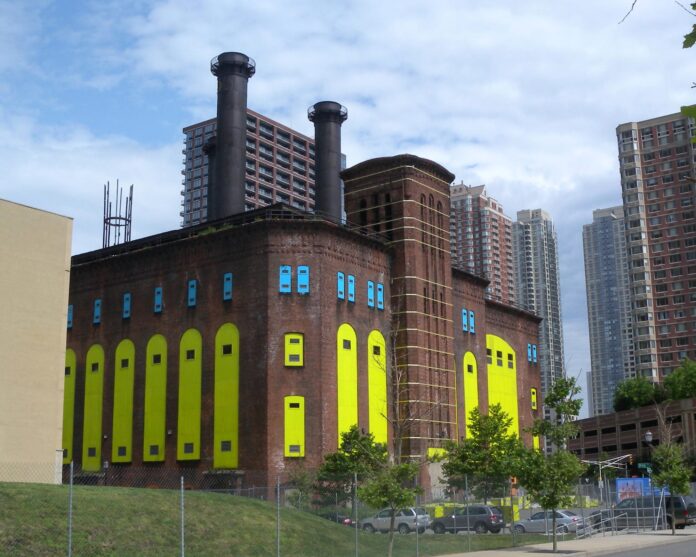

A defining industrial landmark that once helped power the region’s earliest cross-Hudson rail service is now facing its most serious structural crisis in decades, after new damage was discovered at the long-neglected Hudson & Manhattan Railroad Powerhouse in downtown Jersey City.
City officials confirmed that newly visible structural cracking has emerged along portions of the massive brick and steel complex at the corner of Greene and Bay streets, prompting emergency safety measures and temporary traffic disruptions around the site. The building, located just two blocks from the Hudson River, has now been formally classified as an unstable structure as engineers continue to assess the risks posed by ongoing deterioration.
Municipal officials said the latest damage appears to be tied to long-term vibration impacts from the light rail line that runs directly beneath and alongside the property. The transit corridor has operated under the structure for years, but recent inspection activity revealed cracking patterns that had not previously been present or visible.
In response, emergency stabilization efforts were initiated, including the installation of vertical steel restraint straps along the exterior of the building in an effort to hold compromised sections of the façade and interior framing in place. However, city representatives acknowledged that some of the newly installed stabilization hardware showed early signs of loosening, raising further concerns about public safety.
The situation was compounded by one of the harshest winters Jersey City has experienced in years, with repeated snow, freezing temperatures and heavy moisture creating conditions that can accelerate masonry failure and weaken already compromised structural elements.
Out of an abundance of caution, Greene Street was temporarily closed at Bay Street and designated a potential collapse zone while inspectors reviewed the most severely affected areas. Southbound traffic was rerouted along Bay Street during the closure, and pedestrian access around the perimeter of the property was restricted. While the street has since reopened, officials have made clear that monitoring and safety controls will remain in place as the investigation continues.
The scale of the building and the complexity of its deterioration make this far more than a routine property maintenance issue. The former powerhouse stretches the length of an entire city block and has remained largely vacant and deteriorating for years, despite repeated public and private attempts to stabilize, redevelop or repurpose the structure.
The Powerhouse occupies a singular place in Jersey City’s infrastructure history. It first opened in 1908 as a coal- and steam-powered generating facility for the newly constructed Hudson River rail tunnels. Those tunnels made it possible, for the first time, for electric trains to run directly between New Jersey and Manhattan, laying the groundwork for what would later become the modern PATH system.
At the height of its operation, the facility was a critical piece of regional transportation infrastructure, supplying power to one of the most ambitious transit projects in the country at the time. Today, the same building stands as a highly visible reminder of both Jersey City’s industrial legacy and the growing challenges facing large-scale historic preservation in dense urban environments.
The current instability has intensified long-standing questions about whether the Powerhouse can realistically be saved.
For more than a decade, multiple mayoral administrations and redevelopment entities have explored potential reuse scenarios, ranging from cultural and commercial conversions to mixed-use development. None of those concepts have progressed beyond early planning stages, and no formal redevelopment proposals are currently active for the structure itself.
Despite the uncertainty surrounding its future, ownership of the site is scheduled to change in the coming period.
Jersey City is set to formally acquire the Powerhouse property once the Port Authority of New York and New Jersey completes construction of a new electrical substation on an adjacent parcel located directly behind the historic building. The substation project, which broke ground in 2023, remains under active construction and is designed to modernize and replace existing power infrastructure serving the surrounding transportation network.
Under a settlement agreement executed in 2018, the Port Authority is required to transfer the full Powerhouse property to the Jersey City Redevelopment Agency upon completion of the new substation facility. That agreement was intended to finally place the future of the site under local redevelopment control after years of jurisdictional and legal complications.
The redevelopment framework negotiated as part of that settlement includes a Future Revenue Agreement between the city and the Port Authority. Under its terms, any future revenue generated through redevelopment of the Powerhouse would be split evenly between the two parties.
What remains unclear is whether the building’s physical condition will allow any meaningful redevelopment at all.
Structural engineers and preservation advocates have long warned that prolonged vacancy, exposure to moisture and deferred maintenance would significantly increase the cost and complexity of any future rehabilitation. The appearance of fresh cracking and the need for emergency stabilization measures now raise the possibility that portions of the structure may require partial dismantling or extensive reconstruction before any adaptive reuse could be considered.
The situation places Jersey City at a difficult crossroads between preservation, public safety and redevelopment feasibility—an increasingly common challenge for older industrial sites across the state as large legacy structures age faster than funding and planning solutions can keep pace.
As the city prepares to assume ownership, the Powerhouse will almost certainly become one of the most closely watched and technically demanding redevelopment cases in Jersey City. Future decisions about its fate are expected to involve a combination of historic review, structural engineering studies and broader planning discussions tied to nearby infrastructure investment and surrounding neighborhood growth.
Ongoing updates and coverage related to major redevelopment, infrastructure upgrades and structural rehabilitation projects across the state can be found in Sunset Daily News’ dedicated [construction and redevelopment] coverage.
For now, the hulking Powerhouse remains standing, but newly classified as structurally unstable and surrounded once again by uncertainty—its next chapter still unwritten, more than a century after it helped power one of the region’s most transformative transportation breakthroughs.