


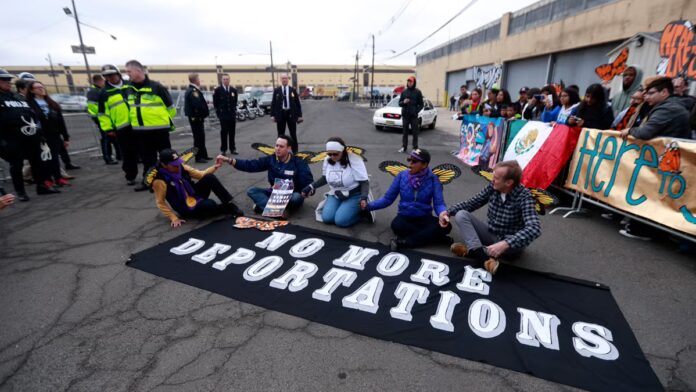

The case of Cristofer Ortega is not just another immigration story—it is a case that cuts directly into how the system is functioning on the ground in New Jersey. Ortega, a 21-year-old resident of Plainfield, was deported to Honduras on March 29, 2026, despite having what many would consider a clear and legitimate path toward permanent legal status in the United States. He had no criminal record, was actively studying for his HVAC license, and had already been approved for Special Immigrant Juvenile (SIJ) status, a designation intended to protect vulnerable young people and provide a structured pathway toward residency.
SIJ status is not a preliminary step or a vague classification. It is a formal recognition under federal law that an individual qualifies for protection due to circumstances such as abandonment, abuse, or neglect, and it is widely understood as a stepping stone toward lawful permanent residency. In Ortega’s case, that pathway appeared firmly in place. Yet, following a traffic stop while visiting family, he was detained by immigration authorities and ultimately removed from the country. The sequence of events raises a fundamental question that now extends far beyond one individual: how secure is a legal pathway if it can be interrupted at any stage?
Across New Jersey, Ortega’s case is not standing alone. A series of similar incidents has surfaced over the past year, involving individuals with long-standing ties to their communities, no criminal histories, and active efforts to comply with the legal system. In Flemington, Karim Daoud—a business owner and father of two U.S. citizen children—was detained on March 12, 2025, during what should have been a routine step in his immigration process. He was there to pick up work authorization documents, part of an ongoing application for a green card through his U.S. citizen spouse. After more than 20 years living in the United States, his detention during a compliance-related appointment illustrates a growing uncertainty: participation in the legal process does not necessarily shield individuals from enforcement actions.
In Bridgeton, Edgar Gomez’s arrest added another layer to this pattern. On March 26, 2026, immigration agents reportedly broke his car window to take him into custody in front of his children after he left a court appearance. His family stated they had spent nine years attempting to formalize his immigration status. The fact that the arrest occurred immediately after a court proceeding—an environment associated with legal compliance—underscores a tension that is becoming increasingly difficult to ignore.
In Newark, Abdellatif Hafraoui, a 60-year-old Moroccan national who had lived in the United States for nearly four decades without a criminal record, was detained at Newark Liberty International Airport in August 2025 while attempting to board a domestic flight to Florida. His case highlights another dimension of enforcement, one that intersects with routine travel and long-term residency rather than any immediate legal violation.
Union City presents yet another variation. Catalino Guerrero, a grandfather who had lived in the United States for more than 25 years with no criminal record, found himself facing deportation proceedings due to a paperwork issue that reportedly originated years earlier. An accountant had misfiled his documentation as an asylum claim, creating a legal complication that lingered over time and ultimately triggered enforcement action. What began as an administrative error evolved into a life-altering situation, raising questions about how procedural mistakes are handled within the system.
What connects these cases is not criminal behavior, but compliance. Each individual was engaged in the legal process—attending appointments, filing paperwork, building cases for lawful status, or simply living within the framework of long-established residency. Yet, despite that engagement, enforcement actions proceeded in ways that appear to contradict the expectation that following the rules provides protection.
The response across communities in New Jersey has been marked by a mix of shock, frustration, and uncertainty. Families have expressed disbelief that individuals who were actively working toward legal status—or who had already secured recognized protections—could be detained or deported under these circumstances. Many of these incidents occurred during routine moments: a traffic stop, a court appearance, an immigration appointment, or a domestic flight. These are not situations typically associated with sudden enforcement outcomes.
New Jersey has long been a focal point for immigration issues due to its diverse population and dense network of immigrant communities. The state’s visibility means that cases like Ortega’s are more likely to surface and gain attention. However, the frequency with which similar stories are emerging suggests that these are not isolated incidents. They reflect a broader pattern that is unfolding across the state.
At the center of this pattern is a growing disconnect between expectation and reality. Public messaging around immigration enforcement has often emphasized a focus on individuals with serious criminal records. Yet, the cases unfolding in New Jersey involve individuals with no criminal history, many of whom were actively pursuing or already on a path toward legal status. That contrast is where the larger issue begins to take shape.
For individuals navigating the immigration system, predictability is essential. It informs decisions about employment, family stability, and long-term planning. When that predictability is disrupted—when compliance does not consistently lead to protection—it introduces uncertainty that extends beyond individual cases and into entire communities.
Cristofer Ortega’s story, along with the cases unfolding across New Jersey, highlights a reality that is becoming increasingly difficult to ignore. The process itself does not always guarantee the outcome people expect. And as more cases continue to surface, the focus shifts from whether these incidents are happening to how often they are occurring, under what circumstances, and what it means for those who believe they are following a clear path toward stability within the system.