



Governor Sherrill’s new upload platform signals a sharp policy shift as civil rights groups and Republicans warn of deepening political and legal conflict
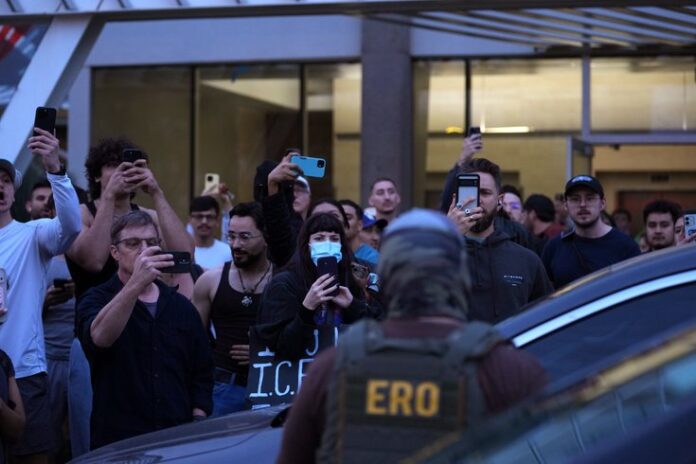
New Jersey has entered a new and highly charged phase in the national immigration debate after Governor Sherrill announced the launch of a statewide online portal that allows residents to upload video footage of Immigration and Customs Enforcement activity, a move framed by the administration as a tool for transparency and community oversight—but criticized by opponents as politically driven and potentially dangerous.
The new system encourages residents to document federal immigration operations in real time, with the governor publicly urging communities to “get your phone out” when ICE activity is observed. Administration officials say the platform is designed to improve accountability, provide a clearer public record of federal enforcement practices, and allow the state to track patterns that may raise civil rights concerns.
The initiative immediately ignited a fierce response inside the Legislature, where partisan divisions over immigration enforcement and public safety are now widening. Republican leaders have accused the administration of effectively placing federal officers under public surveillance while simultaneously limiting the state’s cooperation with federal authorities.
At the center of the legislative pushback is state Senator Jon Bramnick of the 21st Legislative District, who has announced plans to introduce legislation that would criminalize federal immigration officers who conceal their identities during enforcement operations. The proposal would impose jail time on officers who wear face coverings while conducting official duties, a practice that supporters of the bill argue undermines public trust and accountability.
Bramnick has positioned the proposal as a civil liberties measure, arguing that residents deserve to know who is exercising enforcement authority in their neighborhoods. Democratic leadership, however, has signaled firm resistance to the bill, warning that it could interfere with federal operations and expose officers to personal risk.
The standoff is unfolding as Democratic lawmakers simultaneously move to restrict New Jersey’s cooperation with federal immigration enforcement and to block or redirect state-level funding connected to homeland security partnerships that involve ICE. Legislative leaders backing the governor’s strategy argue that the state has an obligation to protect immigrant communities from what they describe as increasingly aggressive federal tactics.
Supporters of the new monitoring portal say public documentation is necessary at a time when immigration enforcement is becoming more visible across urban and suburban communities alike. They argue that video evidence provides an important layer of protection for residents, witnesses, and even officers themselves by offering an objective record of what takes place during encounters.
But law enforcement advocates and several Republican officials warn that encouraging residents to film active enforcement operations risks escalating already tense situations and could place bystanders, officers, and families in danger. They also contend that the portal sends a signal that federal agents should be treated as adversaries rather than public servants carrying out lawful duties.
Civil rights and immigrant advocacy organizations, while welcoming the portal, say the governor’s initiative does not go far enough. Several groups issued statements following the announcement asserting that public video uploads alone will not prevent what they characterize as large-scale deportation campaigns that are expanding across the region. According to advocates, enforcement actions have increased in both visibility and frequency, particularly in working-class communities and areas with large immigrant populations.
These organizations are calling for additional state-level protections, including expanded legal defense funding for immigrants, tighter restrictions on data-sharing between state agencies and federal authorities, and formal limits on when and how local law enforcement can coordinate with ICE.
The political battle now unfolding in Trenton reflects a broader recalibration of New Jersey’s immigration posture under Governor Sherrill, who has made community oversight and state independence from federal enforcement priorities a defining feature of her early administration. Her allies describe the portal as part of a wider effort to restore public confidence in government oversight, while opponents see it as a symbolic move that risks undermining interagency cooperation.
Behind the political rhetoric, business leaders and municipal officials are also watching the situation closely, warning that prolonged conflict between state and federal authorities could ripple into workforce stability, regional investment, and the overall economic climate. Industries that rely heavily on immigrant labor—including construction, logistics, hospitality, healthcare support services, and food distribution—have repeatedly cautioned that uncertainty surrounding enforcement policy can disrupt hiring pipelines and employer planning across New Jersey’s regional economy.
Those broader implications have increasingly pulled immigration enforcement into the state’s wider conversation about growth, development, and the regulatory environment affecting employers, a dynamic now shaping ongoing legislation coverage across the state.
As Democrats move forward with efforts to limit homeland security funding linked to federal enforcement and Republicans prepare legislation aimed at officer identification and accountability, the future of New Jersey’s relationship with ICE appears set for prolonged legal and political confrontation.
For immigrant communities and advocacy groups, the new public upload portal represents a symbolic acknowledgment of long-standing concerns—but not a comprehensive solution. For lawmakers and law enforcement professionals, it marks a dramatic departure from past practice that could permanently alter how immigration enforcement unfolds in New Jersey’s cities and neighborhoods.
With mass deportation efforts escalating nationally and political pressure rising on both sides of the aisle, New Jersey’s approach is now becoming a closely watched test case for how far a state can go in monitoring and challenging federal immigration operations without triggering significant legal and operational backlash.



