



Local Politics, Federal Immigration Policy, and Community Tensions Collide in Morris County After “I Stand With ICE” Post
A single social media post has ignited a far-reaching and emotionally charged debate in Montville, exposing deep divisions within the community over immigration enforcement, federal authority, and the role of local government in a national policy fight that is increasingly landing at the doorstep of suburban New Jersey.
The post, brief and blunt in its message—“I stand with ICE”—was attributed to a local Republican group and surfaced at a particularly sensitive moment, appearing shortly after the fatal shooting of Renee Good in Minneapolis. While the incident occurred hundreds of miles away, the timing intensified public reaction and quickly propelled the message into local political discourse.
In a township of roughly 22,000 residents, the issue has now dominated public comment periods at two consecutive Montville Township Committee meetings, transforming what might otherwise have been a fleeting online statement into a sustained and highly visible community confrontation.
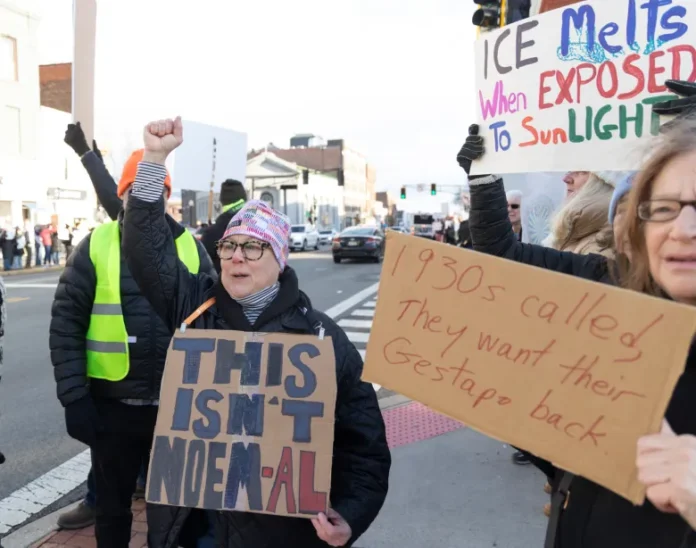
Notably, the debate has unfolded almost entirely among residents rather than elected officials. During both meetings, members of the public engaged in pointed, often emotional exchanges over immigration enforcement, detention practices, and the broader national role of U.S. Immigration and Customs Enforcement.
What makes the situation particularly unusual is that, at present, ICE operations have no direct footprint in Montville itself. The township has not been targeted for enforcement actions, facilities, or official federal partnerships. Yet the controversy has grown well beyond symbolic disagreement.
The local connection, and the catalyst for much of the public anxiety, is centered approximately 15 miles west in Roxbury, where reports have circulated that ICE is exploring the possibility of establishing a detention facility. The prospect of a federal detention site has unsettled residents across the region and has sharpened fears about how immigration enforcement infrastructure could expand into suburban communities.
That concern has already translated into official action elsewhere. In Roxbury, an all-Republican township council adopted a resolution opposing the potential placement of an ICE detention facility within its borders, citing community impact, public perception, and quality-of-life considerations.
That move prompted residents in Montville to press their own governing body to take a similar stand.
However, the legal reality facing municipalities remains clear. Local resolutions carry no binding authority over federal agencies. While such measures can express the political sentiment of a governing body, they do not restrict federal property use, operational decisions, or enforcement authority.
Despite that limitation, speakers during the most recent township meeting argued that symbolic action still carries weight and sends an important message to residents and neighboring communities.
Opponents of immigration detention spoke at length about what they described as inhumane conditions inside detention facilities nationwide and raised concerns that many individuals held by ICE are neither charged with nor convicted of serious crimes. One resident shared a personal account, claiming that a man who had been detained had previously worked in Montville as a waiter, underscoring what she described as the human cost of enforcement policies.
Several speakers insisted that township leaders have a moral obligation to publicly oppose detention practices and to demonstrate solidarity with immigrant residents and families who may feel targeted or fearful, even in the absence of direct enforcement activity within Montville.
Supporters of ICE, in turn, countered that immigration law enforcement is essential to public safety and national sovereignty. They emphasized cases involving violent crimes committed by individuals who entered or remained in the country illegally and argued that a nation cannot function without meaningful border and immigration controls.
One resident noted that previous Democratic presidents, including Bill Clinton and Barack Obama, publicly acknowledged the importance of enforcing immigration laws, pushing back against the notion that the issue is solely partisan. Another speaker, identifying herself as a legal immigrant, argued that individuals who follow established legal pathways should not be treated the same as those who enter the country unlawfully, and said legal immigrants deserve stronger protections under federal policy.
The exchange underscored how immigration enforcement has become one of the most polarizing public issues in local governance, even in communities where no immediate operational changes are occurring.
The discussion ultimately concluded without any formal action by the Montville Township Committee. No resolution was introduced, and elected officials largely remained silent during the public commentary.
Mayor Frank Cooney has not publicly addressed the latest meeting. However, during an earlier session when the controversy first emerged, he stated that the social media post that triggered the backlash did not originate from the Montville Township Republican Club. According to remarks reported by local media at that time, Cooney said the organization was not responsible for the message.
That clarification has done little to slow the debate.
At the same time, the Montville controversy is unfolding against a broader statewide backdrop in which immigration policy and law enforcement boundaries are being redefined at the executive level.
Earlier this year, Governor Mikie Sherrill signed an executive order limiting federal ICE agents’ use of state-owned property, prohibiting such sites from being used as staging areas or processing locations without a judicial warrant. The administration also launched a new “Know Your Rights” website and a public reporting portal designed to document interactions with ICE and provide guidance for residents navigating federal immigration encounters.
Those statewide actions have intensified public attention on the evolving relationship between New Jersey and federal immigration authorities, reinforcing the view among many residents that immigration enforcement is no longer an abstract federal issue, but a policy area with tangible local implications.
As municipal leaders across Morris County monitor developments in Roxbury and other nearby communities, Montville now finds itself drawn into a wider conversation about public safety, civil liberties, and the limits of local authority in shaping federal enforcement policy.
The situation has become a flashpoint in New Jersey’s broader law and order landscape, where questions surrounding public trust, enforcement transparency, and community impact are increasingly intersecting with national political rhetoric.
For now, Montville residents remain divided, and township leaders remain cautious. With no official resolution adopted and no direct federal action pending within the town, the debate is likely to continue—fueled by regional developments, statewide policy shifts, and a community struggling to reconcile sharply different views about immigration, enforcement, and what role local government should play when national controversies arrive at the local microphone.



