



A short but noticeable seismic tremor rolls through central New Jersey, renewing attention on the state’s quiet — but active — fault history
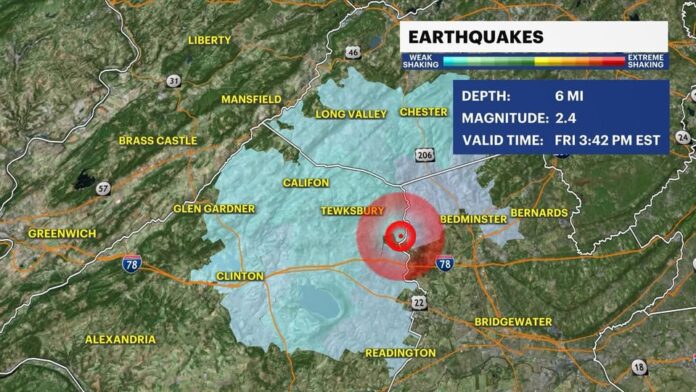
A minor earthquake sent a quick ripple of surprise through parts of Hunterdon County and neighboring communities Thursday afternoon, when a small but clearly felt tremor struck just outside Whitehouse Station and briefly interrupted the normal rhythm of the workday for residents across the region.
The earthquake, measured at magnitude 2.4, occurred at approximately 3:42 p.m. and was centered several miles north-northeast of Whitehouse Station. The shaking originated nearly nine kilometers below the surface, deep enough to limit damage, yet shallow enough for residents in multiple municipalities to feel a sudden jolt, vibration, or low rumble.
From Califon to Lebanon, and through Tewksbury and Glen Gardner, residents described nearly identical experiences — a short burst of movement, a brief shudder through homes and buildings, and in some cases a sharp “boom” that sounded more like a heavy vehicle slamming into a nearby structure than a natural event.
For many, the moment lasted only a second or two.
But it was enough to grab attention.
Social media feeds and neighborhood message boards filled quickly with short posts asking the same question: “Was that an earthquake?”
Emergency officials reported no injuries and no structural damage following the tremor. Early assessments classified the shaking as weak, consistent with what is typically felt during low-magnitude seismic activity in New Jersey. Still, the widespread reports across several towns confirmed that the movement was clearly perceptible to people indoors — particularly in quiet residential settings.
While earthquakes in the Garden State remain relatively uncommon compared to more seismically active parts of the country, they are not unheard of. The area surrounding Whitehouse Station has experienced measurable activity before, including the widely felt magnitude-4.8 earthquake in April 2024 that rattled large portions of New Jersey and neighboring states and became one of the most significant seismic events in the region in decades.
Thursday’s quake, though far smaller, occurred within the same broader seismic corridor that continues to draw scientific monitoring and public interest.
Geologists note that New Jersey sits atop a complex network of ancient fault lines that formed hundreds of millions of years ago. Unlike the major plate boundaries seen along the West Coast, these faults are buried deep and remain mostly inactive. However, accumulated stress within the Earth’s crust can occasionally release small bursts of energy, producing minor earthquakes such as the one felt Thursday afternoon.
Because the faults are older and more fragmented, pinpointing exact long-term patterns remains difficult. What is clear, however, is that even small quakes can be widely felt in the region due to the dense, rigid bedrock beneath much of the state — a geological characteristic that allows seismic waves to travel farther with less energy loss.
Thursday’s tremor was the strongest earthquake recorded in New Jersey since a magnitude-2.8 event near Hillsdale in August 2025. Although neither quake posed a safety threat, the sequence has added to a growing public awareness that the state is not as seismically quiet as many once believed.
Local emergency management officials continue to emphasize that while significant earthquakes remain unlikely in New Jersey, preparedness remains important. Simple precautions — such as securing heavy furniture, knowing safe spots within homes and workplaces, and maintaining basic emergency supplies — can help residents respond calmly should a stronger event ever occur.
State and regional monitoring systems will continue tracking aftershocks, though experts say follow-up tremors after a quake of this size are uncommon and typically too small to be felt.
Residents seeking real-time regional conditions and environmental updates can follow ongoing weather and regional monitoring coverage through Sunset Daily’s dedicated weather reporting section, which tracks atmospheric and geological developments across New Jersey.
For most residents affected by Thursday’s quake, the moment was brief — but memorable.
“It felt like something hit the house,” one Hunterdon County resident said shortly after the shaking stopped. “Then everything went quiet again.”
By early evening, life had returned to normal across Whitehouse Station and surrounding towns. But the short, unexpected tremor served as a reminder that even in a state better known for storms, shorelines and traffic jams, the ground beneath New Jersey can still move.



