



Political anticipation is building inside the State House in Trenton as policymakers, legislative leaders, and economic stakeholders prepare for Governor Mikie Sherrill’s upcoming budget address. In a climate shaped by economic uncertainty, rising fiscal pressures, and national political turbulence, insiders across New Jersey’s capital are closely analyzing what direction the new administration may take as it outlines the state’s financial priorities for the year ahead.
Behind closed doors this week, Democratic lawmakers gathered to examine potential scenarios surrounding the governor’s fiscal strategy. The meetings reflected the cautious tone now surrounding the state’s budget planning process. According to several sources familiar with the discussions, the Sherrill administration has adopted a notably disciplined and guarded approach as it prepares its financial blueprint for the upcoming fiscal year.
Those working inside Trenton’s political ecosystem describe the atmosphere as unusually tight-lipped. Legislative leaders, lobbyists, and policy advisers have been attempting to read signals from the governor’s office while waiting for details that remain largely under wraps.
The reason for the heightened intrigue is clear: New Jersey faces mounting fiscal challenges that could force difficult decisions on spending, tax relief programs, and long-term structural budget planning.
Among the most closely watched issues ahead of the governor’s address is the future of the StayNJ property tax relief initiative—a program that has been widely discussed within the Legislature and strongly supported by Assembly Speaker Craig Coughlin.
StayNJ was designed to provide meaningful financial relief to senior homeowners by reimbursing a portion of their annual property tax bills. Under the current structure of the program, eligible homeowners aged 65 and older can receive reimbursement equal to 50 percent of their property tax payments, up to a maximum benefit of $13,000. For the 2025 benefit year, the cap is set at $6,500.
Eligibility for the program requires homeowners to have owned and occupied their residence for the full calendar year and to maintain annual income below $500,000. The program also extends eligibility to residents who make Payments-in-Lieu-of-Tax to their municipalities.
While the initiative has been promoted as a significant step toward addressing New Jersey’s notoriously high property taxes, insiders now believe the program could face adjustments as Governor Sherrill works to balance the state’s budget.
Sources familiar with ongoing discussions say lawmakers expect the governor may revise the program rather than eliminate it entirely.
One possibility gaining traction among legislative observers involves means-testing the program so that its benefits are more tightly targeted toward middle-income and moderate-income seniors rather than higher-earning households.
Under such a revision, individuals earning at the upper end of the program’s eligibility threshold—such as homeowners with incomes approaching $500,000 annually—could potentially lose access to the tax relief benefit.
Supporters of the adjustment argue that narrowing eligibility would help preserve the program while reducing pressure on the state’s long-term financial outlook.
Critics, however, warn that any scaling back could provoke political backlash among homeowners who have been counting on property tax relief.
The debate highlights the broader challenge facing the Sherrill administration as it prepares its first major budget proposal: balancing fiscal discipline with the demands of a state where property taxes remain one of the most significant economic concerns for residents.
Governor Sherrill herself has signaled that controlling costs will be a central focus of her administration.
During recent discussions with legislative leadership in both chambers, the governor emphasized that the budget must reflect the financial realities facing the state while still addressing the needs of residents.
Property taxes, she acknowledged, remain one of the most frequently raised issues among constituents across New Jersey.
Behind the policy debate lies a larger fiscal concern that has been quietly shaping budget discussions in Trenton.
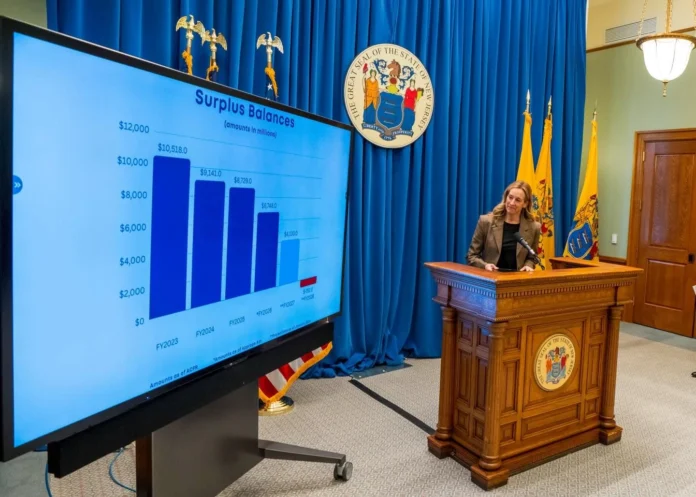
State financial projections indicate that without adjustments to spending growth, New Jersey’s budget reserves could face significant pressure over the next several years.
According to recent fiscal analysis, the state’s projected $7.2 billion surplus could begin to erode by fiscal year 2027 if spending continues to expand at its current pace. By fiscal year 2028, some projections suggest the state could face a deficit approaching $750 million.
These numbers have reinforced calls within government for a more measured approach to budgeting.
New Jersey’s annual spending plan has grown dramatically over the past decade, expanding from approximately $35.5 billion at the end of Governor Chris Christie’s administration to roughly $58 billion in recent years.
That expansion reflects a range of policy priorities, including investments in education, healthcare, infrastructure, and social services.
However, maintaining that level of spending growth amid uncertain revenue forecasts has become an increasingly complex challenge for state leaders.
Several lawmakers say Governor Sherrill appears prepared to adopt a more restrained fiscal approach compared with recent budgets.
Some insiders are describing the expected spending plan as relatively flat compared with previous years, with fewer large-scale spending additions or legislative “Christmas tree” items—political shorthand for the last-minute inclusion of unrelated projects and funding allocations that sometimes appear in final budget negotiations.
If those expectations prove accurate, the upcoming budget proposal could represent a reset moment for New Jersey’s fiscal trajectory.
Complicating the state’s financial outlook are broader national developments that could influence both revenue and spending obligations.
Federal policy shifts, international geopolitical tensions, and economic uncertainty have all contributed to a more volatile fiscal environment.
Within Trenton’s political circles, these factors are shaping conversations about how aggressively the state can expand programs or commit to long-term spending obligations.
Some policymakers have also expressed concern about how upcoming federal budget proposals could affect New Jersey’s financial position.
Federal funding plays a significant role in supporting a range of state programs, from healthcare and transportation infrastructure to disaster relief and education initiatives.
Changes to federal funding formulas or spending priorities could have ripple effects on state budgets across the country, including in New Jersey.
Against that backdrop, the Sherrill administration appears to be carefully calibrating its strategy.
One recurring theme emerging from conversations in Trenton is the governor’s emphasis on maintaining discipline within the budgeting process.
According to insiders familiar with the administration’s approach, senior staff members have been tightly controlling the flow of information about the upcoming proposal.
Even key legislative allies have reportedly received limited advance briefing on the details.
That approach reflects a leadership style focused on maintaining strategic flexibility until the final proposal is unveiled.
Observers say the administration’s “close-to-the-vest” posture has created an atmosphere of heightened speculation among lawmakers and policy analysts who are attempting to anticipate the governor’s priorities.
The upcoming budget address will therefore serve as one of the first major opportunities for Governor Sherrill to define her governing philosophy and fiscal priorities before the entire state.
Beyond the immediate budget debate, the governor is also continuing to engage with the broader business and economic community.
Later this month, Governor Sherrill will deliver a keynote address at the New Jersey Chamber of Commerce ReNew Jersey Business Summit & Expo, scheduled for March 31 at Harrah’s Atlantic City.
The annual summit is expected to bring together business leaders, policymakers, and economic development officials from across the state to discuss strategies for strengthening New Jersey’s economic competitiveness.
For the governor, the event will offer another platform to outline her administration’s vision for economic growth, fiscal stability, and public policy priorities in the months ahead.
As Trenton prepares for the release of the budget proposal, the coming weeks are likely to bring intense negotiations between the governor’s office and legislative leadership.
Budget debates in New Jersey traditionally involve months of hearings, revisions, and political bargaining before a final spending plan is approved.
The stakes are particularly high this year because the budget will help determine how the state addresses property tax relief, manages its surplus reserves, and positions itself for potential economic uncertainty ahead.
For residents across the Garden State, the decisions made during this process will shape everything from tax policy and public services to infrastructure investment and long-term fiscal stability.
Political observers throughout the state will be watching closely as Governor Mikie Sherrill steps to the podium to present her administration’s financial roadmap.
For the latest coverage of New Jersey government, policy debates, and statewide political developments, readers can follow continuing updates in the Sunset Daily News politics section, where the evolving story of the Garden State’s leadership and legislative landscape continues to unfold.



