


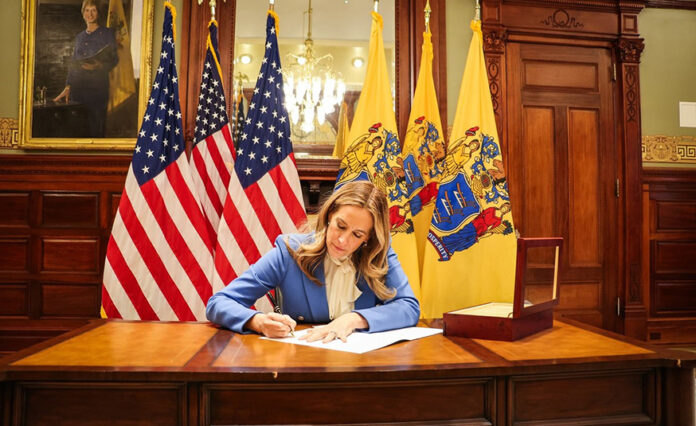

New Jersey politics entered a defining moment this week as Governor Mikie Sherrill moves to reshape the state’s infrastructure agenda, prepare for her first major budget address, and confront a series of complex national and state-level challenges that are quickly positioning her administration at the center of the Garden State’s evolving political landscape.
For residents across North Jersey—from Newark and Jersey City to Bayonne and Hoboken—the developments unfolding in Trenton are more than political headlines. They signal a major recalibration of how the state approaches transportation infrastructure, fiscal policy, federal relations, and the everyday economic realities facing millions of commuters, taxpayers, and businesses.
In a sweeping set of announcements and policy moves, Sherrill has begun outlining what her leadership will look like during the first critical months of her governorship: pragmatic infrastructure investment, fiscal restraint in the face of structural budget pressures, and assertive engagement with federal agencies and international developments affecting New Jersey residents.
The decisions made this week—particularly regarding the Newark Bay Bridge project and the upcoming Fiscal Year 2027 state budget—are already shaping what could become one of the most consequential policy chapters in recent New Jersey history.
New Jersey’s Transportation Future Rewritten as Newark Bay Bridge Project Is Scaled Back
At the center of the week’s most significant development is Governor Sherrill’s decision to scale back the long-debated Newark Bay Bridge expansion project—one of the largest transportation initiatives ever undertaken by the New Jersey Turnpike Authority.
The original proposal, developed during the previous administration, envisioned an ambitious and controversial plan to replace the existing bridge with twin eight-lane spans while widening large sections of the Hudson County Extension between Newark, Jersey City, and Bayonne. That concept was part of a broader multibillion-dollar program to reconstruct more than two dozen bridges and upgrade over eight miles of highway infrastructure leading toward the Holland Tunnel.
While supporters argued the plan would accommodate future traffic demand and improve freight mobility, critics—particularly environmental groups, neighborhood organizations, and local officials—warned that expanding highway capacity would dramatically increase vehicle congestion and worsen air pollution in already overburdened urban communities.
After weeks of review and consultation with regional stakeholders, the Sherrill administration announced a dramatically revised approach.
Instead of constructing a massive eight-lane expansion, the state will now focus on replacing the aging Newark Bay Bridge with a modern four-lane span equipped with improved shoulders and critical safety upgrades. The revised project maintains the essential goal of replacing the deteriorating 70-year-old structure while removing the most controversial aspects of the previous proposal.
The bridge replacement alone carries an estimated cost of approximately $6.7 billion and is expected to become the largest single infrastructure investment ever advanced by the New Jersey Turnpike Authority.
Despite the scaled-down scope, the economic impact remains substantial.
State officials estimate the project will support roughly 19,000 jobs across the construction, engineering, and transportation sectors while generating significant economic activity throughout the region. The new bridge is also designed to allow traffic to gradually shift away from the existing aging span by 2031, addressing safety concerns raised by federal transportation authorities regarding the long-term reliability of the current structure.
Support for the revised approach quickly emerged from local leaders in Hudson and Essex counties, many of whom had opposed the previous expansion plan.
Officials from Newark and Jersey City welcomed the decision as a balanced solution that modernizes critical infrastructure while reducing the environmental risks associated with major highway expansion projects.
Urban planners and transit advocates also praised the move as a signal that the state may be shifting toward a more sustainable transportation strategy—one that prioritizes infrastructure modernization without necessarily increasing roadway capacity in densely populated communities.
Still, the decision has not been without controversy.
Some construction industry leaders have expressed concern that certain project labor requirements could limit participation by smaller contractors, including minority-owned and women-owned firms that operate outside union structures. Critics argue that such policies may inadvertently restrict competition and increase overall project costs.
For Governor Sherrill, however, the revised bridge plan represents an effort to strike a careful balance between infrastructure investment, economic opportunity, and environmental responsibility.
The Newark Bay Bridge has long been recognized as a critical link in the region’s transportation network, carrying commuters, freight traffic, and travelers moving between New Jersey and New York City through the Holland Tunnel corridor. Ensuring its long-term safety and reliability remains a top priority for the state.
By choosing to replace rather than dramatically expand the bridge, the administration appears determined to modernize infrastructure while avoiding the unintended consequences of increased highway capacity in already congested urban areas.
A Budget Defining the New Administration
While the infrastructure announcement captured statewide attention, another moment looms just days away that could define the trajectory of Sherrill’s governorship.
On Tuesday, March 10, the governor will deliver her first Fiscal Year 2027 Budget Address from the State House in Trenton—a major milestone that will outline her administration’s fiscal priorities and economic strategy for the coming year.
The address arrives at a challenging moment for New Jersey’s finances.
According to early estimates, the state faces a structural deficit of between $3 billion and $4 billion inherited from previous budget cycles. Rising costs associated with Medicaid, pension obligations, and education funding continue to exert pressure on the state’s long-term fiscal outlook.
Despite those challenges, Sherrill has repeatedly emphasized one central commitment: the administration does not intend to raise taxes.
Instead, state agencies have been directed to identify cost savings and operational efficiencies across departments in an effort to stabilize the budget without placing additional financial burdens on residents.
This approach reflects one of the defining themes of Sherrill’s political message since her campaign for governor—making New Jersey more affordable while maintaining the investments necessary to support economic growth and public services.
Recent political coverage across the state has highlighted growing concern about shrinking budget surpluses and long-term fiscal sustainability. Policymakers are increasingly aware that the next few budget cycles may require difficult decisions about spending priorities and structural reforms. (Sunset Daily News)
The upcoming budget address will likely outline how the administration intends to navigate those challenges while continuing to fund major initiatives such as transportation infrastructure, public education, and healthcare programs.
For lawmakers in Trenton, the speech will serve as the opening chapter of what could become a highly consequential legislative debate over the direction of New Jersey’s economy.
International Crisis Brings New Responsibilities for State Leadership
Beyond domestic policy and fiscal management, Governor Sherrill has also been forced to address international developments that directly affect New Jersey residents.
Following escalating tensions in the Middle East and the suspension of several commercial airline routes in the region, a number of New Jersey residents found themselves stranded overseas.
In response, the governor issued a public statement confirming that her administration is actively coordinating with the White House, the U.S. State Department, and members of the state’s congressional delegation to assist affected residents.
The effort involves helping families access emergency travel information, connecting individuals with federal resources, and encouraging Americans abroad to enroll in the Smart Traveler Enrollment Program, which allows the State Department to provide real-time safety alerts and assistance during international crises.
For Sherrill, a former Navy helicopter pilot who served nearly a decade in the military during the Global War on Terror, the situation carries personal significance.
Her background in national security and military operations has informed her approach to the crisis, emphasizing preparedness, coordination with federal agencies, and ensuring that American citizens abroad receive clear guidance and support.
While the situation remains fluid, state officials say they will continue working with federal authorities to facilitate the safe return of New Jersey residents affected by the travel disruptions.
Immigration Policy Battle Intensifies
At the same time, the governor’s policy agenda has collided with a growing legal battle involving federal immigration enforcement.
Earlier this year, the administration issued an executive order restricting federal immigration agents from accessing certain areas of state-owned property without a judicial warrant. The measure also prevents federal authorities from using state facilities as operational bases for immigration enforcement activities. (The Guardian)
Supporters of the policy argue that it protects civil liberties and prevents potential abuses by federal agents, particularly in sensitive locations such as public buildings and community institutions.
Critics, however, say the policy interferes with federal law enforcement responsibilities and could create conflicts between state and federal authorities.
The dispute has now escalated into a legal challenge from the federal government, setting the stage for a high-profile court battle that may ultimately determine how far states can go in regulating immigration enforcement activities within their borders.
The case is likely to become one of the most closely watched legal conflicts between New Jersey and the federal government in recent years.
Political Alliances and Regional Leadership
Amid the policy debates, the governor has also begun strengthening political alliances across the state.
One recent example came with her endorsement of longtime Essex County Executive Joseph DiVincenzo for re-election, praising his leadership on infrastructure improvements and fiscal management within one of New Jersey’s largest counties.
The endorsement reflects an effort by the new administration to reinforce partnerships with local leaders who play a key role in implementing state policies at the county and municipal level.
Sherrill has also completed a series of staffing announcements, formally appointing dozens of advisers and senior officials drawn from federal government positions, policy organizations, and her previous congressional office.
The appointments signal an administration that intends to blend national policy experience with local expertise as it tackles some of the state’s most complex challenges.
A New Era in New Jersey Politics
Governor Mikie Sherrill entered office earlier this year after winning one of the most closely watched gubernatorial elections in the country, becoming New Jersey’s 57th governor and continuing a period of Democratic leadership in the state. (People.com)
Her victory followed years of service in Congress representing New Jersey’s 11th District and a prior career in the U.S. Navy, where she flew helicopters during overseas deployments.
Now, only weeks into her tenure as governor, the decisions emerging from Trenton suggest that her administration intends to move quickly on some of the state’s most pressing issues—from aging infrastructure and fiscal pressures to immigration policy and international crises affecting residents abroad.
The scaled-back Newark Bay Bridge project alone could reshape the transportation landscape of North Jersey for decades to come.
Meanwhile, the upcoming state budget will test the administration’s ability to balance fiscal discipline with continued investment in public services and economic development.
Together, these developments mark the beginning of what could become a defining period for New Jersey governance.
For residents across the Garden State, the policies taking shape in Trenton today will influence everything from daily commutes and environmental quality to tax policy and economic opportunity.
As the governor prepares to deliver her first major budget address and continue navigating a rapidly evolving political environment, one thing is already clear: the next chapter of New Jersey’s future is being written right now.