


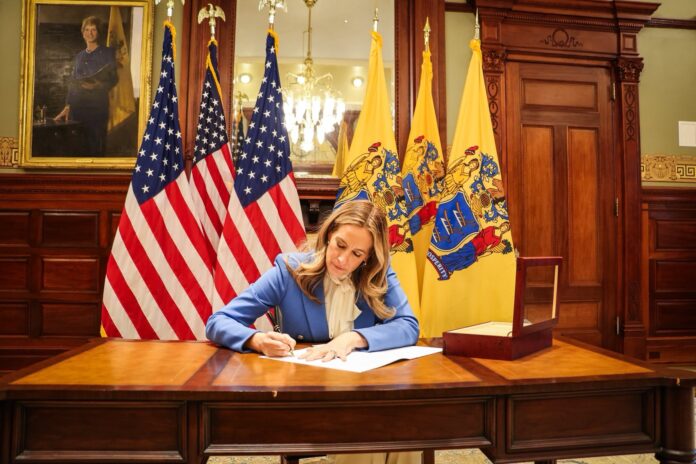

New Jersey’s political landscape is shifting rapidly in early 2026, as Governor Mikie Sherrill and Lt. Governor Dale Caldwell move swiftly to define their administration’s priorities while a high-stakes congressional special election in the state’s 11th District intensifies partisan tensions and national policy debates. From sweeping transition reports outlining structural reforms to a controversial executive order addressing federal immigration enforcement — and a fiercely contested CD-11 race shaping the political narrative — the Garden State has emerged as a central arena for policy direction, governance reform, and ideological contest.
This moment represents not merely a routine change in leadership but a comprehensive recalibration of New Jersey’s political trajectory, touching everything from housing affordability and mental health services to federal-state relations and electoral strategy. The early actions of the Sherrill-Caldwell administration, combined with the escalating rhetoric surrounding the CD-11 special election, signal a transformative period for governance, public policy, and political identity across New Jersey.
The Sherrill-Caldwell Transition: A Blueprint for Structural Reform
Governor Sherrill and Lt. Governor Caldwell entered office with an aggressive timeline, deploying specialized transition “Action Teams” tasked with evaluating core policy areas and delivering strategic recommendations to guide the administration’s first phase of governance. Their final reports — released this week — outline a broad reform agenda centered on three dominant priorities: mental health access, housing affordability, and government accountability.
The transition framework reflects a technocratic approach to governance, emphasizing measurable outcomes, institutional modernization, and expanded public access to services. The administration’s early messaging positions these reforms not simply as policy adjustments but as structural interventions intended to reshape the state’s long-term economic and social resilience.
Mental health reform emerged as a central pillar of the transition process. The Action Teams recommended expanding community-based treatment networks, strengthening crisis intervention infrastructure, and integrating mental health services into primary care systems. These proposals respond to ongoing statewide concerns about post-pandemic psychological impacts, workforce shortages in behavioral health services, and disparities in access across urban and suburban communities.
Housing affordability also received substantial attention, with recommendations addressing rising property costs, zoning reform, and expanded development incentives aimed at increasing supply while protecting community stability. New Jersey’s persistent housing cost pressures — particularly in high-density regions near major employment corridors — have increasingly shaped economic mobility, workforce retention, and regional competitiveness.
Equally significant is the administration’s emphasis on government accountability. Transition recommendations call for greater transparency mechanisms, modernization of administrative processes, and enhanced oversight frameworks intended to strengthen public trust in state institutions. This governance-focused agenda reflects broader national conversations about institutional legitimacy and the role of state governments in delivering efficient public services.
Together, the transition reports establish an early policy roadmap that positions the Sherrill-Caldwell administration as reform-oriented, data-driven, and focused on long-term structural change.
Executive Order on ICE Operations Signals Assertive State-Federal Positioning
Alongside its domestic reform agenda, the Sherrill administration has taken a decisive stance on federal immigration enforcement, recently signing an executive order designed to push back against federal Immigration and Customs Enforcement operations within New Jersey.
The order reflects an increasingly prominent dynamic in contemporary governance: the negotiation of authority between state governments and federal agencies. By asserting limits on cooperation with certain federal enforcement activities, the administration is signaling a policy framework centered on state autonomy, civil protections, and local jurisdictional control.
Supporters characterize the action as necessary to protect vulnerable communities and maintain public trust in local institutions. Critics argue the move raises concerns about federal enforcement capacity and legal boundaries. Regardless of perspective, the order positions New Jersey at the forefront of ongoing national debates surrounding immigration policy, federal authority, and state sovereignty.
The decision also underscores the administration’s willingness to engage directly in politically sensitive policy arenas early in its tenure, reinforcing its broader strategy of rapid, decisive action across multiple fronts.
CD-11 Special Election: A Political Flashpoint
While the governor’s policy initiatives shape statewide governance, the special election in New Jersey’s 11th Congressional District has quickly become one of the most closely watched political contests in the region.
The race will fill the congressional seat vacated by Mikie Sherrill following her transition to the governor’s office, with the April 16 election determining representation for the remainder of the term. The district spans portions of Essex, Passaic, and Morris counties and carries a significant Democratic registration advantage — roughly 60,000 voters — shaping expectations for the contest while intensifying partisan messaging strategies.
Republican candidate Joe Hathaway has launched an aggressive campaign against Democratic nominee Analilia Mejia, delivering pointed criticisms during a recent appearance on Power & Politics on News 12. Hathaway described Mejia as a “radical anti-Semitic socialist,” arguing her positions conflict with American values and could marginalize the district’s Jewish community.
The rhetoric marks a sharp escalation in campaign discourse and reflects broader national political polarization. For some observers, the language represents conventional campaign positioning by an underdog candidate facing unfavorable registration numbers. For others, it illustrates the increasingly ideological framing of congressional races across the country.
Democratic Response and Messaging Strategy
Democratic leaders and party organizations have moved quickly to counter Republican characterizations of Mejia. Party messaging emphasizes her experience as an Essex County Democratic committee member, former Biden administration official, and leader in New Jersey’s democracy-building initiatives, positioning her as a mainstream political figure focused on domestic policy priorities.
Party communications also highlight Mejia’s emphasis on health care access, economic stability, democratic institutions, and cost-of-living concerns — issues Democrats argue reflect voter priorities across the district.
In response to accusations regarding anti-Semitism, Mejia has publicly condemned all forms of hate and emphasized her commitment to the dignity and security of all communities, including Jewish residents. She has acknowledged the rise in anti-Semitism nationally and framed her campaign around inclusive values and civil protections.
On foreign policy issues related to Israel, Mejia has expressed support for Israel’s security while advocating oversight of U.S. military aid to ensure civilian protections — a position aligned with progressive Democrats but debated within broader party coalitions.
AIPAC’s Role and the Primary Landscape
The dynamics of the general election cannot be fully understood without examining the Democratic primary that preceded it. The contest drew significant outside attention, particularly from the American Israel Public Affairs Committee (AIPAC), which invested more than $2 million in advertising efforts targeting former congressman Tom Malinowski, widely viewed as the early frontrunner.
Although the campaign focused heavily on issues related to immigration enforcement and policy positioning, Malinowski ultimately lost the primary, with Mejia emerging as the unexpected victor on February 5. Her win marked a notable moment in the district’s political evolution, reflecting both grassroots mobilization and shifting ideological currents within Democratic voters.
AIPAC’s involvement also elevated foreign policy and national security debates within a race otherwise centered on domestic issues, setting the stage for continued political conflict in the general election.
Campaign Themes and Electoral Reality
The CD-11 contest illustrates a recurring reality in modern elections: campaigns often become defined by issues candidates themselves may not prioritize. While Mejia’s platform emphasizes domestic concerns such as economic opportunity and democratic governance, campaign discourse has increasingly focused on ideological identity, foreign policy positions, and broader national debates.
Republican strategy appears aimed at framing the race as a referendum on ideological direction, seeking to mobilize moderate and independent voters by portraying Mejia as representing a far-left shift. Democratic messaging, by contrast, emphasizes pragmatic governance and community-focused priorities.
The result is a campaign that reflects not only local political dynamics but also national partisan tensions, illustrating how congressional races serve as proxies for broader ideological battles.
New Jersey at a Political Crossroads
Taken together, the Sherrill-Caldwell administration’s policy initiatives and the contentious CD-11 special election underscore a pivotal moment for New Jersey politics. The state is simultaneously pursuing structural governance reforms, redefining state-federal relationships, and navigating a highly charged electoral environment.
The governor’s early actions demonstrate a commitment to rapid policy implementation and institutional change, while the congressional race highlights the continuing influence of national political narratives at the local level. These parallel developments reveal a state in transition — politically, administratively, and ideologically.
As New Jersey moves deeper into 2026, the outcomes of both governance initiatives and electoral contests will shape the state’s policy direction, economic trajectory, and political identity for years to come. For residents, policymakers, and political observers alike, the developments unfolding today mark the beginning of a consequential new chapter in the Garden State’s public life.