


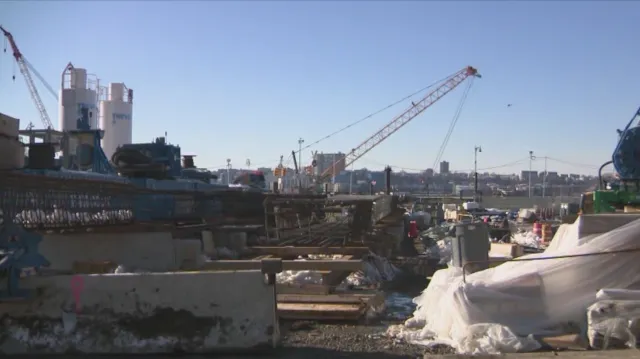

After days of legal back-and-forth, New Jersey’s most critical transportation project remains stalled, with federal funding for the Gateway Tunnel still frozen while a higher court weighs the next move in a fast-moving legal battle that has already rippled through construction sites, union halls and local economies across the region.
The latest twist came Monday when a temporary pause was placed on a court order that would have restarted more than $200 million in federal funding tied to early work on the multibillion-dollar Gateway Program. As of Tuesday, February 10, the money remains locked up, leaving construction activity at a standstill and nearly 1,000 workers sidelined while the appeals process plays out.
The uncertainty stems from a narrow but highly consequential procedural step. Last week, on February 6, U.S. District Judge Jeannette Vargas ordered the federal government to lift its funding freeze, agreeing with New Jersey and New York that the shutdown was causing immediate and irreparable harm to the project and the broader public interest. That ruling was widely interpreted as a green light for work to resume.
But over the weekend, the U.S. Department of Justice filed an emergency appeal with the 2nd Circuit Court of Appeals, triggering a short administrative stay granted by Judge Vargas on Monday. The pause gives the appellate court time to review the case and keeps the federal government from being required to release the funds during that window.
The stay is scheduled to remain in effect until Thursday, February 12, at 5 p.m. Unless the appeals court intervenes before that deadline, the original court order to release the funds would once again take effect.
The rapid sequence of rulings has fueled confusion among contractors, workers and public officials. The apparent contradiction between a judge rejecting a request for a permanent delay while simultaneously approving a temporary pause has led to mixed headlines suggesting that funding had already been restored. In reality, the funding freeze remains in place.
For those closely following developments around the project and other regional infrastructure impacts, ongoing updates are being tracked through Sunset Daily’s rolling coverage and regional updates, including in our broader New Jersey public information and update center.
The human and economic impact of the shutdown is already being felt well beyond the construction fencing surrounding the tunnel approach sites.
Union leaders say the halt in activity has forced nearly 1,000 skilled workers off job sites, freezing paychecks and interrupting spending that normally flows directly into surrounding communities. Local businesses that depend on daily construction traffic — including food vendors, suppliers, equipment services and nearby housing providers — are also feeling the sudden slowdown.
Labor representatives have warned that the funding freeze affects far more than idled crews. Essential household spending on rent, groceries and transportation is being disrupted as workers wait for clarity on when they can return to work.
Governor Mikie Sherrill returned Monday morning to a Gateway Tunnel construction area near Tonnelle Avenue, donning a hard hat for her third site visit since taking office less than a month ago. Her appearance came alongside U.S. Senate Majority Leader Chuck Schumer and union leadership in a show of support aimed at keeping public attention on the funding standoff.
The message at the site was direct and forceful. Union officials framed the freeze not as a technical dispute over federal process, but as a direct hit on American workers. One labor leader told the crowd that workers were not simply getting the short end of the stick — they were getting the stick itself.
Another speaker went further, promising a political response to the funding freeze and warning that halting the project would provoke a broader labor backlash.
The rhetoric highlights an emerging political tension that extends well beyond New Jersey’s transportation needs.
President Donald Trump has built significant electoral support among working-class voters and union households in three consecutive presidential campaigns. Those voters were once a cornerstone of Democratic coalitions in the Northeast and industrial regions, but cultural and social issues shifted many toward Republican candidates in recent years.
Now, critics of the funding freeze are questioning why a project that would generate thousands of union jobs — and support a wide range of skilled trades — is being blocked by an administration that has relied heavily on blue-collar backing.
From a policy perspective, transportation advocates argue that the decision to halt Gateway work defies both infrastructure needs and long-term economic logic. The existing North River Tunnel, which carries Amtrak and NJ Transit trains beneath the Hudson River, is more than a century old and continues to operate under structural and reliability concerns stemming from Superstorm Sandy and decades of heavy use.
From a political standpoint, the move has raised eyebrows inside New Jersey’s already volatile electoral landscape.
At the rally, Schumer emphasized that the Gateway project boils down to a single overriding benefit.
“Jobs, jobs and more jobs,” he said.
The broader economic picture may be amplifying the political risk. National economic polling released this week shows a sharp erosion in public approval of the administration’s handling of the economy, an issue that had previously been one of Trump’s strongest political assets. Political analysts have pointed out that canceling or delaying a high-profile construction project with thousands of jobs attached sends a contradictory signal to voters concerned about economic stability.
Behind the scenes, speculation continues to swirl over the motivations driving the federal government’s resistance to releasing the funds. Some officials close to the negotiations suggest that the standoff has less to do with transportation planning and more to do with longstanding personal and political disputes involving infrastructure priorities in the Northeast.
Reports circulating in political circles claim that the administration previously floated the idea of releasing funding in exchange for naming major transportation hubs after the president — including Penn Station and Dulles International Airport — an idea that was widely dismissed but has since become symbolic of how personal legacy considerations may be influencing infrastructure decisions.
The political implications are growing more serious as New Jersey looks toward an increasingly competitive congressional election cycle.
By most political accounts, the administration’s earlier decision to terminate Gateway funding last fall damaged Republican gubernatorial candidate Jack Ciattarelli’s campaign. Party strategists are now watching closely to see whether the renewed funding fight will further complicate the outlook for New Jersey’s Republican congressional candidates, particularly in suburban districts where transportation reliability and economic development remain top voter concerns.
With the appeals court now holding the next critical decision, state leaders, labor groups and transportation advocates are bracing for a ruling that will either reopen the flow of federal funding later this week or extend the freeze into yet another uncertain phase.
For New Jersey, the stakes go well beyond one project. The Gateway Tunnel has become a test case for how federal infrastructure priorities, labor economics and political calculations intersect — and whether the region’s long-planned investment in its most vital transportation corridor will remain hostage to a widening national political battle.



