


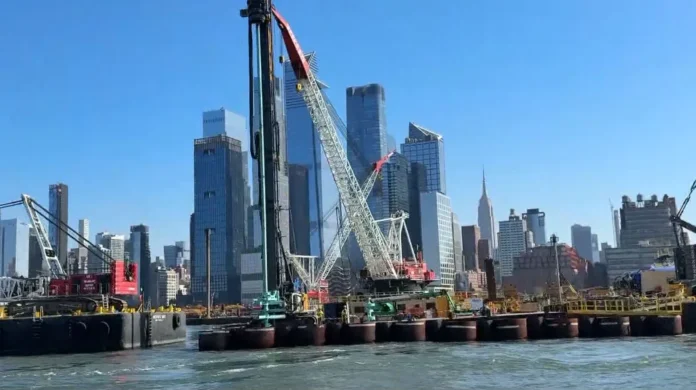

A major federal court decision restoring funding for the long-delayed Gateway rail tunnel beneath the Hudson River is being hailed as a critical turning point for New Jersey’s transportation future and for the broader economic stability of the entire Northeast Corridor.
U.S. Rep. Bonnie Watson Coleman, who represents New Jersey’s 12th Congressional District, issued a forceful response after a federal appeals court ordered the Trump administration to resume financial support for the Gateway Tunnel project connecting New Jersey and New York.
Watson Coleman said the tunnel is not simply another large public works project, but one of the most essential pieces of national infrastructure in the country. She emphasized that millions of commuters, travelers and freight operators rely on the aging rail corridor that runs through the Hudson River crossing each year, and warned that delaying the project would have placed the region’s transportation backbone at serious long-term risk.
The congresswoman also criticized the administration’s prior decision to halt funding, arguing that the freeze lacked legitimate policy justification and threatened economic growth, regional mobility and thousands of union construction jobs tied to the project. She praised the court’s ruling for restoring certainty to the project and allowing construction planning and federal coordination to move forward without political interference.
The Gateway Program is designed to replace and expand century-old rail infrastructure that currently serves as the primary rail connection between New Jersey and Manhattan. The new tunnel will dramatically improve reliability on one of the most heavily traveled passenger rail corridors in North America and is expected to provide long-term resiliency for Amtrak and NJ Transit service.
Transportation experts have repeatedly warned that the existing tunnels—damaged during Superstorm Sandy—remain one of the most vulnerable choke points in the entire national rail network. Any prolonged shutdown would ripple through the economy, affecting workers, businesses, ports, tourism and supply chains far beyond New Jersey and New York.
The court’s order effectively removes one of the most significant funding uncertainties hanging over the Gateway project and allows federal partners, regional transit agencies and construction teams to continue advancing what has been described as one of the largest infrastructure undertakings in the country.
The decision also comes at a pivotal moment for New Jersey, which is already experiencing an unprecedented wave of large-scale transportation and redevelopment activity statewide.
In East Brunswick, a major $86.1 million rehabilitation of Route 18 is now well underway, with completion targeted for fall 2026. The project is focused on improving traffic flow, safety and long-term pavement durability along one of Central Jersey’s most heavily traveled commercial corridors. At the same time, Route 206 is being widened near Hillsborough as part of a multi-phase improvement effort, with several major construction milestones scheduled for summer 2026.
Urban redevelopment projects are also reshaping several North Jersey communities. In Paterson, construction is nearing completion on 138 new luxury apartments at the former Paterson Armory site, converting a long-vacant historic property into a modern residential development that city officials say will help strengthen the downtown housing market and attract new investment. In Bergen County, Westfield Garden State Plaza in Paramus is preparing for a large-scale mixed-use transformation that will introduce new residential, hospitality and lifestyle components to one of the state’s most prominent retail destinations.
Along the Jersey Shore, Ventnor City is moving forward with a $7.1 million reconstruction of its historic boardwalk. The project, which is expected to be completed by May 2026, is focused on long-term structural resilience, improved accessibility and modernized public amenities designed to support tourism and seasonal business activity.
Together, these initiatives reflect a broader statewide surge in public and private investment tied to transportation upgrades, housing development and commercial revitalization. Readers following major statewide building and infrastructure initiatives can find expanded coverage of New Jersey’s ongoing construction and redevelopment activity through Sunset Daily News.
The Gateway tunnel ruling also coincides with another major operational milestone for New Jersey’s rail system.
Amtrak and NJ Transit have officially begun the highly complex “cutover” process that will transition rail operations from the aging Portal Bridge to the newly completed Portal North Bridge. During this transitional period, rail service across the bridge will be temporarily reduced as crews complete system testing and operational integration.
Between February 15 and March 15, the number of NJ Transit trains operating across the bridge will drop from approximately 332 trains per day to about 178, allowing engineers to safely finalize the transfer of service to the new structure. Transportation officials have described the cutover as one of the most technically challenging stages of the project, but also one of the most critical for improving long-term reliability on the busy rail corridor.
Once fully operational, the new Portal North Bridge will eliminate a long-standing bottleneck that has historically caused cascading delays across the regional rail network.
For New Jersey leaders, the restoration of Gateway tunnel funding and the steady progress on projects such as Portal North, Route 18, Route 206 and major urban redevelopments reinforce a broader message: the state’s economic competitiveness and quality of life are increasingly tied to sustained, large-scale investment in modern infrastructure.
With the court clearing the path for continued federal support, New Jersey officials and transportation advocates say the Gateway tunnel is once again firmly positioned as the centerpiece of the region’s long-term transportation strategy—one that is expected to define mobility, economic growth and construction activity in the state for decades to come.