



New Jersey’s 11th Congressional District has officially entered one of the most complex and strategically layered political cycles in recent memory, and the fallout from this week’s filing deadline has only deepened the intrigue. What should have been a routine transition following the departure of a high-profile incumbent has instead become a multi-front contest defined by overlapping elections, intra-party tensions, and a rapidly evolving narrative that is capturing attention across the state’s political landscape. For voters across Essex, Morris, and Passaic counties, CD-11 is no longer just another congressional seat—it is a live case study in how modern electoral dynamics, messaging, and timing collide.
At the center of this unfolding story is a rare dual-election structure that is reshaping campaign strategy on both sides of the aisle. The April 16 special election will determine who fills the remainder of the current congressional term through 2026, while the June primary launches an entirely separate contest for the full term beginning in January 2027. This bifurcated timeline has created a scenario where candidates are simultaneously competing in different political realities, forcing campaigns to calibrate their messaging, resources, and voter outreach with unusual precision.
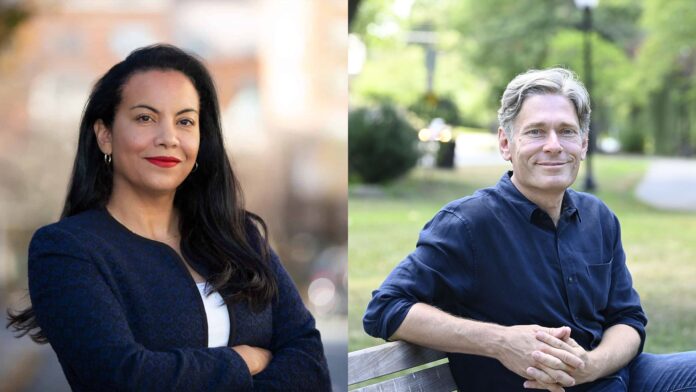
Democrat Analilia Mejia enters the April special election as the clear front-runner, backed by a substantial voter registration advantage that continues to define the district’s electoral math. CD-11, once more competitive, shifted further toward Democrats following the 2020 Census, reinforcing a trend that began with Mikie Sherrill’s decisive victories dating back to 2018. Despite occasional narratives suggesting Republican resurgence, the underlying numbers tell a more consistent story: Democrats hold a structural advantage exceeding 60,000 registered voters, a margin that significantly shapes the strategic ceiling for any Republican challenger.
That challenger, Republican Joe Hathaway, is approaching the race with a sharply defined contrast strategy. A former Randolph mayor and councilman, Hathaway is positioning himself as a pragmatic, experienced alternative while framing Mejia as ideologically out of step with the district. His messaging has focused on portraying Mejia as aligned with progressive policies that he argues do not reflect the priorities of suburban voters. It is a familiar playbook in competitive districts, but one that must overcome both demographic realities and recent voting patterns that have consistently favored Democrats.
Mejia, for her part, has largely dismissed these attacks as predictable partisan rhetoric, choosing instead to lean into the coalition that propelled her to an unexpected primary victory in a crowded field. Her campaign narrative emphasizes grassroots support and a connection to everyday voters rather than institutional party backing, a positioning that has allowed her to maintain momentum even amid internal Democratic scrutiny. That scrutiny intensified when Mejia declined an early debate invitation from the League of Women Voters, a decision that raised eyebrows not only among Republicans but within her own party. The optics of bypassing a traditionally nonpartisan forum created a temporary vulnerability, offering Hathaway an opportunity to question her willingness to engage in open dialogue.
However, the political calculus shifted again when both campaigns agreed to participate in a rescheduled debate sponsored by the New Jersey Globe, now set for April 1 at 4 p.m. The timing adjustment, made to accommodate the first night of Passover, reflects the kind of logistical nuance that can influence voter engagement in a district as diverse as CD-11. The confirmation of a debate has effectively neutralized some of the earlier criticism directed at Mejia, while setting the stage for a high-visibility confrontation that could shape late-stage voter perceptions heading into the special election.
Yet even as the April race commands immediate attention, the June primary introduces an entirely separate layer of complexity—one that is almost entirely internal to the Democratic Party. Former Morristown mayor Donald Cresitello and political newcomer Justin Strickland have both filed to challenge Mejia for the full-term nomination, creating a scenario in which the party’s presumed frontrunner must defend her position just weeks after potentially winning the special election. This dynamic is highly unusual and underscores a broader uncertainty within segments of the Democratic base regarding Mejia’s long-term viability.
Cresitello’s candidacy reflects a more traditional intra-party critique, centered on ideological positioning and electability. He has openly questioned whether Mejia’s policy orientation aligns with the district’s broader electorate, signaling a potential divide between progressive energy and moderate pragmatism. Strickland, meanwhile, is advancing a data-driven argument rooted in the February primary results, noting that a majority of voters supported candidates other than Mejia. While that statistic is technically accurate, it coexists with the fundamental reality that Mejia secured the largest share of votes in a crowded field—a distinction that remains politically decisive.
On the Republican side, the absence of a June primary challenger to Hathaway is equally telling. It suggests both confidence in his candidacy and a pragmatic recognition of the district’s electoral landscape. CD-11 presents a steep climb for Republicans under current conditions, particularly against the backdrop of national political headwinds that continue to influence local races. Economic concerns, including persistent pressure from energy costs and broader geopolitical instability, are expected to factor into campaign messaging, but whether those issues can override the district’s structural partisan lean remains an open question.
What makes this moment particularly significant is how these overlapping dynamics are converging to create a fluid and unpredictable environment. The outcome of the April special election will not only determine immediate representation but could also reshape the narrative heading into June. A strong performance by Mejia would likely consolidate her position within the party, discouraging further challenges and reinforcing her status as the Democratic standard-bearer. Conversely, any signs of underperformance could embolden her primary opponents, transforming the June race into a referendum on both ideology and electability.
This layered electoral structure is also amplifying the importance of voter engagement across multiple timelines. Campaigns must now operate with dual objectives: mobilizing turnout for an off-cycle special election while simultaneously laying the groundwork for a traditional primary contest. The logistical and strategic demands of this approach are significant, requiring disciplined messaging, targeted outreach, and a deep understanding of voter behavior across different electoral contexts.
For Sunset Daily News readers tracking New Jersey’s political landscape, CD-11 represents a defining contest that extends beyond a single race. It is a microcosm of broader trends shaping state and national politics, from shifting district demographics to the evolving balance between grassroots movements and institutional influence. Those looking to follow ongoing developments, candidate positioning, and policy debates can explore additional coverage through the Sunset Daily News politics section, where continuous reporting is capturing the real-time evolution of races like this one.
As the April 16 special election approaches and the June primary looms just weeks behind it, one thing is certain: CD-11 is no longer a predictable district operating on a standard electoral calendar. It is a high-stakes, multi-layered battleground where timing, strategy, and narrative will determine not just who wins, but how the next chapter of representation in northern New Jersey is defined.



