


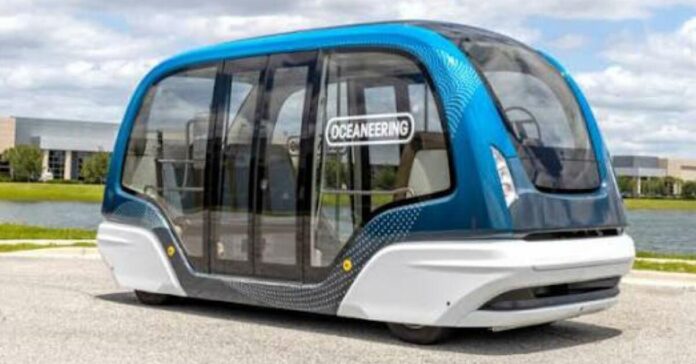

A major transformation in how people move through one of the nation’s busiest transportation hubs is now underway in New Jersey, as the Port Authority of New York and New Jersey begins real-world testing of autonomous vehicle technology at Newark Liberty International Airport. The initiative, unfolding throughout the spring of 2026, represents a pivotal step in redefining airport mobility, infrastructure efficiency, and the passenger experience across the region.
This is not a conceptual pilot or a distant vision. It is a live, operational test environment designed to evaluate how fleets of electric, self-driving shuttles can function within one of the most complex and high-pressure transit ecosystems in the country. At stake is more than convenience. The program is directly tied to the broader, multi-billion-dollar redevelopment of Newark Liberty, positioning autonomous transportation as a foundational component of the airport’s future.
The Port Authority’s approach is methodical and ambitious. Three separate technology companies—each with distinct engineering philosophies and system architectures—have been selected to deploy and test autonomous shuttle fleets in controlled zones across airport property. These vehicles are not being introduced casually; they are being stress-tested under simulated real-world conditions, including multi-vehicle coordination, dynamic routing, and high passenger throughput scenarios.
The first phase is already underway with Oceaneering, a company known for advanced mobility and robotics systems. Later in the testing cycle, Ohmio will introduce its own autonomous shuttle platform, followed by Glydways, which is expected to bring a more infrastructure-integrated transit model into the evaluation process. Each testing window runs for approximately two weeks, allowing the Port Authority to analyze performance across a range of operational variables, from navigation precision to passenger flow efficiency.
What makes this initiative particularly significant is its integration into a much larger infrastructure overhaul. Newark Liberty is currently in the midst of a sweeping redevelopment that began with the opening of Terminal A in 2023 and continues with plans for a new Terminal B and extensive upgrades to Terminal C. At the center of this transformation is the $3.5 billion replacement of the AirTrain Newark system, a project launched in October 2025 and scheduled for completion by 2030. The new AirTrain alignment is designed to eliminate long-standing inefficiencies, including the current disconnect that forces passengers into extended walks between transit access points and terminal entrances.
Autonomous shuttles are being evaluated as a critical connective layer within this evolving ecosystem. Rather than functioning as a standalone novelty, they are intended to bridge gaps between terminals, parking facilities, and transit nodes, creating a seamless, high-frequency circulation network that reduces congestion and enhances accessibility. In practical terms, this could mean significantly shorter transfer times, more predictable passenger movement, and a reduction in the bottlenecks that have long defined the Newark airport experience.
The technology itself reflects the rapid evolution of autonomous systems over the past several years. Most of the vehicles being tested operate at what is known as Level 4 autonomy, meaning they are capable of fully managing driving functions within a defined, geofenced environment. Airports are uniquely suited to this level of automation. Their controlled roadways, predictable traffic patterns, and limited variables create an ideal testing ground for systems that require precision without the unpredictability of open-road conditions.
However, the transition to full autonomy remains a staged process. Many of the current shuttle models include onboard attendants—not drivers in the traditional sense, but trained personnel who monitor system performance, assist passengers, and intervene if necessary. This hybrid approach reflects both regulatory realities and the ongoing need to build public trust in autonomous mobility. At the same time, the industry is moving rapidly toward fully driverless operations, with next-generation vehicles designed without steering wheels or manual controls already on the horizon.
Federal policy is also beginning to catch up with technological advancement. Legislative efforts such as the proposed SELF DRIVE Act of 2026 aim to establish a national regulatory framework that would allow autonomous vehicles to operate commercially without traditional human-centric safety requirements. If enacted, such measures could accelerate deployment timelines and expand the use of autonomous systems beyond controlled environments like airports into broader urban and suburban networks.
For New Jersey, the implications extend well beyond Newark Liberty. The state’s transportation infrastructure is deeply interconnected, linking air travel, rail systems, highways, and regional transit corridors into a single economic engine. Innovations introduced at the airport level often ripple outward, influencing how mobility solutions are developed and deployed across the region. The Port Authority’s investment in autonomous technology signals a strategic commitment to modernization that aligns with broader trends in smart infrastructure, sustainability, and digital integration.
The environmental dimension of the initiative is equally significant. The shuttles being tested are zero-emissions vehicles, aligning with long-term goals to reduce the carbon footprint of major transportation hubs. As airports face increasing pressure to balance growth with environmental responsibility, electrified autonomous fleets offer a pathway to achieving both operational efficiency and sustainability targets.
From a passenger perspective, the shift promises a fundamentally different airport experience. The traditional friction points—long walks, crowded shuttle buses, inconsistent wait times—are being reimagined through a system designed for continuous, responsive movement. The goal is not simply to move people, but to do so in a way that feels intuitive, reliable, and integrated into the broader journey from curb to gate.
For the Port Authority, this initiative builds on years of incremental progress. The agency has been exploring autonomous technology since at least 2022, including successful trials of bus platooning and lane-keeping systems in the Lincoln Tunnel’s Exclusive Bus Lane. Those early experiments laid the groundwork for the more advanced, passenger-facing applications now being deployed at Newark Liberty.
What is unfolding in 2026 is a convergence of infrastructure investment, technological maturity, and strategic vision. The testing of autonomous shuttles is not an isolated experiment; it is a preview of how transportation systems are likely to function in the near future—connected, automated, and designed around the movement of people at scale.
As redevelopment continues and the new AirTrain system takes shape, the role of autonomous mobility will only become more central. The decisions made during this testing phase will influence not just how Newark Liberty operates, but how airports and transit systems across the country approach the integration of emerging technologies.
In New Jersey, where transportation is both a necessity and a defining characteristic of daily life, the significance of this moment is clear. The state is not simply adapting to the future of mobility—it is actively helping to build it, one autonomous shuttle at a time.