



New Jersey is heading into a fast-moving but impactful winter weather setup Friday evening, as a classic Arctic clipper sweeps through the region and opens the door to an extended stretch of bitter cold, gusty winds and dangerous wind chills across the state.
According to regional forecasters, a developing upper-level trough across the eastern United States will steer a northern-stream system directly into the Mid-Atlantic late Friday. While the system will not have enough time to fully phase with southern energy to become a major storm for New Jersey, it will deliver a quick burst of snow followed by a sharp surge of Arctic air.
The evolving setup is being closely monitored through the Sunset Daily New Jersey weather report.
High above the surface, a powerful jet stream pattern is carving a deep trough across the eastern half of the country. At mid-levels of the atmosphere, purely polar energy from the north is diving southeast and attempting to link up with a weaker southern-stream disturbance over the southeastern United States. That interaction occurs too late to generate a large coastal storm for New Jersey, but it is strong enough to drive a compact clipper system across the Great Lakes and northern New York.
New Jersey ends up on the western flank of the broader trough, directly under cross-polar Arctic flow — a configuration that favors brief but intense snowfall followed by rapidly falling temperatures.
At lower levels, the system behaves much like a traditional frontal passage, but with a crucial difference: the air mass is arriving from the north rather than the west.
The northern-stream low will track across the Great Lakes and into northern New York Friday afternoon and evening. Attached to that system is an Arctic cold front that will sweep south through New Jersey between approximately 5 p.m. and midnight.
Along and just ahead of that front, a narrow but potent band of precipitation is expected to develop. The window for snowfall at any one location will be short — roughly three to four hours — but the bursts of snow could be briefly intense.
Forecasters say this will not be a slow, steady snowfall. Instead, snow is expected to fall in squalls and heavier bursts at times, with quick reductions in visibility during the most active periods.
Because surface temperatures will be very cold — generally in the 24 to 27 degree range during the event — and the air column aloft will be exceptionally cold, snow that falls is expected to be light and fluffy.
Snow-to-liquid ratios are projected to be near 15:1 or even higher. That means a relatively small amount of moisture can still produce a noticeable accumulation. In practical terms, a tenth of an inch of liquid would yield roughly an inch and a half of snow, while two-tenths could support close to three inches in localized areas.
Timing will vary across the state.
Snow should begin first in northwestern New Jersey sometime after 4 p.m. Friday. Central, northeastern and southwestern sections of the state are more likely to see their primary snowfall window during the middle of the evening. Southeastern New Jersey should be last to see the band pass through, closer to midnight.
While the main burst of snow will end quickly, lighter flurries could linger into mid to late Saturday morning in some areas.
Overall accumulations look modest but meaningful for travel, especially given the fluffy nature of the snow and the brief periods of heavier intensity. A general coating to one or two inches appears possible statewide, with localized higher totals where the strongest snow bands persist the longest.
Once the clipper passes, the weather pattern becomes far more hostile.
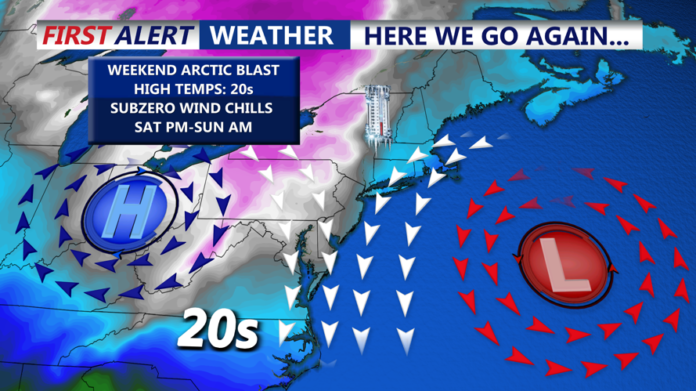
The departing system is expected to rapidly strengthen offshore to the east of New Jersey on Saturday. At the same time, strong high pressure will build in from the west. The interaction between the intensifying offshore low and the approaching high will tighten the pressure gradient across the state.
That setup is expected to produce strong northerly winds throughout Saturday and Saturday night, with gusts likely high enough to create hazardous wind chills and areas of blowing snow.
The wind direction will be straight out of the Arctic, pulling in some of the coldest air of the winter season.
Saturday is shaping up to be brutally cold, even by recent standards. The persistent north wind will make temperatures feel dramatically colder than the actual readings, and wind chills will plunge well below zero in parts of northern and western New Jersey.
Windy conditions may persist into early Sunday morning before gradually easing.
Although Saturday night into early Sunday will likely feel the coldest due to the combination of wind and falling temperatures, the coldest actual air temperatures of the entire stretch may occur Sunday night into Monday morning.
By that time, winds should be lighter and skies clearer, allowing strong radiational cooling to drive temperatures down even further — potentially producing the lowest true readings of the winter so far.
This comes after an already unusually cold stretch since Thanksgiving, making the upcoming period one of the most severe cold episodes of the season.
Beyond the weekend, the weather turns quieter but remains cold.
Saturday through early next week appears dry across New Jersey, but temperatures will stay well below seasonal averages through at least Monday.
Forecasters are also monitoring two potential snow signals in the longer-range outlook.
The first window to watch is Wednesday night into Thursday morning, February 11 through February 12. That system appears milder than the upcoming clipper but could still support accumulating snow if the current trend holds.
A second, more distant signal is emerging for the weekend of February 14 through February 15. Both remain low-confidence at this time, but meteorologists expect to begin taking the midweek signal more seriously by Saturday and the Valentine’s weekend window by early next week if consistency continues in forecast guidance.
In plain terms, New Jersey can expect a quick-hitting round of fluffy snow late Friday afternoon through late Friday night, followed by an extended stretch of very cold and windy weather through the weekend.
Travel Friday evening could become briefly hazardous during heavier snow bursts, and outdoor conditions on Saturday and early Sunday will be dangerous for prolonged exposure due to wind chill.
After a short break early next week, attention will turn once again to the potential for additional snow later in the week and next weekend as the active winter pattern shows no signs of shutting down.