



A missing man was pulled to safety Friday morning after a digital location signal from an Apple AirTag helped New Jersey Transit Police and the Hoboken Fire Department pinpoint his position deep inside a steep, frozen ravine near the 9th Street light rail station, ending an overnight search and launching a complex technical rescue operation along one of the region’s busiest transit corridors.
The incident unfolded along the border of Jersey City and Hoboken, just off Paterson Plank Road, where the man had fallen more than 40 feet down a wooded embankment sometime Thursday and remained stranded for hours in dangerously cold conditions.
According to emergency officials, the man had been reported missing the previous day after he failed to return home and could not be reached. With limited information and a difficult terrain area stretching below elevated roadways and rail infrastructure, early search efforts were slowed by poor visibility and the sheer depth of the ravine.
At approximately 8:40 a.m. Friday, a breakthrough came when a location ping from the man’s Apple AirTag registered in the area. Investigators were able to use the digital signal to narrow the search zone to a tight section of the ravine, allowing responders to move directly toward the steep drop-off below the light rail station.
Once crews visually confirmed the man’s position far below street level, it became clear that a standard rescue approach would not be possible.
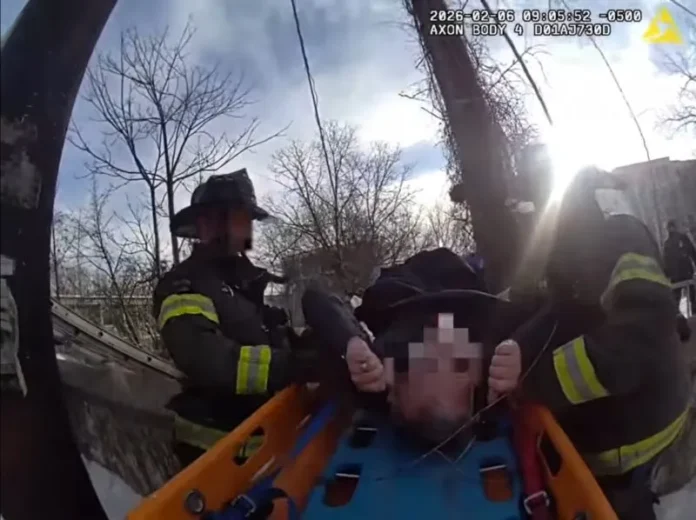
New Jersey Transit’s Emergency Services Unit was activated and coordinated with Hoboken firefighters to conduct a full technical rope rescue. Responders established a secure anchor system using a nearby vehicle positioned along Paterson Plank Road, converting it into a stable tie-off point for the rope system. Specialized rescue lines were then lowered down the embankment as personnel carefully navigated the ice-coated slope.
The man, who had suffered injuries from the fall and prolonged exposure to freezing temperatures, was placed onto a rescue board and stabilized before being slowly hoisted up the nearly vertical terrain. The operation required precise coordination between ground crews and rope technicians, as well as continuous monitoring of the unstable footing below.
Rescuers worked methodically to prevent further injury, controlling the ascent inch by inch while maintaining constant communication between the team members at the top of the ravine and those assisting below.
Once brought safely to roadway level, the man was immediately transferred to emergency medical personnel and transported to a nearby hospital for treatment. Officials confirmed that he sustained injuries related to the fall and hypothermia exposure, but his condition is not believed to be life-threatening, and he is expected to recover.
Authorities emphasized that without the location data provided by the AirTag, the outcome could have been far more serious.
The area where the man fell is heavily wooded and sharply sloped, with limited sightlines from above and frequent noise from nearby rail and traffic corridors, making it extremely difficult for search teams to hear calls for help or spot movement from street level. The ravine also contains multiple ledges and uneven drop-offs, complicating both search and rescue operations.
First responders credited the rapid digital location alert for allowing them to focus their efforts in the correct section of the embankment instead of continuing a broad, time-consuming sweep of the surrounding infrastructure.
Public safety officials say the incident underscores how consumer tracking technology is increasingly becoming an unexpected but valuable tool in missing person cases and emergency response, particularly in urban environments where difficult terrain can exist just feet away from busy roads and transit stations.
While officials cautioned that personal tracking devices should never replace situational awareness or emergency communication, they acknowledged that in this case, the AirTag signal provided a critical link between the missing man and the rescue teams working to locate him.
The successful rescue also highlighted the specialized role of New Jersey Transit’s Emergency Services Unit, which is trained for high-angle and confined-space rescues in rail-adjacent and infrastructure-heavy environments across the state.
As authorities continue to review the circumstances surrounding how the man came to fall into the ravine, officials are reminding residents to exercise extreme caution near elevated roadways, rail corridors and wooded embankments—especially during winter weather, when ice and snow can make already hazardous areas significantly more dangerous.
More developing public safety coverage and breaking local reporting across the state can be found in Sunset Daily News’ ongoing New Jersey news coverage.