



New Jersey awoke Sunday to a convergence of history, uncertainty, and political recalibration as the state marked the passing of one of its most influential figures, entered the closing days of a two-term administration, and prepared for a sweeping change in leadership amid deepening concerns about affordability, energy reliability, and the direction of public policy.
The death of former Governor and longtime State Senator Richard “Dick” Codey has cast a solemn tone over Trenton and far beyond it. Codey, who served for half a century in the Legislature and spent 14 months as governor following Jim McGreevey’s resignation, was widely regarded as the institutional memory of modern New Jersey government. His work reshaped mental-health policy statewide, pushing long-ignored issues into the mainstream and earning bipartisan respect that grew rarer as politics became more polarized. Tributes from leaders across the ideological spectrum poured in throughout the day, portraying Codey as both a reformer and a stabilizing force who understood the machinery of state government perhaps better than anyone else of his generation.
His passing comes as Governor Phil Murphy prepares to deliver his final State of the State address and conclude an administration defined by aggressive climate initiatives, social policy expansion, and a reshaping of state agencies. Murphy’s final legislative push has been unusually intense, with dozens of measures moving through the Legislature in the closing weeks of his term. Among them are a sweeping “bell-to-bell” cellphone ban for K-12 schools, new protections aimed at curbing the financial and social impacts of compulsive gambling on college campuses, and health-care affordability measures designed to blunt rising out-of-pocket costs.
Already in effect are changes that residents are feeling immediately. The minimum wage has climbed again, gas taxes and tolls have risen, and a new Department of Veterans Affairs has officially launched, separating veterans’ services from broader military-focused functions in what officials describe as a modernization effort.
At the center of the political calendar is the inauguration of Governor-elect Mikie Sherrill, who will take the oath of office later this month in a ceremony that itself breaks with more than two centuries of tradition. Instead of the State House in Trenton, Sherrill has chosen the New Jersey Performing Arts Center in Newark, signaling an intent to geographically and symbolically broaden the public face of state government. Her inauguration will be followed by an inaugural ball at the American Dream complex, a venue that underscores the state’s push to frame itself as both an entertainment hub and an economic engine.
Sherrill’s ascension also triggers a fast-moving special election in the 11th Congressional District, where a crowded field of candidates is already jockeying for position. In parallel, the state’s 7th Congressional District has become another flashpoint, with Democratic hopefuls engaging in sharp debate over immigration policy, federal enforcement practices, and the broader direction of national governance. Their exchanges reflect a party seeking both unity on core principles and differentiation in a district that spans a politically diverse swath of northern and western New Jersey.
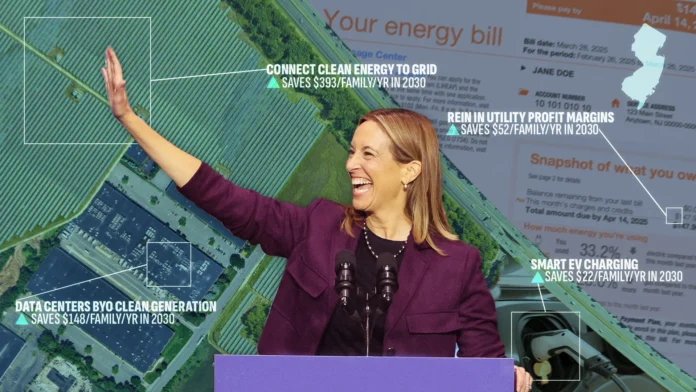
Beyond electoral maneuvering, the most consequential policy battle may be forming around energy. Last summer’s sharp spike in electric bills left many households stunned, particularly seniors on fixed incomes who watched monthly charges balloon seemingly overnight. The increases ignited a fierce blame game between state leaders and PJM Interconnection, the regional grid operator that manages electricity markets across a dozen states. While PJM maintains that its long-range forecasting and auction systems have preserved reliability, critics argue that opaque processes and market structures are driving costs higher for consumers.
Overlaying that dispute is the rapid growth of artificial-intelligence data centers, which are transforming the state into a digital infrastructure hub while simultaneously straining power supplies. Massive facilities now planned or under construction could draw enough electricity to rival that of entire municipalities, raising questions about whether New Jersey can sustain its economic ambitions without undermining affordability and reliability.
Murphy’s aggressive pivot toward renewable energy and offshore wind was intended to place New Jersey at the forefront of the clean-energy transition. Yet delays, investor pullbacks, and public resistance to offshore projects have complicated that strategy. Analysts increasingly point to a regional imbalance, noting that neighboring states maintained more diversified energy portfolios while New Jersey shuttered conventional plants, leaving it more exposed to price volatility.
Sherrill campaigned on confronting those pressures head-on, promising an immediate freeze on rate hikes, stricter oversight of utility accounting practices, and a more confrontational posture toward PJM. She has also signaled openness to controversial solutions, including subsidized nuclear projects using small modular reactors, arguing that the state needs a reliable, carbon-free backbone to support both households and high-growth industries. Environmental advocates counter that nuclear investments could divert funds from renewable development and lock the state into costly long-term commitments.
The debate over energy is quickly becoming a proxy for broader questions about the state’s economic identity: whether New Jersey will lean further into technology-driven growth even if it accelerates infrastructure strains, or recalibrate toward a slower, more distributed model of development that prioritizes stability over scale.
All of this unfolds within an increasingly charged political climate that places New Jersey at the center of regional and national conversations. Coverage and analysis of these evolving dynamics can be found across the state’s political reporting landscape, including within the broader political discourse shaping the Garden State’s next chapter.
With the loss of a legislative giant, the end of one administration, and the imminent start of another, New Jersey is entering 2026 in a moment of transition that feels both historic and unresolved. Decisions made in the coming months on energy, affordability, and governance will not simply define a new governor’s first year in office. They will shape the state’s economic trajectory, political culture, and quality of life for decades to come.



